
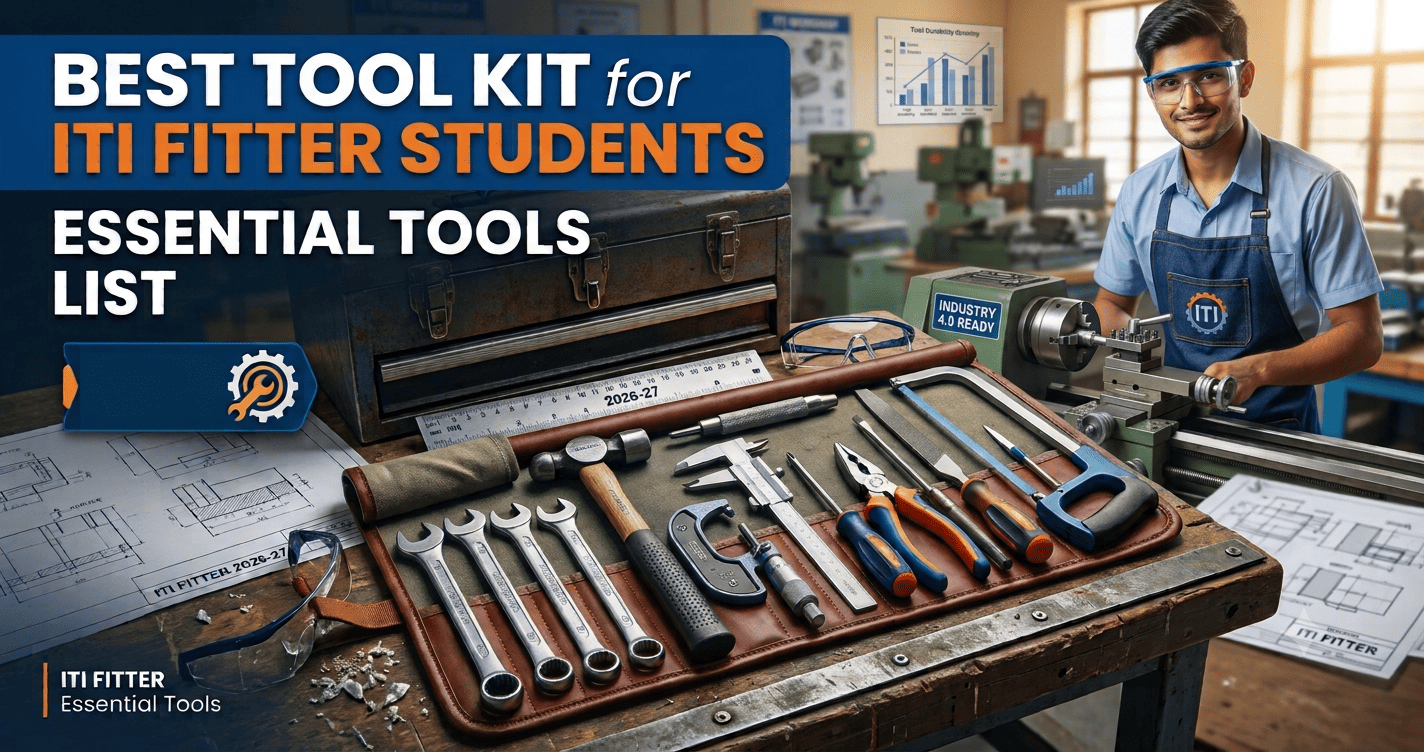
Choosing the best tool kit for ITI Fitter students is important for learning workshop operations and completing practical jobs during ITI training. Fitter students work with different hand tools, measuring instruments, cutting tools and marking tools. Having the right equipment helps them understand practical concepts and develop basic workshop skills.
However, a regular home-repair tool kit may not be sufficient for Fitter trade training. Students need specific tools such as files, a hacksaw, a ball-peen hammer, a try square, a steel rule and measuring instruments.
In this guide, we explain the essential ITI Fitter tools list for first-year and second-year students, what each tool is used for, which items are worth purchasing and how to choose a suitable tool kit without spending unnecessarily.
Quick recommendation: If you are a first-year ITI Fitter student, start with basic measuring, marking, cutting, striking and filing tools. Purchase additional instruments and specialised tools according to your institute’s practical requirements.
Best Tool Kit for ITI Fitter Students: Quick Overview
There is no single ready-made tool kit that is suitable for every ITI Fitter student. A better approach is to build a practical tool collection using individual tools or a suitable hand-tool set.
| Tool category | Important tools | Main purpose |
|---|---|---|
| Measuring tools | Steel rule, vernier caliper, micrometer | Measuring dimensions |
| Marking tools | Scriber, centre punch, divider | Marking workpieces |
| Cutting tools | Hacksaw, cold chisel | Cutting and removing material |
| Striking tools | Ball-peen hammer | Striking and fitting operations |
| Filing tools | Flat, round and half-round files | Removing material and finishing |
| Holding tools | Bench vice, pliers | Holding workpieces |
| Driving tools | Screwdrivers, Allen keys | Tightening and loosening fasteners |
| Safety equipment | Safety goggles, gloves where appropriate | Workshop protection |
Students should check their institute’s prescribed tool list before purchasing a complete kit.
Affiliate Disclosure: Some links in this article are affiliate links. If you buy through them, we may earn a small commission at no extra cost to you. As an Amazon Associate I earn from qualifying purchases.
1. Measuring Tools for ITI Fitter Students
Measuring tools are among the most important items in a Fitter workshop. Students use them to measure length, thickness, diameter and other dimensions during practical work.
Steel Rule
A steel rule is used for measuring straight-line dimensions. It is one of the basic tools used in marking and measuring operations.
What to check before buying:
- Clear metric graduations
- Easy-to-read markings
- Suitable length for workshop practice
- Durable stainless-steel construction
View Steel Ruler for Fitter Students
Vernier Caliper
A vernier caliper is used to measure external dimensions, internal dimensions and depth, depending on its design.
It is useful for learning precision measurement during Fitter practical training.
What to check before buying:
- Suitable measurement range, such as 150 mm
- Clear and readable scale
- Smooth movement of the sliding jaw
- Locking arrangement
- Metric graduation suitable for your course
A digital vernier caliper may be easier to read, but students should also learn how to read a conventional vernier scale if it is part of their practical training.
View Vernier Calipers on Amazon
Outside Micrometer
An outside micrometer is used for measuring small external dimensions with greater precision than an ordinary steel rule.
Students may need it for precision measurement exercises and advanced practical work.
What to check before buying:
- Suitable measurement range
- Clear graduation
- Ratchet or friction-stop mechanism
- Calibration information
- Build quality
Try Square
A try square is used to check and mark right angles. It helps students check whether edges and surfaces are square during fitting operations.
View Try Squares for Workshop Practice
2. Marking Tools for Fitter Workshop Practice
Marking tools help students transfer dimensions and reference lines onto a metal workpiece before cutting, drilling or filing.
Important marking tools include:
| Tool | Use |
|---|---|
| Scriber | Marking fine lines on metal surfaces |
| Centre punch | Making a small indentation before drilling |
| Divider | Marking circles and transferring measurements |
| Dot punch | Making small reference marks |
| Surface gauge | Marking lines at a set height, where required |
When buying marking tools, check the quality of the tip, grip, finish and suitability for workshop use.
View Fitter Marking Tools and Punch Sets
3. Cutting Tools for ITI Fitter Students
Cutting tools are used to remove material or cut metal workpieces into the required shape and size.
Hacksaw Frame
A hacksaw frame holds the blade and is used for cutting metal. It is a basic tool for learning hacksawing operations.
Buying tips:
- Select a sturdy frame.
- Check whether blade tension can be adjusted.
- Check compatibility with the required blade length.
- Choose a comfortable handle.
View Adjustable Hacksaw Frames
Hacksaw Blades
Hacksaw blades are replaceable cutting blades used with a hacksaw frame.
Check the blade length, tooth pitch and compatibility with the frame before purchasing. Different materials and thicknesses may require different blade selections.
View Metal Cutting Hacksaw Blades
Cold Chisel
A cold chisel is used for cutting or chipping metal when struck with a hammer.
Students should choose a properly finished chisel with a suitable cutting edge and handle it according to workshop safety instructions.
4. Files Required for ITI Fitter Trade
Files are essential for removing small amounts of material, smoothing surfaces and bringing workpieces to the required dimensions.
Different file shapes are used for different jobs.
| File type | Main use |
|---|---|
| Flat file | Filing flat surfaces |
| Half-round file | Filing flat and curved surfaces |
| Round file | Filing round holes and curved areas |
| Square file | Filing square openings and corners |
| Triangular file | Filing grooves and angular surfaces |
| Needle file set | Fine filing and detailed work |
What should students check before buying files?
- File shape and length
- Cut type and grade
- Handle quality
- Surface finish
- Suitability for the intended workshop operation
A beginner should understand the difference between rough, second-cut and smooth files before selecting them.
View Fitter File Sets on Amazon
5. Striking Tools for Fitter Students
Striking tools are used during operations such as chipping, punching and fitting.
Ball-Peen Hammer
A ball-peen hammer is commonly used in metalworking and fitting workshops. It has a flat striking face and a rounded peen.
When choosing one, check:
- Suitable head weight for your training task
- Secure handle fitting
- Comfortable grip
- Good-quality striking surfaces
Other Hammer Options
Depending on the practical job, students may also encounter soft-face hammers or other specialised hammers.
Do not purchase multiple hammer types at the beginning unless your instructor or practical syllabus requires them.
6. Holding Tools for ITI Fitter Workshop
Holding tools help secure workpieces during cutting, filing, drilling and other workshop operations.
Important examples include:
- Bench vice
- Hand vice
- Combination pliers
- Long-nose pliers
- Adjustable spanner
- Pipe wrench, where required
A bench vice is generally a workshop fixture, so students should check whether it is already available in their institute before buying one personally.
View Pliers and Hand-Holding Tools
7. Screwdrivers, Spanners and Allen Keys
These tools are used for tightening and loosening different types of fasteners.
| Tool | Main use |
|---|---|
| Flat-head screwdriver | Slotted screws |
| Phillips screwdriver | Cross-head screws |
| Combination spanner | Tightening and loosening nuts and bolts |
| Adjustable spanner | Working with different fastener sizes within its capacity |
| Allen key set | Hexagonal socket screws |
What to check before buying?
Choose tools with comfortable handles, suitable sizes and durable construction. For spanners and Allen keys, check the size range and fit before purchasing.
8. Safety Equipment for ITI Fitter Students
Safety equipment is just as important as workshop tools. Students should follow their instructor’s safety instructions and use the protective equipment required for each operation.
Common workshop safety items include:
| Safety item | Purpose |
|---|---|
| Safety goggles | Protect eyes from flying particles |
| Safety shoes | Help protect feet from workshop hazards |
| Suitable work gloves | Protection during tasks where gloves are appropriate |
| Workshop apron or overalls | Protect clothing and support safe working practices |
Important: Gloves are not suitable for every workshop operation. They can create an entanglement hazard near rotating machinery. Follow the instructor’s instructions and the machine-specific safety rules.
9. Recommended Tool Kit for ITI Fitter 1st Year Students
First-year students should focus on basic fitting operations and learn how to use common workshop tools correctly.
A practical starter collection may include:
| Tool | Priority |
|---|---|
| Steel rule | Essential |
| Try square | Essential |
| Scriber | Essential |
| Centre punch | Essential |
| Hacksaw frame and suitable blades | Essential |
| Flat file | Essential |
| Ball-peen hammer | Essential |
| Screwdriver set | Useful |
| Divider | Useful |
| Vernier caliper | As per institute requirement |
| Safety goggles | Essential for relevant workshop tasks |
10. Additional Tools for ITI Fitter 2nd Year Students
Second-year students may work on more advanced fitting, assembly, maintenance and precision-related practical tasks.
Depending on the syllabus and institute’s facilities, additional tools and instruments may include:
- Outside micrometer
- Feeler gauge
- Additional file shapes and grades
- Allen key set
- Combination spanner set
- Dial indicator, where required
- Specialised measuring instruments
- Tools for assembly and maintenance work
Some instruments are expensive or shared among students in the workshop. Confirm whether your institute provides them before purchasing them individually.
11. Should You Buy a Complete Fitter Tool Kit or Individual Tools?
Both options can work, but the right choice depends on what is included in the kit.
| Buying option | Advantages | Limitations |
|---|---|---|
| Complete hand-tool kit | Convenient and may include storage | May contain unnecessary tools or miss Fitter-specific instruments |
| Individual tools | Allows you to select exactly what you need | Requires more research and separate purchases |
| Basic starter kit | Suitable for beginners | May need additional tools later |
| Professional workshop kit | May offer a wider selection | Can be expensive and unnecessary for a beginner |
12. How to Choose the Best Tool Kit for ITI Fitter Students
Keep these points in mind before placing an order.
1. Check Your ITI’s Tool List
Every institute may have its own instructions about which tools students need to bring. Ask your instructor or workshop teacher for the recommended list.
2. Check the Tool Material and Build Quality
Tools should be suitable for regular workshop practice. Pay attention to the material, handle quality, finish and overall construction.
3. Choose the Correct Size
A tool may be unsuitable if its size does not match the practical job. Check the length, measurement range and other specifications.
4. Avoid Unnecessary Multi-Piece Kits
A 100-piece kit is not automatically better than a smaller kit. Some kits contain many general-purpose accessories but lack essential Fitter tools.
5. Check the Product Description
Before purchasing, review the product’s complete contents, specifications, seller information and return conditions.
6. Compare Individual Tool Prices
Sometimes purchasing a few good-quality individual tools is more useful than buying a large, low-quality set.
7. Keep Your Tools Organised
A toolbox or storage pouch helps protect tools and makes it easier to identify missing items.
13. Where to Buy ITI Fitter Tools Online?
Students can explore online marketplaces and industrial tool suppliers to compare individual tools and tool kits.
Before ordering, check:
- Complete product specifications
- Tool dimensions and material
- Number of pieces included
- Seller and manufacturer information
- Delivery and return conditions
- Whether the product matches your institute’s requirement
You can compare suitable products using the links provided in the relevant sections of this guide.
14. Free Resources to Learn Fitter Tools and Their Uses
Buying tools is only one part of practical learning. Students should also understand how to use them correctly.
The Directorate General of Training (DGT) publishes the Fitter CTS curriculum, which covers trade practical and professional knowledge.
You can refer to the official curriculum here: Download the DGT Fitter CTS curriculum
Students can also visit Bharat Skills for available ITI learning material and training resources.
Use these official resources along with your instructor’s guidance and practical workshop sessions.
The best tool kit for ITI Fitter students is not necessarily the largest or most expensive one. It is the collection of tools that matches the practical requirements of the Fitter trade.
First-year students should focus on basic measuring, marking, cutting, filing and striking tools. Second-year students can add more specialised measuring and maintenance tools as their training progresses.
Before buying anything, check your institute’s recommended tool list, compare product specifications and avoid spending money on tools you may not need. Most importantly, learn the correct and safe use of every tool during practical training.
Affiliate disclosure: This article contains affiliate links. If you purchase through these links, we may earn a commission at no additional cost to you. As an Amazon Associate I earn from qualifying purchases.
Also, Read:
- ITI Fitter vs Welder
- ITI Fitter vs Electrician
- How to Prepare for ITI Semester Exams?
- Career Options After ITI
- ITI vs Diploma for Government Jobs
Best Tool Kit for ITI Fitter Students - FAQs
Which tools are required for ITI Fitter students?
Common tools include a steel rule, try square, scriber, centre punch, hacksaw, files, ball-peen hammer, screwdrivers and measuring instruments. The exact list depends on the practical syllabus and institute requirements.
What is the basic tool kit for ITI Fitter 1st Year?
A basic first-year collection generally includes measuring and marking tools, a hacksaw, files, a ball-peen hammer and safety equipment. Students should confirm the required sizes and items with their institute.
Do ITI Fitter students need a vernier caliper?
Vernier calipers are important for learning measurement operations in the Fitter trade. Students should learn to use and read the instrument, but should check whether their institute requires them to purchase an individual instrument.
Is a complete tool kit necessary for ITI Fitter students?
No. A complete kit is not always necessary. Students can purchase individual tools according to their institute's requirements and practical work.
Which file is used in the Fitter trade?
Flat, half-round, round, square and triangular files are commonly used for different filing operations. The correct file depends on the shape and surface of the workpiece.
What is the difference between a regular tool kit and an ITI Fitter tool kit?
A regular tool kit is usually designed for general household repairs. An ITI Fitter tool collection includes workshop-specific tools such as files, marking tools, measuring instruments, a hacksaw and a ball-peen hammer.