ITI Government Jobs 2026: Latest Govt Jobs After ITI, Salary & Eligibility

ITI Government Jobs 2026

Many ITI students struggle to find the right government job opportunities after completing their trade courses. Some are unsure which departments recruit ITI candidates, while others miss important vacancies due to a lack of timely information.

The good news is that ITI Government Jobs 2026 offer thousands of opportunities in Railways, PSUs, Defence, Electricity Boards, Apprenticeships, State Departments, and Technical Posts across India. From fitter, electrician, welder, diesel mechanic, and COPA trades to technician and apprentice recruitment, ITI candidates can apply for a wide range of stable government jobs with good salary, allowances, and career growth.

Check the latest ITI Govt Jobs 2026, eligibility, salary, departments hiring ITI candidates, selection process, upcoming vacancies, and best government jobs after ITI.

Check: Government Jobs in India 2026

ITI Government Jobs 2026 Overview

Particulars Details
Category ITI Government Jobs 2026
Qualification ITI Pass
Job Type Central & State Government Jobs
Departments Railways, PSU, Defence, Electricity, Technical Departments
Selection Process CBT, Merit, Skill Test, Trade Test
Salary Range ₹18,000 to ₹65,000 per month
Job Location Across India
Official Mode Online Application

Latest ITI Government Jobs 2026

Thousands of ITI vacancies are expected in 2026 across different government departments. Candidates from electrician, fitter, welder, mechanic, COPA, machinist, wireman, plumber, and technician trades can apply for these posts.

Upcoming ITI Govt Jobs 2026 List

Recruitment Expected Vacancies
Railway Recruitment 2026 25,000+
Railway Apprentice Jobs 15,000+
PSU Apprentice Recruitment 10,000+
Indian Army Technical Jobs 5,000+
DRDO Technician Recruitment 2,000+
ISRO Technician Jobs 1,000+
State Electricity Board Jobs 8,000+
Indian Oil Apprentice Recruitment 3,000+
ONGC Technical Jobs 2,500+
BHEL Technician Recruitment 2,000+

Best Government Jobs After ITI in 2026

ITI candidates can apply for multiple technical and non-technical government jobs depending on their trade specialization.

Top ITI Government Jobs

Railway Jobs After ITI

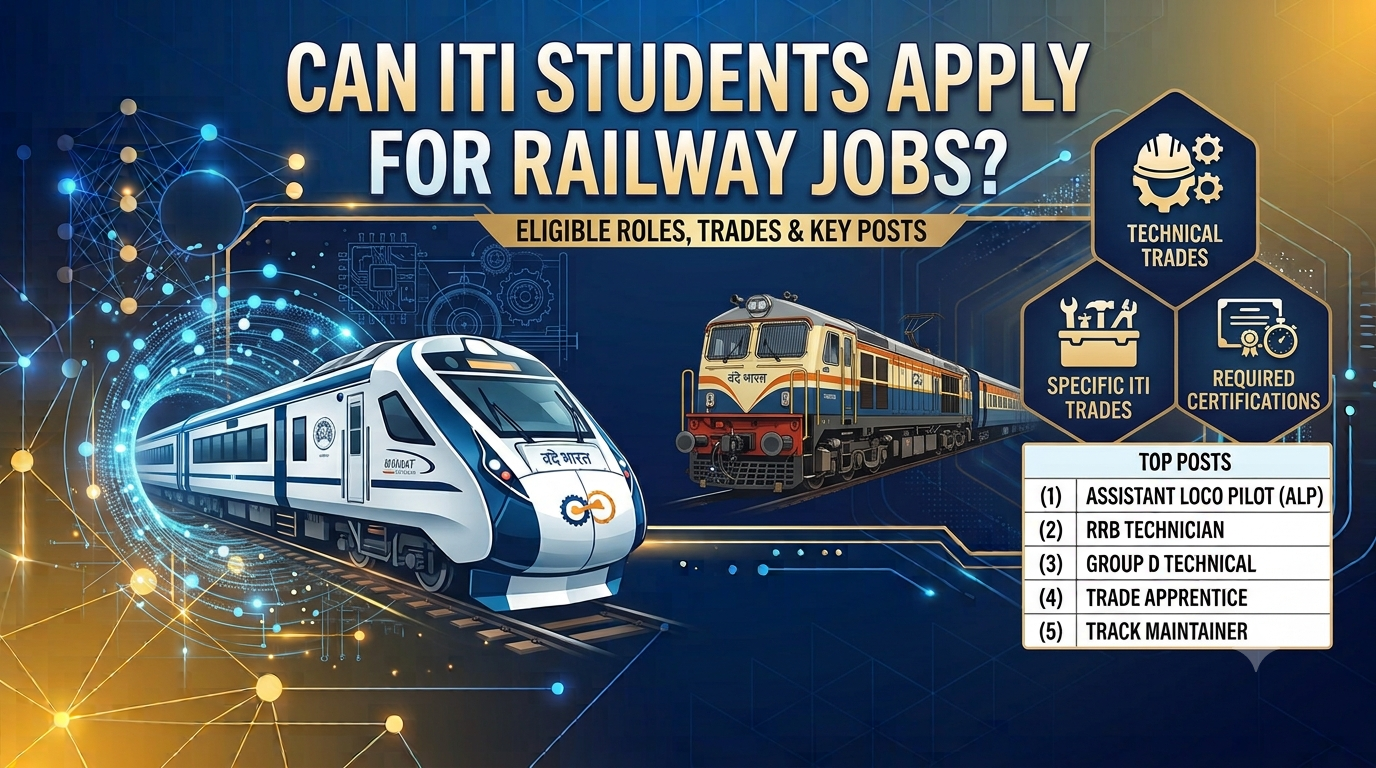
Indian Railways is one of the biggest recruiters for ITI pass candidates. Recruitment is released for:

  • Technician
  • Assistant Loco Pilot (ALP)
  • Apprentice
  • Junior Engineer Support Posts
  • Fitter & Electrician Posts

PSU Jobs For ITI Candidates

Public Sector Units offer high salary and job security.

Top PSUs recruiting ITI candidates:

  • BHEL
  • ONGC
  • IOCL
  • SAIL
  • GAIL
  • NTPC
  • BEL

Defence Jobs After ITI

Defence sector jobs are highly preferred due to stability and benefits.

Recruitment includes:

  • Army Technical Posts
  • Navy Tradesman
  • Air Force Technical Staff
  • DRDO Technician
  • Ordnance Factory Recruitment

State Government ITI Jobs

Every state releases technical vacancies in:

  • Electricity Boards
  • PWD Departments
  • Transport Departments
  • Water Departments
  • Technical Assistant Posts

ITI Govt Jobs 2026 Eligibility Criteria

Candidates must fulfill the required eligibility before applying.

Educational Qualification

  • Candidates should have passed ITI from a recognized institute.
  • NCVT or SCVT certification is usually accepted.
  • Some jobs also require 10th or 12th pass qualification.

Age Limit

Category Age Limit
Minimum Age 18 Years
Maximum Age 40 Years

Age relaxation is provided for reserved categories as per government rules.

Trade-Wise ITI Government Jobs 2026

Different departments recruit candidates from different ITI trades.

Popular ITI Trades Eligible For Govt Jobs

  • Electrician
  • Fitter
  • Welder
  • COPA
  • Diesel Mechanic
  • Turner
  • Machinist
  • Wireman
  • Plumber
  • Motor Mechanic
  • Refrigeration & AC Technician
  • Electronics Mechanic

ITI Government Jobs Salary 2026

Government jobs after ITI provide stable salary with allowances and promotion opportunities.

ITI Govt Job Salary Structure

Job Type Average Salary
Railway Technician ₹25,000 – ₹45,000
PSU Technician ₹35,000 – ₹65,000
Apprentice Jobs ₹8,000 – ₹15,000 Stipend
Defence Technical Jobs ₹28,000 – ₹50,000
State Govt Technical Posts ₹20,000 – ₹40,000

Additional benefits may include:

  • DA
  • HRA
  • Medical Facilities
  • Pension Benefits
  • Travel Allowance

Selection Process For ITI Government Jobs

The selection process varies by department and recruitment type.

Common Selection Stages

  1. Online Written Examination
  2. Trade Test / Skill Test
  3. Document Verification
  4. Medical Examination

Some apprentice recruitment processes are merit-based and do not require written exams.

Railway Jobs After ITI 2026

Railway jobs are among the most searched government jobs for ITI candidates.

Popular Railway ITI Posts

  • RRB ALP
  • Railway Technician
  • Railway Apprentice
  • Signal Technician
  • Track Machine Maintainer

Why Railway Jobs Are Popular

  • Good salary
  • Job security
  • Pension benefits
  • Promotion opportunities
  • Technical work profile

PSU Jobs For ITI Candidates 2026

PSU jobs are considered among the highest-paying government jobs after ITI.

Top PSU Companies Hiring ITI Candidates

  • BHEL
  • ONGC
  • IOCL
  • GAIL
  • NTPC
  • BPCL
  • SAIL

PSU Job Benefits

  • High salary packages
  • Medical facilities
  • Housing benefits
  • Career growth
  • Stable work environment

Apprentice Jobs After ITI 2026

Apprenticeship recruitment provides industry experience and training opportunities.

Top Apprentice Recruiters

  • Indian Railways
  • IOCL
  • ONGC
  • BHEL
  • DRDO
  • HAL
  • BEL

Many apprentices later receive permanent job opportunities based on performance and vacancies.

Government Jobs For Electrician ITI Trade

Electrician trade candidates are highly demanded in:

  • Railways
  • Electricity Boards
  • PSU Plants
  • Metro Rail Projects
  • Defence Technical Departments

Government Jobs For Fitter ITI Trade

Fitter trade is one of the most versatile ITI trades for government recruitment.

Common sectors:

  • Railways
  • Manufacturing PSUs
  • Heavy Engineering Units
  • Defence Production Units

How To Prepare For ITI Government Jobs 2026

Proper preparation can increase selection chances significantly.

Understand Exam Pattern

Focus on:

  • Trade Theory
  • Reasoning
  • Mathematics
  • General Awareness
  • Technical Questions

Practice Previous Year Papers

Previous papers help understand:

  • Question level
  • Important topics
  • Time management

Focus On Technical Subjects

Technical trade questions usually carry high weightage.

Stay Updated With Notifications

Candidates should regularly track:

  • Railway Recruitment
  • PSU Vacancies
  • Apprentice Recruitment
  • State Technical Jobs

Documents Required For ITI Govt Jobs

Candidates generally need:

  • ITI Marksheet
  • NCVT/SCVT Certificate
  • 10th Certificate
  • Aadhaar Card
  • Caste Certificate (if applicable)
  • Passport Size Photos
  • Signature

Why ITI Government Jobs Are Popular

ITI government jobs are highly preferred because they offer:

  • Stable career
  • Technical skill-based work
  • Government benefits
  • Promotion opportunities
  • Pension benefits
  • Good work-life balance

Many ITI candidates prefer government jobs over private sector jobs because of long-term job security and salary growth.

ITI Government Jobs 2026 provide excellent career opportunities for technical candidates across Railways, PSUs, Defence, Electricity Boards, and State Departments. With thousands of upcoming vacancies expected in technician, apprentice, fitter, electrician, and technical support roles, ITI candidates should regularly track recruitment notifications and prepare strategically.

Candidates looking for stable salary, job security, technical work profiles, and long-term government careers can find strong opportunities through ITI government jobs in 2026.

FAQs On ITI Government Jobs 2026

Which government jobs are best after ITI?

Railway jobs, PSU jobs, Defence technical jobs, and apprentice recruitment are among the best government jobs after ITI.

Can ITI candidates apply for Railway jobs?

Yes, ITI candidates can apply for Railway Technician, ALP, Apprentice, and multiple technical posts.

What is the salary of ITI government jobs?

The average salary ranges from ₹18,000 to ₹65,000 per month depending on the department and post.

Which PSU companies recruit ITI candidates?

BHEL, ONGC, IOCL, GAIL, SAIL, NTPC, and BEL regularly recruit ITI candidates.

Are apprentice jobs good after ITI?

Yes, apprenticeships provide technical experience, stipend, and future employment opportunities.

How to Use AI for Exam Preparation: A Smart Study Guide for Students

How to Use AI for Exam Preparation

Preparing for exams has changed significantly in recent years. Earlier, students depended only on textbooks, coaching classes, and handwritten notes. Today, Artificial Intelligence (AI) is helping students learn faster, revise better, and improve their exam performance.

Whether you are preparing for school exams, board exams, competitive exams like NEET, JEE, UPSC, SSC, Banking, Railways, or any government job exam, AI can become your personal study assistant.

Here, you will learn how to use AI for exam preparation effectively, the best ways to study with AI, common mistakes to avoid, and practical examples that can help you score better.

What is AI in Exam Preparation?

AI (Artificial Intelligence) refers to technology that can understand questions, generate explanations, create study plans, solve doubts, and even test your knowledge.

Instead of spending hours searching for answers online, students can use AI tools to get instant explanations, summaries, quizzes, and revision notes.

Think of AI as a 24/7 tutor that is always available whenever you need help.

Why Students Are Using AI for Studies

AI helps students:

  • Save time during preparation
  • Understand difficult concepts easily
  • Create personalized study plans
  • Generate notes and summaries
  • Practice mock questions
  • Improve revision efficiency
  • Get instant doubt-solving support

The biggest advantage is that AI can adapt to your learning style and study pace.

How to Use AI for Exam Preparation Effectively

1. Create a Personalized Study Plan

Many students waste time deciding what to study every day.

AI can help create a customized timetable based on:

  • Exam date
  • Syllabus
  • Available study hours
  • Strong and weak subjects

Real-Life Example

Suppose you are preparing for SSC CGL and have 90 days left.

You can ask:

“Create a 90-day SSC CGL study plan for a beginner who can study 5 hours daily.”

AI can divide subjects, revision schedules, and mock tests accordingly.

2. Understand Difficult Topics Quickly

Sometimes students struggle with topics because textbooks use complicated language.

AI can explain concepts in simple language.

Example

If you are preparing for NEET and don’t understand Photosynthesis, you can ask:

“Explain photosynthesis in simple language with examples for NEET preparation.”

AI can break down complex concepts into easy-to-understand explanations.

3. Generate Short Notes for Revision

Revision is one of the most important parts of exam preparation.

AI can convert long chapters into:

  • Short notes
  • Bullet points
  • Revision sheets
  • One-page summaries

Example

Instead of reading a 20-page chapter again, ask AI:

“Create one-page revision notes for Indian Polity Fundamental Rights.”

This saves significant revision time.

4. Practice Mock Questions

Regular practice improves exam performance.

AI can generate:

  • MCQs
  • Subject-wise tests
  • Previous-year style questions
  • Topic-wise quizzes

Example

A banking aspirant can ask:

“Generate 30 quantitative aptitude questions with solutions at moderate difficulty level.”

This provides additional practice without purchasing extra materials.

5. Improve Answer Writing Skills

For descriptive exams such as UPSC, State PSC, and university examinations, answer writing is crucial.

AI can help by:

  • Checking structure
  • Improving language
  • Suggesting better introductions and conclusions
  • Identifying missing points

Example

Write an answer and ask:

“Evaluate this UPSC answer and suggest improvements.”

AI can provide detailed feedback.

6. Solve Doubts Instantly

Students often get stuck on a single question and lose valuable study time.

AI can provide instant explanations for:

  • Mathematics
  • Science
  • Reasoning
  • English grammar
  • Current affairs concepts

This reduces dependency on waiting for teachers or searching multiple websites.

7. Learn Through Examples

AI can explain topics using real-life examples.

Example

For Economics:

Instead of memorizing inflation definitions, AI can explain inflation through rising vegetable prices, fuel costs, and household expenses.

This makes concepts easier to remember during exams.

8. Create Revision Quizzes

Active recall is one of the best study techniques.

AI can create:

  • Flashcards
  • Quiz questions
  • Rapid revision tests
  • Topic-based practice sets

This helps strengthen memory retention.

Best Ways to Use AI for Competitive Exams

Students preparing for competitive exams can use AI for:

Government Exams

  • SSC
  • Banking
  • Railways
  • State PSC
  • Teaching Exams

Engineering Exams

  • JEE Main
  • JEE Advanced
  • GATE

Medical Exams

  • NEET
  • Nursing Entrance Exams
  • Paramedical Exams

Other Exams

  • CAT
  • CLAT
  • CUET
  • University Entrance Tests

AI can help in syllabus planning, revision, mock tests, and concept clarity for all these examinations.

Common Mistakes Students Make While Using AI

AI is a powerful tool, but students should avoid these mistakes:

Blindly Trusting Every Answer

Always verify important facts, formulas, and current affairs from reliable sources.

Replacing Study Materials Completely

AI should support your preparation, not replace textbooks, class notes, and official study materials.

Using AI Only for Shortcuts

The goal should be understanding concepts, not just copying answers.

Ignoring Mock Tests

AI cannot replace real exam practice. Regular mock tests remain essential.

Best AI Study Tips for Students

To get maximum benefits:

  • Use AI daily for doubt solving.
  • Create weekly revision plans.
  • Generate topic-wise quizzes.
  • Summarize lengthy chapters.
  • Analyze mistakes after mock tests.
  • Use AI for answer-writing improvement.
  • Focus on understanding rather than memorization.

Can AI Help You Score Better in Exams?

Yes, AI can improve productivity, understanding, and revision efficiency. However, success still depends on:

  • Consistent study
  • Practice
  • Revision
  • Mock tests
  • Discipline

AI is a tool that can make preparation smarter, but students must put in the effort.

Artificial Intelligence is transforming the way students prepare for exams. From creating study schedules and solving doubts to generating revision notes and mock tests, AI can save time and make learning more effective.

The best approach is to combine AI with traditional study methods. Use AI as a personal study assistant while continuing to follow your syllabus, textbooks, and mock test strategy.

Students who learn how to use AI wisely can prepare more efficiently, revise faster, and stay ahead in today’s competitive exam environment.

FAQs

How can AI help students prepare for exams?

AI helps students create study plans, solve doubts, generate notes, conduct revisions, and practice mock questions.

Which AI tool is best for exam preparation?

Different AI tools serve different purposes. Students should choose tools that provide explanations, quizzes, revision notes, and personalized study support.

Can AI replace teachers?

No. AI can assist learning, but teachers provide guidance, experience, and personalized mentorship that AI cannot fully replace.

Is AI useful for competitive exam preparation?

Yes. AI can be highly useful for SSC, Banking, UPSC, NEET, JEE, Railways, and other competitive exams.

Should students rely completely on AI?

No. AI should be used as a support tool alongside textbooks, official materials, coaching resources, and regular practice.

MP Sub Engineer Study Plan 2026: Best Strategy for Civil, Mechanical & Electrical

MP Sub Engineer Study Plan

The MP Sub Engineer Exam 2026 is expected to be one of the biggest technical recruitment opportunities in Madhya Pradesh, with around 900 vacancies likely across Civil, Mechanical, and Electrical branches.

Thousands of diploma and engineering candidates are preparing for this exam because it offers stable government jobs, good salary, and career growth in the technical department.

Many aspirants start preparation but struggle with time management, technical subjects, revision, and mock test practice. A proper MP Sub Engineer Study Plan 2026 can help candidates complete the syllabus on time and improve accuracy before the exam.

Also, Read: MP Sub Engineer Job Profile & Salary

MP Sub Engineer Exam 2026 Overview

The MP Sub Engineer recruitment is expected to include 900 posts for Civil, Electrical and Mechanical branches.

  • Exam Mode: Online (CBT)
  • Question Type: Multiple Choice Questions (MCQs)
  • Total Questions: 200 Questions
  • Total Marks: 200 Marks
  • Duration: 3 Hours
  • Marking Scheme: 1 Mark for each correct answer
  • Negative Marking: 1/4 Negative Marking (Expected)
  • Language: Hindi and English
  • Selection Process: Written Examination + Document Verification
  • Exam Level: Diploma / Engineering Level

The exam generally checks technical knowledge, basic reasoning, mathematics, and general awareness. Since competition is increasing every year, candidates need a structured preparation strategy instead of random study.

Why You Need a Study Plan for MP Sub Engineer 2026

Many candidates prepare without a timetable and spend too much time on easy topics while ignoring important sections. A proper MP Sub Engineer preparation strategy helps you:

  • Complete the syllabus on time
  • Improve technical concepts
  • Practice MCQs regularly
  • Increase speed and accuracy
  • Manage revision effectively
  • Perform better in mock tests

A smart study plan is more important than studying for long hours without direction.

Best MP Sub Engineer Study Plan 2026

1. Understand the Latest Syllabus and Exam Pattern

Before starting preparation, carefully check the MP Sub Engineer syllabus for your branch. Separate the topics into:

  • Strong topics
  • Moderate topics
  • Weak topics

Focus first on high-weightage technical subjects because technical questions usually dominate the paper.

For Civil candidates, subjects like RCC, SOM, Surveying, Transportation, Environmental Engineering, and Fluid Mechanics are important.

For Mechanical candidates, focus on Thermodynamics, Manufacturing, Theory of Machines, Strength of Materials, and Industrial Engineering.

For Electrical candidates, important topics include Power Systems, Electrical Machines, Network Theory, Measurements, and Control Systems.

2. Follow a Daily Study Routine

A balanced daily timetable is necessary for MP Sub Engineer exam preparation 2026.

Suggested Daily Routine

  • Technical Subject Study: 4–5 hours
  • MCQ Practice: 2 hours
  • Revision: 1 hour
  • General Awareness & Reasoning: 1 hour
  • Mock Test Analysis: 30 minutes

Candidates preparing with jobs or college can divide study sessions into morning and evening slots.

3. Focus More on Technical Subjects

The technical section decides the final merit in most engineering exams. Avoid only reading theory. Practice objective questions daily.

While studying:

  • Make short notes
  • Highlight formulas
  • Revise standard concepts repeatedly
  • Solve previous year technical questions

The more MCQs you solve, the stronger your accuracy becomes.

4. Practice Previous Year Papers

Previous year papers are extremely important for MP Sub Engineer preparation.

They help candidates:

  • Understand question level
  • Identify important topics
  • Improve speed
  • Reduce exam fear

Try solving papers in exam-like conditions with a timer.

5. Attempt Regular Mock Tests

Mock tests are essential for improving performance in competitive exams.

A good MP Sub Engineer mock test strategy should include:

  • One sectional test every 2–3 days
  • One full-length mock test every week
  • Detailed analysis after every test

Do not ignore mistakes. Most score improvement comes from test analysis.

6. Make a Smart Revision Plan

Revision is the key to remembering technical formulas and concepts.

Best Revision Strategy

  • Daily revision of formulas
  • Weekly revision of completed topics
  • Monthly full syllabus revision
  • Quick notes before mock tests

Avoid starting new topics in the final days before the exam.

7. Improve Speed and Accuracy

Many candidates know answers but fail because of poor speed management.

To improve performance:

  • Practice timer-based MCQs
  • Avoid lengthy calculations
  • Learn shortcut methods
  • Attempt easy questions first

Accuracy is more important than attempting all questions.

Best Books for MP Sub Engineer 2026 Preparation

Candidates should use simple and standard books instead of too many resources.

Recommended Preparation Sources

  • Diploma engineering notes
  • Previous year question papers
  • Technical objective books
  • Mock test series
  • Formula handbooks

Stick to limited resources and revise them multiple times.

Final 3-Month Preparation Strategy for MP Sub Engineer 2026

First Month

  • Complete pending syllabus
  • Build strong technical concepts

Second Month

  • Increase MCQ practice
  • Start full-length mock tests

Third Month

  • Focus on revision
  • Solve previous year papers
  • Improve accuracy and speed

Consistency matters more than studying for very long hours.

The MP Sub Engineer Exam 2026 is expected to create major opportunities for Civil, Mechanical, and Electrical engineering aspirants in Madhya Pradesh. With nearly 900 expected vacancies, competition will be high, but candidates with a proper MP Sub Engineer Study Plan 2026 can stay ahead.

Focus on technical subjects, regular mock tests, revision, and previous year paper practice. A disciplined preparation strategy with daily consistency can significantly improve your chances of securing a government sub engineer job in MP.

MP Sub Engineer Job Profile & Salary 2026: In Hand Salary, Work, Promotion & Career Growth

MP Sub Engineer Recruitment 2026 is expected to become one of the biggest government job opportunities for engineering diploma and degree holders in Madhya Pradesh. Every year, thousands of candidates prepare for MPESB Group 3 Sub Engineer exam because this job offers good salary, government benefits, job security and strong career growth.

If you are preparing for upcoming MP Sub Engineer Vacancy 2026, then it is very important to understand the complete MP Sub Engineer Job Profile, Salary Structure, In Hand Salary, Work Responsibilities, Promotion and Future Scope.

In this article, we will explain everything in so every aspirant can easily understand the real work and salary of MP Sub Engineer.

What is MP Sub Engineer?

MP Sub Engineer is a technical government officer who works in different departments of Madhya Pradesh Government. The main responsibility of a Sub Engineer is to supervise construction work, technical projects, maintenance and site inspection.

This recruitment is usually conducted through MPESB Group 3 Combined Recruitment Examination.

Candidates from Civil, Mechanical and Electrical branches mainly apply for this post.

MP Sub Engineer 2026 Overview

Particulars Details
Recruitment Board MPESB
Exam Name Group 3 Sub Engineer Recruitment
Expected Vacancy Around 900 Posts
Job Type Government Job
Post Name Sub Engineer
Work Area Civil, Mechanical, Electrical
Selection Process Written Exam + Document Verification
Job Location Madhya Pradesh

The official notification for MP Sub Engineer Recruitment 2026 is expected soon.

MP Sub Engineer Job Profile 2026

Many students search online:

  • MP Sub Engineer ka kaam kya hota hai?
  • MP Sub Engineer work profile
  • MP Sub Engineer duty details

So let us understand the actual work of a Sub Engineer.

1. Construction Work Supervision

Sub Engineer supervises government construction projects such as:

  • Roads
  • Buildings
  • Bridges
  • Water supply systems
  • Drainage work
  • Public infrastructure

They ensure that the work is completed properly according to technical standards.

2. Site Inspection

Regular site visits are part of the job. Engineers inspect construction quality, material usage and project progress.

3. Technical Reporting

Sub Engineers prepare:

  • Estimates
  • Measurement Books (MB)
  • Technical reports
  • Project progress reports
  • Cost calculations

4. Contractor Supervision

Contractors and labour teams work under project supervision. The Sub Engineer checks whether work is being done correctly and on time.

5. Quality Control

Quality check is one of the most important responsibilities. Engineers ensure that government standards are followed in every project.

Departments Where MP Sub Engineers Get Posting

MP Sub Engineers can get posting in many departments such as:

  • PWD Department
  • Rural Engineering Services
  • Water Resources Department
  • Public Health Engineering
  • Panchayat & Rural Development
  • Urban Development Department
  • Energy Department

Department allocation depends on vacancy and merit.

MP Sub Engineer Working Hours

Normally, office timing remains around 8 to 9 hours daily. However, during project work or urgent government assignments, field visits and extra work may also happen.

Work Environment

  • Office Work + Field Work
  • Technical Inspection
  • Site Visits
  • Government Meetings

Overall, this job provides a stable and respected working environment.

MP Sub Engineer Salary 2026

Now comes the most searched query:

“MP Sub Engineer Salary kitni hoti hai?”

MP Sub Engineer salary is considered very good for fresh engineering candidates in Madhya Pradesh.

The salary is based on 7th Pay Commission rules.

MP Sub Engineer Salary Structure

Salary Component Amount
Basic Pay ₹32,800 – ₹34,800
Dearness Allowance (DA) As per rules
HRA City based
Travel Allowance Applicable
Other Allowances Included
Expected In Hand Salary ₹38,000 – ₹50,000

The exact salary may vary depending on posting location and department.

MP Sub Engineer In Hand Salary 2026

After deductions, the approximate in hand salary of MP Sub Engineer can range between:

₹38,000 to ₹50,000 per month

With experience and annual increments, salary gradually increases.

MP Sub Engineer Probation Period Salary

Many candidates search:

“MP Sub Engineer probation salary kitni milegi?”

In Madhya Pradesh government jobs, probation rules are generally applied during initial years.

Expected structure may be:

  • First Year – 70% Salary
  • Second Year – 80% Salary
  • Third Year – 90% Salary

After probation completion, full salary and allowances are provided.

Final details will be confirmed in official notification.

MP Sub Engineer Allowances & Benefits

Apart from basic salary, Sub Engineers also receive many government benefits.

Major Benefits

  • Dearness Allowance (DA)
  • House Rent Allowance (HRA)
  • Medical Benefits
  • Pension Benefits
  • Paid Leaves
  • Travel Allowance
  • Job Security

This is why many students prefer engineering government jobs over private sector jobs.

MP Sub Engineer Promotion

Career growth in this post is considered very good.

Promotion Hierarchy

  1. Sub Engineer
  2. Assistant Engineer (AE)
  3. Executive Engineer
  4. Senior Engineering Officer

Promotion depends on:

  • Experience
  • Department Exams
  • Seniority
  • Performance

MP Sub Engineer Career Growth

This post offers:

  • Stable government career
  • Good salary growth
  • Respect in society
  • Long-term security
  • Technical experience

Candidates preparing for government engineering jobs often target MP Sub Engineer because of its balanced work life and career opportunities.

MP Sub Engineer Eligibility 2026

As per previous recruitment trends, candidates must have:

  • Engineering Diploma OR
  • Engineering Degree

Relevant branches:

  • Civil Engineering
  • Mechanical Engineering
  • Electrical Engineering

Age limit and detailed eligibility will be available in official notification.

MP Sub Engineer Selection Process 2026

1. Written Examination

Candidates have to appear in Computer Based Test (CBT).

2. Document Verification

Qualified candidates are called for verification.

3. Final Merit List

Final selection is done based on exam marks and eligibility.

MP Sub Engineer Exam Pattern 2026

Expected exam pattern based on previous recruitment:

Subject Questions
General Knowledge Included
General Science Included
Technical Subject Included
Total Questions 200
Total Marks 200

Negative marking details will be confirmed in official notification.

MP Sub Engineer Preparation Tips

Focus on Technical Subject

Technical section carries highest weightage.

Solve Previous Year Papers

PYQs help in understanding exam level.

Attempt Mock Tests

Mock tests improve speed and accuracy.

Study MP GK & Current Affairs

Current affairs play an important role in competitive exams.

Is MP Sub Engineer Job Good?

Yes, MP Sub Engineer is considered one of the best engineering government jobs in Madhya Pradesh because it offers:

  • Good Salary
  • Government Benefits
  • Respectable Position
  • Promotion Opportunities
  • Long-Term Career Security

For diploma and engineering graduates, this can be a life-changing government job opportunity.

Government Jobs in India 2026: Latest Sarkari Naukri, Govt Jobs, Exams, Salary & Eligibility

Government Jobs in India 2026

Government jobs in India remain one of the most preferred career options for students and job seekers in 2026. Every year, lakhs of vacancies are released across SSC, UPSC, Banking, Railways, Defence, Teaching, Police, PSU and State Government departments.

From 10th pass candidates to graduates and engineers, Sarkari Naukri opportunities are available for almost every qualification level. Government jobs provide stable salary, job security, pension benefits, promotions, and social respect, making them highly competitive in India.

In this complete guide, you will learn about the latest government jobs in India 2026, top exams, eligibility criteria, salary structure, benefits, preparation strategy, and best career options after 10th, 12th and graduation.

Why Government Jobs Are So Popular in India

Government jobs continue to attract millions of aspirants because they offer long-term financial security and career growth.

Major Benefits of Government Jobs

  • Permanent job security
  • Fixed working hours
  • Work-life balance
  • Attractive salary with increments
  • Pension and retirement benefits
  • Medical facilities and allowances
  • Paid holidays and leave benefits
  • Social respect and stable career growth

Because of these advantages, competition for Sarkari Naukri in India is extremely high every year.

Latest Government Job Vacancies in India 2026

Thousands of government vacancies are expected in 2026 across various sectors.

Major Upcoming Government Recruitments 2026

Sector Expected Vacancies
SSC Jobs 15,000+
Railway Jobs 50,000+
Banking Jobs 20,000+
Defence Jobs 30,000+
Teaching Jobs 40,000+
State Government Jobs 1 Lakh+

Recent SSC CGL notifications alone announced over 12,000 vacancies for Group B and Group C posts.

Types of Government Jobs in India

Government jobs are mainly divided into Central Government Jobs and State Government Jobs.

Central Government Jobs

Central government recruitments are conducted at the national level.

Popular Central Government Sectors

  • SSC Jobs
  • UPSC Civil Services
  • Railway Jobs
  • Banking Jobs
  • Defence Jobs
  • PSU Jobs
  • Income Tax Department
  • Central Secretariat Services

State Government Jobs

Every state conducts recruitment through PSCs and recruitment boards.

Popular State Government Jobs

  • State PSC Officer
  • State Police
  • Teacher Recruitment
  • Patwari Jobs
  • Forest Department
  • State Health Department
  • Sub Engineer Jobs

Top Government Exams in India 2026

Popular govt job exams in India are:

UPSC Civil Services Examination

UPSC conducts India’s most prestigious government recruitment exam.

Top UPSC Posts

  • IAS Officer
  • IPS Officer
  • IFS Officer

Eligibility

Graduation

Age Limit

21–32 Years

Salary

₹56,100 to ₹2,50,000 per month

Civil services jobs provide the highest authority and career growth.

SSC Government Exams 2026

SSC exams are among the most popular government job exams in India.

Major SSC Exams

  • SSC CGL
  • SSC CHSL
  • SSC MTS
  • SSC GD
  • SSC JE
  • SSC Selection Post

Eligibility

10th / 12th / Graduation

Salary

₹25,000 – ₹80,000 per month

SSC jobs offer stable office-based central government careers.

Banking Government Jobs

Banking jobs are highly preferred because of salary and promotions.

Popular Banking Exams

  • SBI PO
  • SBI Clerk
  • IBPS PO
  • IBPS Clerk
  • RBI Grade B
  • RRB PO

Eligibility

Graduation

Salary

₹35,000 – ₹90,000 per month

Bank jobs provide excellent career growth and work-life balance.

Railway Government Jobs

Indian Railways is one of the largest recruiters in India.

Popular Railway Exams

  • RRB NTPC
  • RRB Group D
  • RRB JE
  • RRB ALP

Eligibility

10th / 12th / Diploma / Graduation

Salary

₹25,000 – ₹70,000 per month

Railway jobs provide travel benefits, allowances and job security.

Defence Government Jobs

Defence jobs are ideal for candidates who want to serve the nation.

Popular Defence Exams

  • NDA
  • CDS
  • AFCAT
  • Agniveer Recruitment

Salary

₹30,000 – ₹1,00,000+ per month

Teaching Government Jobs

Teaching jobs are highly respected and stable careers.

Major Teaching Exams

  • CTET
  • State TET
  • KVS Recruitment
  • NVS Recruitment

Eligibility

Graduation + B.Ed / D.El.Ed

Salary

₹40,000 – ₹90,000 per month

Government Jobs After 10th Pass

Candidates can apply for many Sarkari jobs after Class 10.

Best Government Jobs After 10th

  • Railway Group D
  • SSC MTS
  • Police Constable
  • Army GD
  • Post Office Jobs

Government Jobs After 12th Pass

12th pass candidates can apply for multiple government exams.

Best Government Jobs After 12th

  • SSC CHSL
  • NDA
  • Railway NTPC
  • SSC GD
  • State Police Jobs

Government jobs after 12th remain among the most searched career options in India.

Government Jobs After Graduation

Graduates have access to the highest number of government opportunities.

Best Government Jobs for Graduates

  • SSC CGL
  • Bank PO
  • UPSC Civil Services
  • RBI Grade B
  • State PSC

Highest Paying Government Jobs in India

Some government jobs offer very high salary packages and benefits.

Top High Salary Government Jobs

Job Role Salary
IAS Officer ₹56,100 – ₹2,50,000
RBI Grade B ₹80,000+
PSU Engineer ₹70,000+
SSC CGL Officer ₹60,000+
Bank PO ₹52,000+

Government Jobs Eligibility Criteria

Government job eligibility depends on qualification, age limit and nationality.

Educational Qualification

Qualification Government Jobs
10th Pass Group D, MTS, Police
12th Pass CHSL, Defence, Clerk
Graduate UPSC, Banking, SSC CGL
Engineer SSC JE, PSU, Railways

Government Job Age Limit

Most government exams require candidates between 18 to 32 years.

Age Relaxation

  • OBC → 3 Years
  • SC/ST → 5 Years
  • PwD → 10 Years

Government Job Salary and Benefits

Government employees receive multiple benefits besides basic salary.

Major Government Job Benefits

  • Dearness Allowance (DA)
  • House Rent Allowance (HRA)
  • Medical Facilities
  • Pension & Gratuity
  • Paid Leaves
  • Travel Allowance
  • Promotions

How to Prepare for Government Jobs in India 2026

Proper strategy and consistency are important to crack competitive exams.

Step 1 – Choose the Right Exam

Select exams according to:

  • Qualification
  • Interest
  • Age eligibility
  • Career goals

Step 2 – Understand the Syllabus

Most exams include:

  • Quantitative Aptitude
  • Reasoning
  • English
  • General Awareness

Step 3 – Follow a Study Plan

Study at least 4–6 hours daily.

Include:

  • Concept learning
  • Mock tests
  • Current affairs
  • Revision

Step 4 – Solve Previous Year Papers

Benefits include:

  • Better speed
  • Pattern understanding
  • Accuracy improvement

Step 5 – Attempt Mock Tests

Mock tests improve:

  • Time management
  • Confidence
  • Real exam performance

Future Scope of Government Jobs in India

Government jobs will continue to remain one of the safest career options in India.

Large-scale recruitments are expected in:

  • Railways
  • Banking
  • Defence
  • SSC
  • Education sector
  • State government departments

More than 60,000 government vacancies are already active across major departments in India.

Govt Jobs in India 2026

Government jobs in India 2026 offer excellent career opportunities for 10th pass, 12th pass, graduates, engineers and professionals. Whether you want to prepare for SSC, UPSC, Banking, Railways, Defence or Teaching jobs, proper strategy and consistent preparation can help you secure a Sarkari Naukri.

Candidates should regularly check latest government job notifications, exam dates, admit cards and results to avoid missing important opportunities.

Government Jobs in India 2026 FAQs

Which government job is best in India?

IAS, IPS, Bank PO, SSC CGL and PSU jobs are considered the best.

Which government exam is easiest to crack?

SSC CHSL, RRB Group D and Clerk exams are comparatively easier.

Can 12th pass students get government jobs?

Yes. SSC CHSL, Defence, Railway and Police jobs are available.

What is the age limit for Sarkari jobs?

Usually 18–32 years with age relaxation for reserved categories.

Are government jobs secure?

Yes, government jobs provide high job security and pension benefits.

MPESB Recruitment Rule Change 2026: One Exam, Multiple Govt Job Opportunities

The Madhya Pradesh Government has proposed a major change in the recruitment system for government jobs in the state. The General Administration Department (GAD) has released the draft of “Junior Service Combined Examination Rules, 2026” for public suggestions. These new rules will completely change how recruitment exams, scorecards, and appointments are handled through the Madhya Pradesh Employees Selection Board (MPESB).

According to the notification, the new rules will come into effect from 1 October 2026 and will replace the old MP Junior Service Combined Eligibility Exam Rules 2013.

MP Government Invites Public Suggestions

The Madhya Pradesh Government has invited objections and suggestions from candidates, institutions, and stakeholders till 5 June 2026. Suggestions can be submitted through email or the official GAD portal.

This is one of the biggest recruitment reforms introduced for MP government jobs in recent years.

MPESB Recruitment Rule Change 2026 Official GAD Notification PDF

What Is the New MP Recruitment Rule 2026?

Under the new system, recruitment for almost all government departments and state undertakings outside the scope of the will be conducted through a common eligibility-based examination process managed by.

The rules will apply to:

  • Government departments
  • Boards and corporations
  • Autonomous bodies
  • Cooperative banks
  • Local bodies
  • Government societies and institutions

Three Types of Eligibility Exams Introduced

The new rules divide recruitment exams into three categories:

1. Combined Technical Eligibility Test

This exam will be conducted for technical and professional posts.

Subjects may include:

  • Engineering
  • Agriculture
  • Commerce
  • Law
  • Statistics
  • Computer Science
  • Management
  • Paramedical
  • Electronics
  • Veterinary Science and more.

2. Combined General Eligibility Test

This exam will be conducted for non-technical government posts like:

  • Clerk
  • Assistant
  • Group-4 type posts
  • Administrative support jobs

3. Teacher Eligibility Test

Separate eligibility tests will be conducted for:

  • Primary teachers
  • Middle school teachers
  • Higher secondary teachers.

Biggest Change: Scorecard Validity System

One of the most important changes is the introduction of a long-term scorecard validity system.

Scorecard Validity for Technical and General Exams

Candidates who qualify will receive a scorecard valid till 31 December of the second calendar year after result declaration.

Example

If a scorecard is issued on:

  • 10 July 2026

Then it will remain valid till:

  • 31 December 2028

This means candidates will not need to appear repeatedly for the same eligibility exam every year.

Teacher Eligibility Lifetime Validity

The Teacher Eligibility qualification will remain valid for lifetime for teaching purposes. However, for government teacher recruitment, the scorecard validity rule will still apply.

New Online Appointment Portal Introduced

The government will now launch a centralized Appointment Portal (Niyukti Portal).

Under this system:

  • Departments will publish vacancies online
  • Candidates will apply using valid scorecards
  • Merit lists will be prepared automatically
  • Recruitment will become more transparent and digital.

Candidates Can Use Best Scorecard

If a candidate has multiple valid scorecards, they can use the best-performing scorecard while applying for recruitment.

This rule may benefit repeat candidates significantly.

Minimum 30 Days Application Window

The rules also state that departments must provide at least:

  • 30 days application time

after publishing vacancies on the appointment portal.

If new exam results are declared during the application period, additional time may also be given.

Merit List Preparation Rules

Selection lists will be prepared:

  • Category-wise
  • Reservation-wise
  • Merit-wise.

Tie-Breaking Rules

If two candidates get equal percentile scores:

  1. Higher exam rank will get preference
  2. Older candidate will get priority if rank is also equal.

Major Rule for Existing Government Employees

One of the strictest changes is related to already employed government workers.

According to the proposed rules:

  • A government employee can get appointment through MPESB only one more time after joining a regular government job
  • After the second appointment, the candidate will become permanently ineligible for future MPESB recruitments.

This rule may create major discussion among aspirants already working in government departments.

Only Class 10 Date of Birth Will Be Accepted

The government has clearly stated that only the date of birth mentioned in:

  • Class 10 marksheet

will be accepted for age verification. Other documents like affidavits or birth certificates will not be considered.

Strict Action Against Unfair Means

The new rules also introduce strict cancellation provisions for:

  • Fake documents
  • Cheating
  • Impersonation
  • Hidden information
  • Use of unfair means
  • Suspicious data activity after exams.

New Exam Pattern Details

Combined Technical Eligibility Test Pattern

  • 25 questions from General Knowledge, MP GK, reasoning, language and current affairs
  • 75 questions from subject specialization
  • Total Questions: 100.

Combined General Eligibility Test Pattern

The paper will include:

  • General Knowledge
  • MP GK
  • Current Affairs
  • Maths
  • Reasoning
  • Data Analysis
  • Computer Knowledge
  • Grammar and Language.

Old Recruitment Rules to Be Replaced

The notification confirms that the:

  • MP Junior Service Combined Eligibility Exam Rules 2013

will be repealed once the new rules are implemented.

However, ongoing recruitments already notified before implementation will continue under old rules.

Why This MP Recruitment Rule Change Is Important

These proposed reforms may completely change the recruitment process for:

  • MP Group 2
  • MP Group 3
  • MP Group 4
  • MP Teacher Vacancy
  • Technical recruitment exams
  • Paramedical recruitment
  • Engineering recruitment
  • Clerical recruitment and more.

The new system aims to:

  • Reduce repeated exams
  • Improve transparency
  • Create centralized recruitment
  • Speed up appointments
  • Standardize eligibility testing across departments.

Final Words

The proposed MP Recruitment Rules 2026 could become one of the biggest recruitment reforms in Madhya Pradesh. The introduction of eligibility scorecards, centralized appointment portal, and long-term validity system may reduce exam burden for lakhs of candidates.

However, some rules, especially restrictions on multiple government appointments, may also trigger debate among aspirants.

Candidates preparing for upcoming MPESB vacancies should carefully understand these proposed changes because they may directly affect future recruitment exams from October 2026 onward.

Official draft rules were released by the Madhya Pradesh General Administration Department on 21 May 2026.

NHAI Deputy Manager Recruitment 2026, Apply Online for 60 Posts

NHAI Deputy Manager Recruitment 2026

The National Highways Authority of India has officially released the much-awaited NHAI Deputy Manager Recruitment 2026 notification for Civil Engineering graduates. This recruitment drive offers a golden opportunity for candidates preparing for PSU and government engineering jobs through GATE.

According to the latest notification, NHAI is recruiting candidates for the post of Deputy Manager (Technical) through valid GATE 2026 Civil Engineering scores. A total of 60 vacancies have been announced across different categories. ()

If you are preparing for GATE and looking for a high-paying central government engineering job, this NHAI Recruitment through GATE can become a career-changing opportunity.

NHAI Deputy Manager Recruitment 2026 Overview

Particulars Details
Organization National Highways Authority of India (NHAI)
Post Name Deputy Manager (Technical)
Total Vacancies 60 Posts
Recruitment Mode Through GATE 2026
Discipline Civil Engineering
Job Location Across India
Salary Level-10 Pay Matrix
Application Mode Online
Last Date to Apply 15 June 2026

NHAI Deputy Manager Notification 2026

NHAI Recruitment 2026 notification has been issued for 60 Deputy Manager (Technical) positions through GATE score. A direct link to access the official notification PDF is attached below.

NHAI Notification 2026 PDF

NHAI Recruitment 2026 Vacancy Details

NHAI has released category-wise vacancies for Deputy Manager Technical posts:

  • UR: 26 Posts
  • OBC (NCL): 16 Posts
  • SC: 09 Posts
  • ST: 04 Posts
  • EWS: 05 Posts

Additionally, some seats are reserved for PwBD candidates as per government norms.

Eligibility Criteria for NHAI Recruitment Through GATE

Candidates must fulfill the following eligibility conditions:

Educational Qualification

Applicants should have:

  • Bachelor’s Degree in Civil Engineering from a recognized university or institute.

GATE Requirement

  • A valid GATE 2026 score in Civil Engineering (CE) is mandatory.
  • Selection will be based mainly on GATE score performance.

Age Limit

  • Maximum age: 30 years
  • Age relaxation applicable for reserved categories as per government rules.

NHAI Recruitment 2026 Apply Online Link

The online application process for NHAI Recruitment 2026 started on May 15, 2026 at nhai.gov.in. Eligible candidates can apply online till June 15, 2026 by clicking a direct link below.

NHAI Apply Online Link

Selection Process

The selection process for NHAI Deputy Manager Recruitment 2026 is simple and highly competitive:

  1. Shortlisting based on GATE 2026 score
  2. Document Verification
  3. Final Merit List

There will be no separate written examination conducted by NHAI. ()

NHAI Deputy Manager Salary 2026

Selected candidates will receive salary under Level-10 Pay Matrix of the 7th CPC.

Expected Salary Structure

  • Basic Pay: ₹56,100 per month
  • Additional Benefits:
    • Dearness Allowance (DA)
    • HRA
    • Transport Allowance
    • Medical Facilities
    • Pension Benefits

The overall annual package can become very attractive after allowances and promotions.

Important Dates

Event Date
Online Application Start 15 May 2026
Last Date to Apply 15 June 2026
GATE 2026 Score Requirement Mandatory

How to Apply for NHAI Recruitment 2026

Candidates can apply online through the official NHAI website.

Steps to Apply

  1. Visit the official NHAI portal
  2. Open the recruitment section
  3. Click on Deputy Manager (Technical) Recruitment 2026
  4. Fill application form carefully
  5. Upload required documents
  6. Submit the form online

Candidates are advised to keep their GATE registration details ready before filling the application form.

Why NHAI Jobs Are Popular Among Engineers

NHAI jobs are considered among the best opportunities for Civil Engineers because of:

  • Central Government Job Security
  • High Salary Package
  • Career Growth Opportunities
  • Engineering Field Exposure
  • Prestigious Infrastructure Projects
  • Work on National Highway Development

Many GATE aspirants on engineering forums and online communities are calling this recruitment one of the best PSU-level opportunities of 2026 for Civil Engineers.

Documents Required

Candidates may need the following documents during application:

  • GATE 2026 Scorecard
  • Engineering Degree Certificate
  • Category Certificate (if applicable)
  • Passport Size Photograph
  • Signature
  • ID Proof

The NHAI Deputy Manager Recruitment 2026 is an excellent opportunity for Civil Engineering graduates aiming for a stable and prestigious government career. Since selection is based on GATE 2026 score, candidates should focus seriously on GATE preparation to improve their chances of selection.

With good salary, central government benefits, and the opportunity to work on major highway infrastructure projects, this recruitment is expected to attract thousands of applicants across India.

Candidates should apply before the last date and regularly check official updates related to NHAI Recruitment through GATE 2026.

How to Score High in Re-NEET 2026 Exam – Complete Strategy & Study Plan

How to Score High in Re-NEET 2026 Exam

The National Eligibility cum Entrance Test is one of the most competitive exams in India. As per the official update from the National Testing Agency (NTA), the NEET 2026 exam held on 3 May 2026 was cancelled, and the Re-NEET 2026 exam will now be conducted on 21 June 2026.
This unexpected change has given aspirants a second opportunity to improve their scores and secure a top medical college seat.

This guide will help you understand how to use the remaining time smartly and score high in Re-NEET 2026 with a focused revision strategy.

Also, Read: NEET 2026 Exam Cancelled! Reason & Latest Updates

Why Re-NEET 2026 Is a Big Opportunity

Many students felt unprepared in the May attempt due to syllabus pressure, exam stress, or time management issues. The new exam date offers:

  • Extra revision time
  • Opportunity to fix weak topics
  • Chance to improve accuracy and speed
  • Second attempt advantage

Students who prepare strategically in this last phase often see massive score improvement (50–120 marks).

How to Stay Motivated after NEET 2026 Exam Cancellation?

Re-NEET 2026 Exam Pattern (Official Overview)

Understanding the paper structure is the first step to scoring high.

Subjects & Questions

Subject Questions Marks
Physics 50 (45 to attempt) 180
Chemistry 50 (45 to attempt) 180
Botany 50 (45 to attempt) 180
Zoology 50 (45 to attempt) 180

Total Marks: 720
Exam Duration: 3 hours 20 minutes
Marking Scheme:

  • +4 for correct answer
  • –1 for wrong answer

👉 Target Score for Top Govt Colleges: 650+

Also, Read: Re-NEET 2026 Revision Strategy

30-Day Strategy to Score High in Re-NEET 2026

Here is the 30-day strategy for Re-NEET 2026 to help aspirants score high marks:

Phase 1 (Day 1–10): Complete Syllabus Revision

Goal: Revise 100% NCERT + formulas

Daily Plan

  • Biology → 5–6 hours
  • Chemistry → 3–4 hours
  • Physics → 3–4 hours

Focus on:

  • NCERT line-by-line revision
  • Important diagrams and reactions
  • Physics formulas and concepts

Do not start new books now.

Phase 2 (Day 11–20): Intensive Practice & Mock Tests

Goal: Improve accuracy and time management.

What to do

  • Attempt 1 full mock test daily
  • Analyse mistakes for 3–4 hours
  • Create a “Mistake Notebook”

Students who analyse mocks improve 80–100 marks.

Phase 3 (Day 21–Exam Day): Final Polishing

Goal: Revision + confidence boost

  • Revise short notes daily
  • Attempt alternate day mock tests
  • Focus only on weak areas
  • Sleep properly and maintain routine

Subject-Wise Strategy for Re-NEET 2026

Students must follow the subject-wise strategy for Re-NEET 2026 to score high:

Biology Strategy (Target: 340+ Marks)

Biology contributes 50% of the paper.

High-weightage chapters

  • Human Physiology
  • Genetics & Evolution
  • Ecology
  • Plant Physiology
  • Biotechnology

Golden Rule:
👉 Read NCERT 3–4 times before exam.

Most NEET Biology questions are directly from NCERT lines.

Chemistry Strategy (Target: 150+ Marks)

Divide into 3 parts:

Physical Chemistry

  • Practice numericals daily
  • Focus on formulas

Organic Chemistry

  • Named reactions
  • Mechanisms
  • NCERT reactions

Inorganic Chemistry

  • Pure NCERT memorisation
  • Periodic table trends

Physics Strategy (Target: 150+ Marks)

Physics becomes scoring when you focus on PYQs + formulas.

Important chapters

  • Current Electricity
  • Ray Optics
  • Mechanics
  • Modern Physics
  • Semiconductor

Practice 40–60 MCQs daily.

Most Important Topics for Re-NEET 2026 (High Weightage)

Biology

  • Human Health & Disease
  • Molecular Basis of Inheritance
  • Photosynthesis & Respiration
  • Reproduction

Chemistry

  • Chemical Bonding
  • Thermodynamics
  • Coordination Compounds
  • Biomolecules

Physics

  • Laws of Motion
  • Electrostatics
  • Magnetism
  • Waves

Daily Study Timetable (12-Hour Plan) for Re-NEET 2026

Time Task
6:00 – 9:00 AM Biology Revision
9:30 – 12:30 PM Physics Practice
1:30 – 4:00 PM Chemistry Revision
5:00 – 7:30 PM Mock Test / PYQs
8:30 – 10:30 PM Mistake Analysis

Consistency matters more than long study hours.

How Many Mock Tests to Attempt Before Re-NEET?

Ideal target: 15–20 full syllabus tests

Benefits:

  • Improves speed
  • Reduces exam fear
  • Boosts confidence

Always analyse:

  • Wrong questions
  • Guesswork
  • Time spent per section

Common Mistakes to Avoid in Re-NEET 2026

❌ Starting new books now
❌ Ignoring NCERT
❌ Not analysing mock tests
❌ Studying without revision
❌ Sleeping late before exam

Avoid these to protect your score.

Exam Day Strategy for Re-NEET 2026

During the Exam

  1. Start with Biology
  2. Attempt easy questions first
  3. Skip doubtful questions
  4. Keep last 20 minutes for review

Smart attempts = Higher score.

Final Motivation for Re-NEET Aspirants

Remember:
The NEET 2026 exam held on 3 May was cancelled, and the Re-NEET 2026 exam on 21 June 2026 is your second chance.

Many toppers improve drastically in second attempts because:

  • They know exam pattern
  • They know their mistakes
  • They revise smarter

Stay calm, stay consistent, and focus on NCERT + mock tests.

Final Checklist Before Re-NEET 2026

  • NCERT revised 3–4 times
  • 15+ mock tests completed
  • Mistake notebook ready
  • Formula sheets revised
  • Sleep schedule fixed

Follow this plan and 650+ score is achievable.

How to Stay Motivated After NEET 2026 Exam Cancellation, Practical Tips for Re-NEET Aspirants

How to Stay Motivated After NEET 2026 Exam Cancellation
The cancellation of NEET UG 2026 has shocked millions of students across India. After months or even years of hard work, hearing that the exam has been cancelled can feel heartbreaking, frustrating, and mentally exhausting. Many students are feeling confused about what to do next.

Recently, the National Testing Agency (NTA) officially announced the cancellation of the NEET UG 2026 exam conducted on May 3 due to alleged paper leak investigations. The exam will now be conducted again on fresh dates.

If you are feeling demotivated right now, you are not alone. Thousands of NEET aspirants are facing the same emotions. But this phase is temporary, and how you respond now can decide your future result.

Instead of losing confidence, this is the right time to stay calm, focused, and mentally strong.

Why the NEET 2026 Exam Cancellation Feels So Difficult

NEET is one of the most competitive medical entrance exams in India. Students spend years preparing for it with discipline and dedication. Naturally, when an exam gets cancelled unexpectedly, students may experience:

  • Stress and anxiety

  • Lack of motivation

  • Mental exhaustion

  • Fear about the future

  • Difficulty concentrating on studies

Many aspirants had already mentally completed the exam process. Some students even stopped studying after the exam. Restarting preparation again can feel difficult, but it is still possible with the right mindset.

Accept Your Emotions First

The first step is to accept that feeling disappointed is completely normal. Do not force yourself to become positive immediately.

Take a short break for one or two days. Spend time with family, talk to friends, and relax your mind. Keeping emotions inside can increase stress and reduce focus.

Remember one important thing: the exam has been cancelled for everyone equally. Your competition level has not changed.

Focus Only on What You Can Control

You cannot control the cancellation decision, but you can control your preparation strategy from this point onward.

Instead of wasting time on rumors and social media discussions, focus on productive activities such as:

  • Revising NCERT textbooks

  • Solving mock tests

  • Practicing previous year questions

  • Improving weak subjects

  • Maintaining physical and mental health

Your hard work is still valuable. The concepts you studied are not wasted. In fact, this extra time can help you improve your score further.

Avoid Comparing Yourself With Other Students

After the cancellation news, social media became full of stress, confusion, memes, and negative discussions. Some students may appear confident while others may seem completely hopeless.

Do not compare your preparation level or emotional condition with others.

Every student has a different journey, different strengths, and different struggles. Your only goal should be to improve yourself daily.

Create a Simple and Realistic Study Plan

One major reason behind low motivation is confusion. When students do not have a proper study plan, they feel mentally stuck.

Create a short and realistic daily schedule such as:

  • 2 hours Biology revision

  • 1 hour Physics numericals

  • 1 hour Chemistry MCQs

  • Daily NCERT reading

  • One mock test every few days

Avoid unrealistic study plans of 12 to 14 hours daily. Right now, consistency is more important than study hours.

Focus More on Revision

This is the best time to strengthen your revision rather than starting too many new topics.

Concentrate mainly on:

  • NCERT Biology

  • Important formulas

  • High-weightage chapters

  • Mock tests

  • Previous year questions

  • Weak areas

Most NEET toppers improve their scores through multiple revisions and better accuracy.

Take Care of Your Mental Health

Mental health plays a very important role during competitive exam preparation. Continuous stress and uncertainty can affect focus and confidence.

To stay mentally strong:

  • Sleep properly for 6 to 7 hours

  • Take short breaks during study

  • Exercise or walk daily

  • Avoid excessive social media usage

  • Eat healthy food

  • Stay connected with supportive people

A calm mind performs much better in exams.

Use This Extra Time as an Opportunity

Although the NEET 2026 exam cancellation feels unfair, this extra time can actually become an opportunity for many students.

You can use this period to:

  • Improve accuracy and speed

  • Strengthen weak topics

  • Revise NCERT multiple times

  • Practice more mock tests

  • Build confidence before the re-exam

Many students who were not fully satisfied with their performance now have another chance to improve.

Follow Only Official Updates

During such situations, many fake updates and rumors spread online. Constantly checking unverified news can increase stress and confusion.

Always follow only official announcements and authentic updates regarding the NEET re-exam schedule and process.

Avoid depending on random social media posts or unofficial sources.

Final Thoughts

The NEET 2026 exam cancellation is definitely a challenging moment for aspirants, but it is not the end of your journey. Difficult situations test your patience, mindset, and consistency.

Right now, staying mentally strong is just as important as studying hard.

Take proper rest, restart your preparation slowly, and stay focused on your goal. Every hour you study today will help you in the upcoming examination.

Success in NEET is not only about intelligence. It is also about discipline, consistency, and the ability to stay motivated during difficult times.

Stay positive, trust your preparation, and keep moving forward.

Re-NEET 2026 Revision Strategy: 45-Day Study Plan, Timetable & Subject-Wise Tips

Re-NEET 2026 Revision Strategy

Preparing again for Re-NEET 2026 can feel stressful, confusing, and tiring. Many students are unsure how to restart preparation, what to revise first, and how to use the remaining time effectively.

The good news? You already studied the syllabus once. Now your goal is smart revision, not starting from zero.

This blog gives a complete Re-NEET 2026 revision strategy, covering a daily timetable, subject-wise plan, mock test strategy, and last-month tips.

Latest News – NEET 2026 Cancelled!

Why Revision is the Most Important Step for Re-NEET 2026

NEET is not about learning new topics at the last moment.
It is about recalling quickly, avoiding mistakes, and improving accuracy.

In the final phase, toppers focus on:

  • NCERT revision multiple times
  • Practising MCQs daily
  • Analysing mistakes from mock tests
  • Improving speed and accuracy

Your revision should now be exam-oriented, not theory-heavy.

How Many Hours Should You Study Daily for Re-NEET?

Ideal study time during revision phase:

Student Level Daily Study Hours
Dropper 8–10 hrs
Class 12 Student 6–8 hrs
Weak in concepts 10 hrs (with breaks)

Focus more on active revision + questions, not passive reading.

45-Day Re-NEET 2026 Revision Plan

Phase 1 (Day 1–20): Complete Syllabus Revision

Goal → Revise entire syllabus once

Daily pattern:

  • Biology → 3 hrs
  • Chemistry → 2.5 hrs
  • Physics → 2.5 hrs
  • MCQs practice → 2 hrs

Focus on weak chapters first.

Phase 2 (Day 21–35): Intensive Practice + Mock Tests

Goal → Improve accuracy & speed

  • Alternate day full syllabus mock test
  • Analyse mistakes same day
  • Revise weak topics next day

Students improve 30–80 marks in this phase.

Phase 3 (Last 10 Days): Final Quick Revision

Goal → Strengthen memory & confidence

Only revise:

  • NCERT Biology
  • Formula sheets
  • Important reactions
  • Previous year questions

No new topics.

Subject-Wise Re-NEET 2026 Revision Strategy

Subject-wise Re-NEET 2026 revision strategy helps you revise Biology, Chemistry, and Physics in a balanced, smart, and exam-focused way to maximise marks in limited time.

Biology Revision Strategy (Most Scoring – 50% Paper)

Target → 330+ marks in Biology

How to revise Biology effectively:

  1. Read NCERT line-by-line
  2. Highlight important lines
  3. Revise diagrams daily
  4. Practise assertion-reason questions

Must-Revise Chapters

Class 11:

  • Cell Unit of Life
  • Biomolecules
  • Human Physiology
  • Plant Physiology

Class 12:

  • Genetics & Evolution
  • Biotechnology
  • Ecology
  • Human Health & Disease

Golden rule:
👉 Revise NCERT Biology 3–4 times before exam

Chemistry Revision Strategy

Chemistry needs balanced preparation of all 3 parts.

Physical Chemistry

Focus on:

  • Formula revision
  • Numerical practice
  • Short notes

Important chapters:

  • Mole Concept
  • Thermodynamics
  • Equilibrium
  • Electrochemistry

Organic Chemistry

Most students lose marks here due to confusion.

Revise in order:

  1. Reaction mechanisms
  2. Named reactions
  3. Conversion questions

Important chapters:

  • GOC
  • Hydrocarbons
  • Haloalkanes
  • Alcohol Phenol Ether
  • Biomolecules

Tip: Make reaction flowchart sheets.

Inorganic Chemistry

This is pure NCERT based.

Revise:

  • Periodic Table trends
  • Chemical Bonding
  • Coordination Compounds
  • p-Block & d-Block

Read NCERT repeatedly.

Physics Revision Strategy (Score Booster Subject)

Students fear Physics, but smart revision can boost 40–60 marks easily.

Physics Revision Formula

Concept → Formula → MCQs → PYQs

Important Chapters

Class 11:

  • Laws of Motion
  • Work Power Energy
  • Thermodynamics
  • SHM

Class 12:

  • Current Electricity
  • Magnetism
  • Optics
  • Modern Physics

Tip:
Make a one-page formula sheet per chapter.

Revise formulas daily.

Mock Test Strategy for Re-NEET 2026

Mock tests decide your final rank.

How many mock tests to attempt?

  • Minimum: 12 full syllabus tests
  • Ideal: 15–20 tests

How to analyse mock tests

After every test:

  • Write mistakes in notebook
  • Identify weak chapters
  • Revise those topics next day

Never skip analysis.

Common Mistakes Students Must Avoid

❌ Starting new topics now
❌ Studying without solving MCQs
❌ Ignoring mock test analysis
❌ Not revising NCERT enough
❌ Studying too many books

Stick to limited resources + multiple revisions.

Last 7 Days Strategy for Re-NEET 2026

Final week checklist:

  • Revise Biology NCERT twice
  • Revise Chemistry reactions & formulas
  • Revise Physics formula sheets daily
  • Solve 2–3 previous year papers
  • Sleep 7 hours daily

Avoid stress and over-study.

Daily Timetable for Re-NEET Aspirants

Sample schedule:

Morning
6:30 – Wake up
7:00–9:00 → Biology revision
9:30–11:30 → Physics concepts + MCQs

Afternoon
12:30–2:30 → Chemistry revision
3:00–5:00 → MCQ practice

Evening
6:00–8:00 → Weak topic revision
9:00–10:00 → Formula + NCERT reading

Final Words for Aspirants

Re-NEET is a second chance, not a setback.

If you revise smartly, practise daily, and analyse mistakes, you can increase your score by 50–150 marks.

Stay consistent.
Stay confident.
Your medical dream is still within reach.

error: Content is protected !!