MP Sub Engineer Syllabus 2026-27: Exam Pattern & Branch-Wise Syllabus

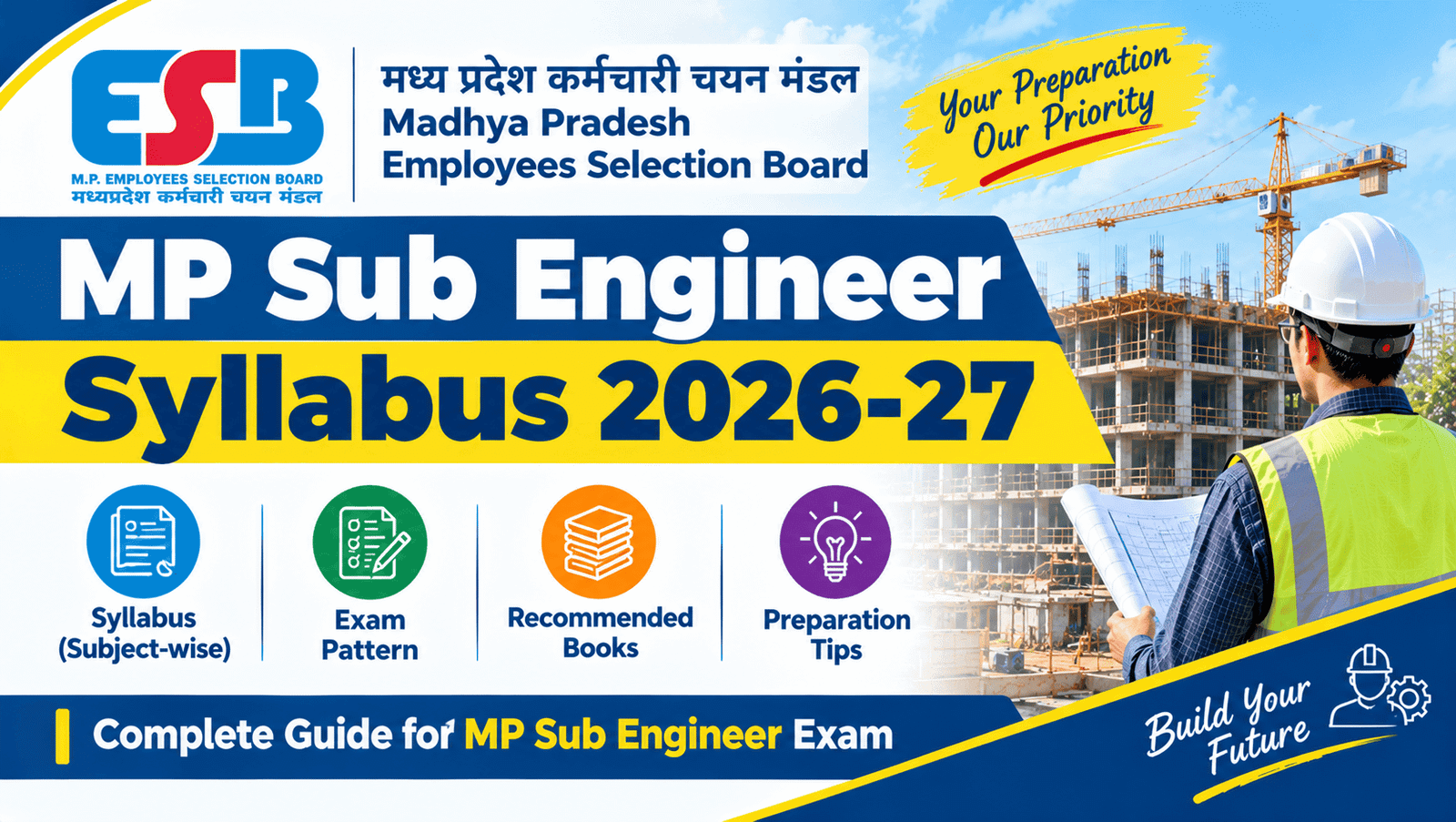
MP Sub Engineer Syllabus 2026-27

The MP Sub Engineer Syllabus 2026-27 is an important resource for candidates preparing for the Madhya Pradesh Employees Selection Board (MPESB) Group-3 Sub Engineer and Other Post Combined Recruitment Test 2026. The examination is scheduled for 20 January 2027.

The MP Sub Engineer examination covers two broad areas: general subjects and technical subjects related to the candidate’s engineering discipline. The technical section is relevant to Civil, Electrical and Mechanical Engineering posts, while the general section covers subjects such as General Knowledge, Hindi, English, Mathematics, Reasoning, Science and Computer Knowledge.

Candidates should check the complete MP Sub Engineer subject-wise syllabus before starting their preparation. This page provides an overview of the exam pattern, common subjects, branch-wise technical topics and preparation strategy. You can also access the detailed Civil, Electrical and Mechanical Engineering syllabus through the links given below.

Also, Check: MP Sub Engineer Previous Year Question Papers

MP Sub Engineer Syllabus 2026-27: Overview

Particular Details
Exam Conducting Body Madhya Pradesh Employees Selection Board (MPESB)
Exam Name Group-3 Sub Engineer and Other Post Combined Recruitment Test 2026
Post Category Sub Engineer and other equivalent posts
Exam Date 20 January 2027
Exam Mode Computer-Based Test (CBT)
Total Marks 200
General Section 100 Marks
Technical Section 100 Marks
Technical Disciplines Civil, Electrical and Mechanical Engineering
Official Website esb.mp.gov.in

MP Sub Engineer Exam Pattern 2026-27

The MPESB Group-3 Sub Engineer examination is divided into two broad sections:

  • Part A – General Subjects: Covers general knowledge, Hindi, English, mathematics, reasoning, science and computer knowledge.
  • Part B – Technical Subject: Covers the engineering discipline relevant to the post, such as Civil, Electrical or Mechanical Engineering.

The broad section-wise marks distribution is given below.

Part Subjects Marks
Part A General Knowledge, General Hindi, General English, General Mathematics, General Reasoning, General Science and General Computer Knowledge 100
Part B Relevant Technical Subject (Civil/Electrical/Mechanical Engineering) 100
Total General + Technical 200

The technical subject depends on the post and applicable post code. Candidates should not assume that every applicant will attempt all three engineering disciplines.

MP Sub Engineer Syllabus 2026-27: Part A – General Subjects

Part A is the common general section for candidates preparing for the MP Sub Engineer examination. It carries 100 marks in the broad examination pattern.

The following subjects and topics should be included in your preparation plan.

1. General Knowledge

  • Indian History and Culture
  • Indian Constitution and Polity
  • Indian Geography
  • Indian Economy
  • Current Affairs – National and Madhya Pradesh
  • Madhya Pradesh History and Geography
  • Madhya Pradesh Culture, Art and Heritage
  • Important rivers, dams and natural resources of Madhya Pradesh
  • Government schemes and important developments
  • Important national and international events
  • General Awareness

2. General Hindi

  • हिंदी व्याकरण
  • संधि और समास
  • पर्यायवाची और विलोम शब्द
  • उपसर्ग और प्रत्यय
  • मुहावरे और लोकोक्तियाँ
  • वाक्य शुद्धि
  • शब्द शुद्धि
  • अनेकार्थी शब्द
  • गद्यांश आधारित प्रश्न

3. General English

  • English Grammar
  • Vocabulary
  • Synonyms and Antonyms
  • Sentence Correction
  • Error Detection
  • Tenses
  • Articles and Prepositions
  • Active and Passive Voice
  • Direct and Indirect Speech
  • Reading Comprehension

4. General Mathematics

  • Number System
  • Simplification
  • Percentage
  • Ratio and Proportion
  • Average
  • Profit and Loss
  • Simple and Compound Interest
  • Time and Work
  • Time, Speed and Distance
  • Mensuration
  • Basic Algebra
  • Data Interpretation

5. General Reasoning

  • Analogy
  • Classification
  • Number and Alphabet Series
  • Coding-Decoding
  • Blood Relations
  • Direction Sense
  • Ranking and Order
  • Syllogism
  • Venn Diagrams
  • Logical Puzzles
  • Statement and Conclusion

6. General Science

  • Basic Physics
  • Basic Chemistry
  • Basic Biology
  • Everyday Science
  • Scientific Instruments
  • Environment and Ecology
  • Basic scientific principles and applications

7. General Computer Knowledge

  • Computer Fundamentals
  • Hardware and Software
  • Input and Output Devices
  • Operating Systems
  • MS Word, Excel and PowerPoint
  • Internet and Email
  • Computer Networks
  • Cyber Security Basics
  • Digital Services

MP Sub Engineer Technical Syllabus 2026-27: Part B

Part B covers the technical subject relevant to the candidate’s engineering discipline. Candidates should prepare the branch-specific subjects instead of studying all three technical syllabi in equal detail.

The following table provides a quick overview of the major technical subjects. For detailed chapter-wise topics, use the separate syllabus pages linked in the table.

Branch-Wise MP Sub Engineer Syllabus 2026-27

Engineering Branch Detailed Syllabus
Civil Engineering MP Sub Engineer Civil Engineering Syllabus 2026-27
Electrical Engineering MP Sub Engineer Electrical Engineering Syllabus 2026-27
Mechanical Engineering MP Sub Engineer Mechanical Engineering Syllabus 2026-27

1. MP Sub Engineer Civil Engineering Syllabus

The Civil Engineering technical syllabus covers important subjects generally taught in a Civil Engineering diploma programme. Candidates should focus on construction materials, surveying, structural mechanics, soil, water resources and infrastructure-related subjects.

Major subjects include:

  • Building Materials and Construction Technology
  • Surveying
  • Engineering Mechanics
  • Strength of Materials
  • Structural Analysis
  • Concrete Technology
  • Reinforced Cement Concrete (RCC) Design
  • Steel Structures
  • Fluid Mechanics and Hydraulics
  • Hydrology and Irrigation Engineering
  • Soil Mechanics and Foundation Engineering
  • Transportation Engineering
  • Environmental Engineering
  • Estimating, Costing and Valuation
  • Construction Management

2. MP Sub Engineer Electrical Engineering Syllabus

The Electrical Engineering technical syllabus focuses on electrical circuits, machines, power generation, transmission, distribution, measurement and control systems. Candidates should revise fundamental electrical laws and practise numerical problems regularly.

Major subjects include:

  • Basic Electrical Engineering
  • Electrical Circuit Theory
  • Electrical Engineering Materials
  • Electrical and Electronic Measurements
  • Electrical Machines
  • Power Generation
  • Transmission and Distribution of Electrical Power
  • Power System Protection
  • Power Electronics
  • Electrical Drives
  • Basic Electronics Engineering
  • Control Systems
  • Electrical Wiring, Installation and Maintenance
  • Utilisation of Electrical Energy
  • Renewable Energy and Smart Grid Fundamentals

3. MP Sub Engineer Mechanical Engineering Syllabus

The Mechanical Engineering technical syllabus includes fundamental engineering subjects, manufacturing processes, machine components, thermal engineering and production-related topics.

Major subjects include:

  • Engineering Mechanics
  • Strength of Materials
  • Thermodynamics
  • Fluid Mechanics
  • Hydraulic Machines
  • Theory of Machines
  • Machine Design
  • Manufacturing Technology
  • Workshop Technology
  • Engineering Materials
  • Metrology and Quality Control
  • Heat Transfer
  • Internal Combustion Engines
  • Refrigeration and Air Conditioning
  • Power Plant Engineering
  • Industrial Engineering and Production Management
  • Automobile Engineering
  • Engineering Drawing and CAD Fundamentals

Important Topics for MP Sub Engineer Exam 2027

Candidates should prioritise the core subjects of their respective engineering discipline while preparing for the technical section. The following table provides a quick revision guide.

Branch Important Subjects for Revision
Civil Engineering Surveying, Strength of Materials, Soil Mechanics, RCC Design, Fluid Mechanics, Hydraulics and Transportation Engineering
Electrical Engineering Basic Electrical Engineering, Circuit Theory, Electrical Machines, Power Systems, Electrical Measurements and Power Electronics
Mechanical Engineering Engineering Mechanics, Strength of Materials, Thermodynamics, Fluid Mechanics, Theory of Machines and Manufacturing Technology

These are suggested preparation priorities based on the branch-wise study guides, not an official MPESB topic-wise weightage chart. Actual question distribution may vary.

How to Prepare for MP Sub Engineer Exam 2026-27

A balanced preparation strategy is important because the examination includes both general and technical subjects. Follow these steps to organise your preparation.

1. Understand the Latest Exam Pattern

Start by reading the latest MPESB Group-3 rulebook. Check the applicable post code, technical paper, examination scheme and revised instructions before preparing a study schedule.

2. Complete Your Branch-Wise Technical Syllabus

Focus on the engineering discipline relevant to your post. Divide the technical syllabus into smaller topics and set weekly targets.

Use the detailed syllabus pages:

3. Prepare General Subjects Alongside Technical Topics

Do not postpone the general section until the technical syllabus is complete. Allocate time every day to General Knowledge, Hindi, English, Mathematics, Reasoning, Science and Computer Knowledge.

4. Practise Numerical Questions

Numerical practice is important for engineering subjects. Solve questions regularly from subjects such as Strength of Materials, Surveying, Fluid Mechanics, Electrical Circuits, Electrical Machines, Thermodynamics and Machine Design, depending on your branch.

5. Make Short Notes and Formula Sheets

Prepare short notes for important definitions, formulas, units, engineering laws and technical concepts. These notes will help you revise quickly before the examination.

6. Solve Previous Year Question Papers

Practise relevant MP Sub Engineer previous-year question papers and sample questions. Review incorrect answers and identify the subjects that need more attention.

7. Attempt Mock Tests

Take regular mock tests to improve speed, accuracy and time management. Analyse your performance after each test and revise weak topics.

MP Sub Engineer Syllabus 2026-27 - FAQs

What is the MP Sub Engineer Syllabus 2026-27?

The MP Sub Engineer syllabus is divided into a general section and a technical section. The general section includes General Knowledge, Hindi, English, Mathematics, Reasoning, Science and Computer Knowledge. The technical section covers the relevant engineering discipline, such as Civil, Electrical or Mechanical Engineering.

What is the MP Sub Engineer Exam Pattern 2026-27?

The examination pattern consists of 100 marks for the general section and 100 marks for the technical section, making a total of 200 marks. 

What is the MP Sub Engineer Exam Date 2027?

The MP Sub Engineer examination is scheduled for 20 January 2027.

How many marks are allotted to the technical section in the MP Sub Engineer exam?

The technical section carries 100 marks in the broad examination pattern. The general section carries another 100 marks, making the total 200 marks.
MP Sub Engineer Mechanical Engineering Syllabus 2026-27: Subject-Wise Topics & Books

MP Sub Engineer Mechanical Syllabus 2026-27

The MP Sub Engineer Mechanical Engineering Syllabus 2026-27 helps candidates prepare for the technical section of the Madhya Pradesh Employees Selection Board (MPESB) Group-3 Sub Engineer and Other Post Combined Recruitment Test 2026. The examination is scheduled for 20 January 2027.

Candidates preparing for Mechanical Engineering posts should cover the core subjects of a diploma-level Mechanical Engineering course. These include Engineering Mechanics, Strength of Materials, Thermodynamics, Fluid Mechanics, Theory of Machines, Manufacturing Technology, Machine Design, Heat Transfer, Refrigeration and Air Conditioning, and Industrial Engineering.

Along with the technical section, candidates must also prepare the general subjects included in the examination. This article provides the MP Sub Engineer Mechanical syllabus, important technical topics, exam pattern and preparation tips.

Also, Read:

MP Sub Engineer Mechanical Engineering Syllabus 2026-27: Overview

Particular Details
Conducting Body Madhya Pradesh Employees Selection Board (MPESB)
Exam Name Group-3 Sub Engineer and Other Post Combined Recruitment Test 2026
Post/Discipline Sub Engineer – Mechanical Engineering
Exam Date 20 January 2027
Exam Mode Computer-Based Test (CBT)
Total Marks 200
General Section 100 Marks
Technical Section 100 Marks
Technical Subject Mechanical Engineering
Official Website esb.mp.gov.in

Candidates should verify the applicable technical paper and post code in the latest revised MPESB rulebook before beginning their final revision.

MP Sub Engineer Mechanical Exam Pattern 2026-27

The MPESB Group-3 examination includes a general section and a technical section. The general section carries 100 marks, while the Mechanical Engineering technical section carries 100 marks.

Section Subject Marks
Part A General Knowledge 100
General Hindi
General English
General Mathematics
General Reasoning
General Science
General Computer Knowledge
Part B Mechanical Engineering 100
Total General + Technical 200

Note: Refer to the latest revised MPESB rulebook for the detailed examination duration, question distribution and marking scheme. The table above represents the broad section-wise marks distribution.

MP Sub Engineer Mechanical Syllabus 2026-27: Part A – General Subjects

The general section is important for Mechanical Engineering candidates because it carries 100 marks. Candidates should include all the general subjects in their daily preparation schedule.

1. General Knowledge

  • Indian History
  • Indian Geography
  • Indian Constitution and Polity
  • Indian Economy
  • Current Affairs
  • General Awareness
  • Madhya Pradesh History
  • Madhya Pradesh Geography
  • Madhya Pradesh Culture and Heritage
  • Important Government Schemes
  • Important national and international events

2. General Hindi

  • हिंदी व्याकरण
  • संधि और समास
  • पर्यायवाची और विलोम शब्द
  • उपसर्ग और प्रत्यय
  • मुहावरे और लोकोक्तियाँ
  • वाक्य शुद्धि
  • शब्द शुद्धि
  • अनेकार्थी शब्द
  • गद्यांश आधारित प्रश्न

3. General English

  • English Grammar
  • Vocabulary
  • Synonyms and Antonyms
  • Sentence Correction
  • Error Detection
  • Tenses
  • Articles and Prepositions
  • Active and Passive Voice
  • Direct and Indirect Speech
  • Reading Comprehension

4. General Mathematics

  • Number System
  • Simplification
  • Percentage
  • Ratio and Proportion
  • Average
  • Profit and Loss
  • Simple and Compound Interest
  • Time and Work
  • Time, Speed and Distance
  • Mensuration
  • Basic Algebra
  • Data Interpretation

5. General Reasoning

  • Analogy
  • Classification
  • Number Series
  • Alphabet Series
  • Coding-Decoding
  • Blood Relations
  • Direction Sense
  • Ranking and Order
  • Syllogism
  • Venn Diagrams
  • Logical Puzzles

6. General Science

  • Basic Physics
  • Basic Chemistry
  • Basic Biology
  • Everyday Science
  • Scientific Instruments
  • Environment and Ecology
  • Basic scientific concepts

7. General Computer Knowledge

  • Computer Fundamentals
  • Hardware and Software
  • Input and Output Devices
  • Operating Systems
  • MS Word, Excel and PowerPoint
  • Internet and Email
  • Computer Networks
  • Cyber Security Basics
  • Digital Services

MP Sub Engineer Mechanical Technical Syllabus 2026-27: Part B

The Mechanical Engineering technical section carries 100 marks. Candidates should revise important theoretical concepts, engineering principles, formulas and numerical problems from their relevant diploma-level subjects.

Syllabus clarification: The following topics are a preparation guide based on standard diploma-level Mechanical Engineering subjects. They are not a verbatim chapter-wise syllabus published by MPESB. Candidates should use the applicable post code and latest revised rulebook as the final reference for the examination.

1. Engineering Mechanics

  • Force systems
  • Resolution and composition of forces
  • Equilibrium of forces
  • Moments and couples
  • Friction
  • Centre of gravity
  • Moment of inertia
  • Work, power and energy
  • Simple machines
  • Laws of motion
  • Basic dynamics

2. Strength of Materials

  • Stress and strain
  • Elasticity and Hooke’s law
  • Young’s modulus
  • Shear stress and shear strain
  • Poisson’s ratio
  • Thermal stresses
  • Bending moment and shear force
  • Bending stress
  • Torsion of circular shafts
  • Columns and struts
  • Principal stresses
  • Deflection of beams
  • Factor of safety

3. Thermodynamics

  • Basic concepts of thermodynamics
  • System, surroundings and properties
  • Zeroth law of thermodynamics
  • First law of thermodynamics
  • Second law of thermodynamics
  • Thermodynamic processes
  • Work and heat transfer
  • Internal energy and enthalpy
  • Entropy
  • Properties of steam
  • Steam tables
  • Thermodynamic cycles
  • Air-standard cycles

4. Fluid Mechanics

  • Properties of fluids
  • Fluid pressure
  • Pressure measurement
  • Hydrostatic forces
  • Buoyancy
  • Fluid flow
  • Continuity equation
  • Bernoulli’s theorem
  • Flow through pipes
  • Losses in pipe flow
  • Laminar and turbulent flow
  • Reynolds number
  • Flow measurement
  • Pumps and hydraulic machines

5. Hydraulic Machines

  • Classification of hydraulic machines
  • Centrifugal pumps
  • Reciprocating pumps
  • Pump performance
  • Priming and cavitation
  • Hydraulic turbines
  • Pelton wheel
  • Francis turbine
  • Kaplan turbine
  • Turbine performance
  • Hydraulic efficiency

6. Theory of Machines

  • Kinematic links and pairs
  • Mechanisms
  • Four-bar chain
  • Slider-crank mechanism
  • Velocity and acceleration analysis
  • Cams and followers
  • Gears and gear trains
  • Flywheel
  • Governors
  • Balancing of rotating masses
  • Vibrations
  • Clutches and brakes
  • Belt, rope and chain drives

7. Machine Design

  • Design principles
  • Material selection
  • Factor of safety
  • Design of shafts
  • Keys and couplings
  • Riveted and welded joints
  • Bolted joints
  • Springs
  • Bearings
  • Gears
  • Power transmission elements
  • Failure theories and basic design considerations

8. Manufacturing Technology

  • Introduction to manufacturing processes
  • Casting processes
  • Pattern making
  • Moulding and core making
  • Welding processes
  • Gas welding and arc welding
  • Forging
  • Rolling
  • Extrusion
  • Drawing
  • Sheet metal operations
  • Machining processes
  • Lathe operations
  • Drilling
  • Milling
  • Shaping and planing
  • Grinding
  • Cutting tools and tool materials

9. Workshop Technology

  • Fitting operations
  • Bench work
  • Carpentry fundamentals
  • Welding workshop
  • Foundry workshop
  • Smithy and forging
  • Machine shop practices
  • Measuring tools
  • Workshop safety
  • Use and maintenance of workshop equipment

10. Engineering Materials

  • Classification of engineering materials
  • Ferrous and non-ferrous metals
  • Properties of metals
  • Cast iron
  • Carbon steel
  • Alloy steel
  • Aluminium and copper alloys
  • Heat treatment
  • Annealing
  • Normalising
  • Hardening and tempering
  • Surface hardening
  • Corrosion and its prevention
  • Material testing

11. Metrology and Quality Control

  • Measurement fundamentals
  • Accuracy and precision
  • Measurement errors
  • Limits, fits and tolerances
  • Vernier caliper
  • Micrometer
  • Dial gauge
  • Comparators
  • Gauges
  • Surface finish
  • Linear and angular measurement
  • Quality control
  • Statistical quality control
  • Inspection methods

12. Heat Transfer

  • Modes of heat transfer
  • Conduction
  • Convection
  • Radiation
  • Thermal conductivity
  • Heat exchangers
  • Overall heat transfer coefficient
  • Heat transfer through composite walls
  • Basic heat transfer calculations

13. Internal Combustion Engines

  • Classification of IC engines
  • Two-stroke and four-stroke engines
  • Petrol and diesel engines
  • Engine components
  • Working principles
  • Ignition systems
  • Fuel supply systems
  • Cooling and lubrication systems
  • Engine performance
  • Brake power and indicated power
  • Thermal efficiency
  • Engine testing

14. Refrigeration and Air Conditioning

  • Refrigeration fundamentals
  • Refrigeration cycles
  • Vapour compression system
  • Vapour absorption system
  • Refrigerants and their properties
  • Refrigeration capacity
  • Compressors
  • Condensers
  • Evaporators
  • Expansion devices
  • Air conditioning fundamentals
  • Psychrometry
  • Cooling load basics
  • Comfort air conditioning

15. Power Plant Engineering

  • Introduction to power plants
  • Thermal power plants
  • Hydroelectric power plants
  • Nuclear power plants
  • Gas turbine power plants
  • Boilers and steam generators
  • Steam turbines
  • Condensers
  • Fuels and combustion
  • Power plant efficiency
  • Renewable energy fundamentals

16. Industrial Engineering and Production Management

  • Production planning and control
  • Plant layout
  • Work study
  • Method study
  • Time study
  • Inventory control
  • Material handling
  • Quality management
  • Maintenance management
  • Productivity
  • Industrial safety
  • Basic operations research

17. Automobile Engineering

  • Automobile fundamentals
  • Chassis and body
  • Engine systems
  • Transmission system
  • Clutch and gearbox
  • Differential
  • Steering system
  • Braking system
  • Suspension system
  • Cooling and lubrication
  • Automobile maintenance
  • Fuel injection systems

18. Engineering Drawing and CAD Fundamentals

  • Engineering drawing basics
  • Orthographic projections
  • Isometric projections
  • Sectional views
  • Dimensioning
  • Geometrical constructions
  • Development of surfaces
  • Assembly drawings
  • Machine component drawings
  • Basic computer-aided drafting concepts

Important Topics for MP Sub Engineer Mechanical Exam 2027

Candidates can use the following table to organise their technical revision. These are suggested preparation priorities, not an official MPESB topic-wise weightage.

Subject Important Areas
Engineering Mechanics Force, equilibrium, friction and moment of inertia
Strength of Materials Stress, strain, bending and torsion
Thermodynamics Laws, cycles, entropy and steam properties
Fluid Mechanics Bernoulli’s theorem, flow and Reynolds number
Theory of Machines Gears, cams, flywheel and governors
Manufacturing Technology Casting, welding and machining
Machine Design Shafts, bearings, gears and springs
Heat Transfer Conduction, convection and radiation
IC Engines Engine cycles, components and performance
Refrigeration and Air Conditioning Refrigeration cycles and psychrometry
Metrology Measurement, limits, fits and tolerances
Industrial Engineering Production planning, work study and quality control

How to Prepare for MP Sub Engineer Mechanical Exam 2026-27

Candidates should focus on conceptual clarity, formula revision and regular numerical practice.

  1. Check the applicable technical paper: Verify the Mechanical Engineering paper against your post code in the latest MPESB rulebook.
  2. Revise basic engineering concepts: Start with Engineering Mechanics, Strength of Materials, Thermodynamics and Fluid Mechanics.
  3. Practise numerical problems: Solve questions involving thermodynamics, fluid mechanics, heat transfer, machine design and strength of materials.
  4. Understand machine components: Revise the working principles and applications of pumps, turbines, engines, gears, bearings and other mechanical equipment.
  5. Cover manufacturing subjects: Give attention to casting, welding, machining, metrology and workshop technology.
  6. Prepare the general section: Practise General Knowledge, Hindi, English, Mathematics, Reasoning, Science and Computer Knowledge.
  7. Attempt mock tests: Take timed tests, review incorrect answers and revise weak topics regularly.

Best Books and Study Material for MP Sub Engineer Mechanical Engineering 2026-27

MP Sub Engineer Mechanical Engineering Syllabus 2026-27 - FAQs

What is the MP Sub Engineer Mechanical Engineering Syllabus 2026-27?

The preparation guide includes Engineering Mechanics, Strength of Materials, Thermodynamics, Fluid Mechanics, Theory of Machines, Manufacturing Technology, Machine Design, Heat Transfer, IC Engines and Refrigeration and Air Conditioning.

How many marks are allotted to the Mechanical Engineering section?

The technical section carries 100 marks, while the general section carries 100 marks. The total examination is worth 200 marks.

When will the MP Sub Engineer Mechanical exam be conducted?

The examination is scheduled for 20 January 2027.

Which subjects are important for MP Sub Engineer Mechanical preparation?

Candidates should prioritise Engineering Mechanics, Strength of Materials, Thermodynamics, Fluid Mechanics, Theory of Machines, Manufacturing Technology and Machine Design, along with the general section.

MP Sub Engineer Electrical Engineering Syllabus 2026-27: Subject-Wise Topics & Books

MP Sub Engineer Electrical Syllabus 2026-27

Candidates preparing for the MPESB Group-3 Sub Engineer and Other Post Combined Recruitment Test 2026 should check the MP Sub Engineer Electrical Engineering Syllabus 2026-27 before starting their preparation. The examination is scheduled for 20 January 2027.

The Electrical Engineering technical section is important for candidates applying for relevant electrical posts. Preparation should cover core diploma-level subjects such as Electrical Circuits, Electrical Machines, Power Systems, Electrical Measurements, Basic Electronics, Power Electronics and Control Systems.

The examination also includes a general section covering subjects such as General Knowledge, Hindi, English, Mathematics, Reasoning, Science and Computer Knowledge. Candidates should prepare both sections to make their study plan balanced.

Also, Read:

MP Sub Engineer Electrical Engineering Syllabus 2026-27: Overview

Particular Details
Conducting Body Madhya Pradesh Employees Selection Board (MPESB)
Exam Name Group-3 Sub Engineer and Other Post Combined Recruitment Test 2026
Post/Discipline Sub Engineer – Electrical Engineering
Exam Date 20 January 2027
Exam Mode Computer-Based Test (CBT)
Total Marks 200
General Section 100 Marks
Technical Section 100 Marks
Technical Subject Electrical Engineering
Official Website esb.mp.gov.in

Candidates should verify the technical paper applicable to their post code in the latest revised MPESB rulebook. Different technical disciplines are linked to different post codes.

MP Sub Engineer Electrical Exam Pattern 2026-27

The examination has two broad sections: Part A (General Subjects) and Part B (Technical Subject). The general section carries 100 marks, while the Electrical Engineering technical section carries 100 marks.

Section Subject Marks
Part A General Knowledge 100
General Hindi
General English
General Mathematics
General Reasoning
General Science
General Computer Knowledge
Part B Electrical Engineering 100
Total General + Technical 200

Note: Candidates should refer to the latest revised rulebook for the confirmed duration, question distribution and marking scheme. The table above shows the broad section-wise marks distribution.

MP Sub Engineer Electrical Syllabus 2026-27: Part A – General Subjects

Part A is common in nature and should be included in the preparation plan of Electrical Engineering candidates.

1. General Knowledge

  • Indian History
  • Indian Geography
  • Indian Constitution and Polity
  • Indian Economy
  • Current Affairs
  • General Awareness
  • Madhya Pradesh History and Geography
  • Madhya Pradesh Culture and Heritage
  • Important Government Schemes
  • Important national and international events

2. General Hindi

  • हिंदी व्याकरण
  • संधि और समास
  • पर्यायवाची और विलोम शब्द
  • उपसर्ग और प्रत्यय
  • मुहावरे और लोकोक्तियाँ
  • वाक्य शुद्धि
  • शब्द शुद्धि
  • अनेकार्थी शब्द
  • गद्यांश

3. General English

  • English Grammar
  • Vocabulary
  • Synonyms and Antonyms
  • Sentence Correction
  • Error Detection
  • Tenses
  • Articles and Prepositions
  • Active and Passive Voice
  • Direct and Indirect Speech
  • Reading Comprehension

4. General Mathematics

  • Number System
  • Simplification
  • Percentage
  • Ratio and Proportion
  • Average
  • Profit and Loss
  • Simple and Compound Interest
  • Time and Work
  • Time, Speed and Distance
  • Mensuration
  • Basic Algebra
  • Data Interpretation

5. General Reasoning

  • Analogy
  • Classification
  • Number Series
  • Alphabet Series
  • Coding-Decoding
  • Blood Relations
  • Direction Sense
  • Ranking and Order
  • Syllogism
  • Venn Diagrams
  • Logical Puzzles

6. General Science

  • Basic Physics
  • Basic Chemistry
  • Basic Biology
  • Everyday Science
  • Scientific Instruments
  • Environment and Ecology
  • Basic scientific concepts

7. General Computer Knowledge

  • Computer Fundamentals
  • Hardware and Software
  • Input and Output Devices
  • Operating Systems
  • MS Office
  • Internet and Email
  • Computer Networks
  • Cyber Security Basics
  • Digital Services

MP Sub Engineer Electrical Technical Syllabus 2026-27: Part B

The Electrical Engineering technical section carries 100 marks. Candidates should revise fundamental concepts, electrical laws, circuit calculations, machines, power systems and electrical measurements.

Syllabus clarification: The following list is a preparation guide based on standard diploma-level Electrical Engineering subjects. It should not be treated as a verbatim chapter-wise MPESB syllabus. Candidates must check the latest rulebook and their applicable post code for the official examination requirements.

1. Basic Electrical Engineering

  • Fundamental electrical quantities
  • Electric current, voltage and resistance
  • Ohm’s Law
  • Kirchhoff’s Current Law (KCL)
  • Kirchhoff’s Voltage Law (KVL)
  • Electrical power and energy
  • Series and parallel circuits
  • Resistance and resistivity
  • Magnetic circuits
  • Electromagnetic induction
  • Faraday’s laws
  • Lenz’s law
  • Electrical safety and basic wiring

2. Electrical Circuit Theory

  • Network elements
  • Active and passive components
  • DC circuit analysis
  • AC circuit fundamentals
  • Series and parallel AC circuits
  • Network theorems
  • Thevenin’s theorem
  • Norton’s theorem
  • Superposition theorem
  • Maximum power transfer theorem
  • Transient response
  • Resonance in electrical circuits
  • Three-phase circuits
  • Power factor and power factor correction

3. Electrical Engineering Materials

  • Conducting materials
  • Insulating materials
  • Magnetic materials
  • Semiconductor materials
  • Properties and applications of electrical materials
  • Dielectric materials
  • Magnetic circuits and applications
  • Basic material selection for electrical equipment

4. Electrical and Electronic Measurements

  • Measurement fundamentals
  • Accuracy and precision
  • Measurement errors
  • Ammeter and voltmeter
  • Wattmeter
  • Energy meter
  • Power factor meter
  • Moving-coil instruments
  • Moving-iron instruments
  • Instrument transformers
  • Digital measuring instruments
  • Bridges and potentiometers
  • Measurement of electrical power and energy

5. Electrical Machines

  • Working principles of electrical machines
  • DC generators
  • DC motors
  • Characteristics of DC machines
  • Starting and speed control of DC motors
  • Transformers
  • Single-phase transformers
  • Three-phase transformers
  • Transformer losses and efficiency
  • Induction motors
  • Three-phase induction motors
  • Single-phase induction motors
  • Synchronous generators
  • Synchronous motors
  • Alternators
  • Motor applications and maintenance

6. Power Generation

  • Conventional power generation
  • Thermal power plants
  • Hydroelectric power plants
  • Nuclear power generation
  • Gas-based power plants
  • Renewable energy sources
  • Solar power generation
  • Wind energy
  • Basic power station components
  • Load and demand concepts

7. Transmission and Distribution of Electrical Power

  • Transmission system fundamentals
  • Transmission line parameters
  • Overhead transmission lines
  • Underground cables
  • Insulators
  • Conductors
  • Cable insulation
  • Substations
  • Distribution systems
  • Radial and ring-main distribution
  • Voltage regulation
  • Power losses
  • Earthing and grounding
  • Electrical protection fundamentals

8. Power System Protection

  • Protective relays
  • Overcurrent protection
  • Earth fault protection
  • Differential protection
  • Circuit breakers
  • Fuses
  • Isolators
  • Lightning protection
  • Protective devices used in substations
  • Basic concepts of electrical fault analysis

9. Power Electronics

  • Semiconductor devices
  • Diodes
  • Bipolar junction transistors
  • MOSFETs
  • IGBTs
  • Thyristors
  • SCR characteristics
  • Rectifiers
  • Controlled rectifiers
  • Inverters
  • Choppers
  • AC voltage controllers
  • Power electronic converters
  • Applications of power electronics

10. Electrical Drives

  • Fundamentals of electric drives
  • Types of electric drives
  • DC motor drives
  • AC motor drives
  • Starting and braking methods
  • Speed control of electrical motors
  • Industrial applications of drives
  • Selection and maintenance of drives

11. Basic Electronics Engineering

  • Semiconductor fundamentals
  • PN junction diode
  • Zener diode
  • Rectifier circuits
  • Transistors
  • Amplifiers
  • Oscillators
  • Operational amplifiers
  • Digital electronics fundamentals
  • Logic gates
  • Boolean algebra
  • Flip-flops and counters
  • Basic electronic circuits

12. Control Systems

  • Basic control system concepts
  • Open-loop and closed-loop systems
  • Feedback principles
  • Transfer functions
  • Block diagrams
  • Signal flow graphs
  • Time response
  • Stability concepts
  • Basic controllers
  • Industrial control applications

13. Electrical Wiring, Installation and Maintenance

  • Domestic wiring
  • Industrial wiring
  • Electrical installation
  • Wiring accessories
  • Electrical safety
  • Earthing systems
  • Testing of electrical installations
  • Maintenance of electrical equipment
  • Electrical fault identification
  • Safety procedures and protective equipment

14. Utilisation of Electrical Energy

  • Electric heating
  • Electric welding
  • Electric traction
  • Illumination engineering
  • Lighting systems
  • Electrical drives in industries
  • Energy conservation
  • Power factor improvement
  • Energy-efficient equipment

15. Renewable Energy and Smart Grid Fundamentals

  • Solar photovoltaic systems
  • Solar power generation
  • Wind energy systems
  • Battery storage
  • Renewable energy integration
  • Smart grid fundamentals
  • Energy management
  • Basic concepts of distributed generation

Important Topics for MP Sub Engineer Electrical Exam 2027

The following subjects are useful priorities for technical revision. They are not an official question-weightage list.

Subject Important Areas
Basic Electrical Engineering Ohm’s Law, KCL, KVL and electrical power
Circuit Theory Network theorems, AC circuits and resonance
Electrical Machines Transformers, DC machines and induction motors
Power Systems Generation, transmission and distribution
Electrical Measurements Measuring instruments and electrical energy
Power Electronics Rectifiers, inverters, converters and SCR
Control Systems Transfer functions and feedback systems
Protection Relays, circuit breakers and earthing
Basic Electronics Diodes, transistors and logic gates
Electrical Installation Wiring, testing and electrical safety

How to Prepare for MP Sub Engineer Electrical Exam 2026-27

Candidates should use a structured preparation plan to cover both the general and technical sections.

  1. Check the applicable technical paper: Confirm the Electrical Engineering paper against your post code in the revised rulebook.
  2. Revise electrical fundamentals: Start with Ohm’s Law, Kirchhoff’s laws, AC/DC circuits and basic electrical calculations.
  3. Focus on electrical machines: Understand the working principles, characteristics, losses and applications of transformers, DC machines and induction motors.
  4. Practise numerical problems: Solve questions on circuits, power, energy, machines, measurements and power systems.
  5. Prepare the general section: Give regular time to General Knowledge, Hindi, English, Mathematics, Reasoning, Science and Computer Knowledge.
  6. Make short revision notes: Maintain separate notes for formulas, definitions, electrical symbols, units and important concepts.
  7. Practise mock tests: Attempt timed practice tests and review incorrect answers to identify weak topics.

Best Books and Study Material for MP Sub Engineer Electrical Engineering 2026-27

MP Sub Engineer Electrical Engineering Syllabus 2026-27 - FAQs

What is the MP Sub Engineer Electrical Engineering Syllabus 2026-27?

The preparation guide covers Basic Electrical Engineering, Circuit Theory, Electrical Machines, Power Systems, Electrical Measurements, Power Electronics, Control Systems, Basic Electronics and other diploma-level subjects.

How many marks are allotted to the Electrical Engineering section?

The technical section carries 100 marks. The general section carries another 100 marks, making the total examination worth 200 marks.

When is the MP Sub Engineer Electrical exam?

The examination is scheduled for 20 January 2027.

Which Electrical Engineering subjects should I prepare first?

Start with Basic Electrical Engineering, Circuit Theory, Electrical Machines, Power Systems and Electrical Measurements. Also prepare the general section regularly.

MP Sub Engineer Civil Engineering Syllabus 2026-27: Subject-Wise Topics & Books

MP Sub Engineer Civil Engineering Syllabus 2026-27

The MP Sub Engineer Civil Engineering Syllabus 2026-27 is an important resource for candidates preparing for the Madhya Pradesh Employees Selection Board (MPESB) Group-3 Sub Engineer and Other Post Combined Recruitment Test 2026. The examination is scheduled for 20 January 2027.

Candidates preparing for Civil Engineering posts should understand both sections of the examination. The paper includes a general section and a technical section based on the candidate’s relevant engineering discipline.

The Civil Engineering portion requires preparation of core diploma-level subjects such as Building Materials, Surveying, Strength of Materials, Soil Mechanics, RCC Design, Hydraulics, Transportation Engineering and Environmental Engineering.

This article covers the MP Sub Engineer Civil syllabus, important technical subjects, exam pattern and preparation strategy to help candidates organise their studies.

Also, Read:

MP Sub Engineer Civil Engineering Syllabus 2026-27: Overview

Particular Details
Exam Conducting Body Madhya Pradesh Employees Selection Board (MPESB)
Examination Name Group-3 Sub Engineer and Other Post Combined Recruitment Test 2026
Post/Discipline Sub Engineer – Civil Engineering
Exam Date 20 January 2027
Exam Mode Computer-Based Test (CBT)
Total Marks 200
General Section 100 Marks
Technical Section 100 Marks
Technical Subject Civil Engineering
Official Website esb.mp.gov.in

Candidates should also check the applicable post code and the latest revised rulebook before the examination. The technical paper is linked to the relevant post and discipline.

MP Sub Engineer Civil Exam Pattern 2026-27

The MPESB Group-3 examination is divided into two broad sections: a general section and a technical section. Each section carries 100 marks, making the total examination worth 200 marks.

Section Subject Marks
Part A General Knowledge 100
Part A General Hindi
Part A General English
Part A General Mathematics
Part A General Reasoning
Part A General Science
Part A General Computer Knowledge
Part B Civil Engineering 100
Total General + Technical 200

Important: The official examination rulebook should be treated as the final authority for the detailed examination scheme, question distribution, duration and marking rules. Do not assume a subject-wise question count or negative-marking rule unless it is confirmed in the applicable revised rulebook.

MP Sub Engineer Civil Engineering Syllabus 2026-27: Part A – General Subjects

Part A covers general subjects that candidates from different technical disciplines need to prepare. Candidates should not ignore this section because it carries 100 marks.

1. General Knowledge

  • Indian History and Geography
  • Indian Constitution and Polity
  • Indian Economy
  • Important national and international events
  • General awareness
  • Madhya Pradesh history and geography
  • Madhya Pradesh culture, art and heritage
  • Important places, rivers and natural resources of Madhya Pradesh
  • Government schemes and important developments

2. General Hindi

  • हिंदी व्याकरण
  • संधि और समास
  • उपसर्ग और प्रत्यय
  • पर्यायवाची और विलोम शब्द
  • मुहावरे और लोकोक्तियाँ
  • वाक्य शुद्धि
  • शब्द शुद्धि
  • अनेकार्थी शब्द
  • गद्यांश आधारित प्रश्न

3. General English

  • Grammar
  • Vocabulary
  • Synonyms and Antonyms
  • Sentence Correction
  • Error Detection
  • Articles and Prepositions
  • Tenses
  • Active and Passive Voice
  • Direct and Indirect Speech
  • Reading Comprehension

4. General Mathematics

  • Number System
  • Simplification
  • Percentage
  • Ratio and Proportion
  • Average
  • Profit and Loss
  • Simple and Compound Interest
  • Time and Work
  • Time, Speed and Distance
  • Mensuration
  • Basic Algebra
  • Data Interpretation

5. General Reasoning

  • Analogy
  • Classification
  • Number and Alphabet Series
  • Coding-Decoding
  • Blood Relations
  • Direction Sense
  • Ranking and Order
  • Syllogism
  • Venn Diagrams
  • Logical Puzzles
  • Statement and Conclusion

6. General Science

  • Basic Physics
  • Basic Chemistry
  • Basic Biology
  • Everyday Science
  • Scientific Instruments
  • Environment and Ecology
  • Basic scientific principles and applications

7. General Computer Knowledge

  • Computer Fundamentals
  • Hardware and Software
  • Input and Output Devices
  • Operating Systems
  • MS Word, Excel and PowerPoint
  • Internet and Email
  • Computer Networks
  • Cyber Security Basics
  • Digital Services

MP Sub Engineer Civil Technical Syllabus 2026-27: Part B

The Civil Engineering technical section carries 100 marks. Candidates should revise the core subjects covered in a Civil Engineering diploma programme and practise numerical problems along with theoretical concepts.

Syllabus clarification: The following is a branch-wise preparation checklist based on standard Civil Engineering diploma-level subjects. It is not a verbatim chapter-wise syllabus published by MPESB. Use it as a study guide and cross-check the applicable post code and latest rulebook.

1. Building Materials and Construction Technology

  • Properties and uses of bricks, stones, cement and concrete
  • Lime, timber, steel and other construction materials
  • Types of cement and their applications
  • Tests on cement, aggregates and concrete
  • Concrete ingredients and mix properties
  • Mortar and concrete
  • Types of foundations
  • Masonry and its construction
  • Floors, roofs, doors and windows
  • Damp-proofing and waterproofing
  • Building maintenance and repair

2. Surveying

  • Principles and classification of surveying
  • Chain and tape surveying
  • Compass surveying
  • Plane table surveying
  • Levelling and contouring
  • Theodolite surveying
  • Tacheometry
  • Traversing
  • Measurement of horizontal and vertical angles
  • Area and volume calculations
  • Curves and setting out
  • Total station and GPS fundamentals

3. Engineering Mechanics

  • Force systems and resolution of forces
  • Moments and couples
  • Equilibrium of forces
  • Friction
  • Centre of gravity
  • Moment of inertia
  • Simple machines
  • Work, power and energy

4. Strength of Materials

  • Stress and strain
  • Elasticity and Hooke’s law
  • Young’s modulus and Poisson’s ratio
  • Shear force and bending moment
  • Bending stress in beams
  • Shear stress distribution
  • Torsion of shafts
  • Slope and deflection of beams
  • Columns and struts
  • Principal stresses
  • Thin cylinders and pressure vessels

5. Structural Analysis

  • Types of structures
  • Determinate and indeterminate structures
  • Analysis of beams
  • Simply supported and cantilever beams
  • Trusses and frames
  • Support reactions
  • Bending moment and shear force diagrams
  • Deflection of beams
  • Influence lines and basic structural concepts

6. Concrete Technology

  • Ingredients of concrete
  • Properties of fresh and hardened concrete
  • Water-cement ratio
  • Workability and its measurement
  • Concrete mix design fundamentals
  • Tests on concrete
  • Curing methods
  • Admixtures
  • Special types of concrete
  • Quality control in concrete construction

7. Reinforced Cement Concrete (RCC) Design

  • Working stress and limit state concepts
  • Design principles of RCC structures
  • Singly and doubly reinforced beams
  • One-way and two-way slabs
  • T-beams
  • Columns
  • Footings
  • Staircases
  • Development length and anchorage
  • Reinforcement detailing
  • Basic design concepts as per relevant codes

8. Steel Structures

  • Properties of structural steel
  • Types of steel sections
  • Bolted and welded connections
  • Tension members
  • Compression members
  • Beams and columns
  • Roof trusses
  • Structural connections
  • Basic design concepts

9. Fluid Mechanics and Hydraulics

  • Properties of fluids
  • Pressure and pressure measurement
  • Hydrostatic forces
  • Buoyancy and flotation
  • Fluid flow and continuity equation
  • Bernoulli’s theorem
  • Flow through pipes
  • Losses in pipes
  • Open channel flow
  • Notches and weirs
  • Pumps and turbines
  • Hydraulic machines

10. Hydrology and Irrigation Engineering

  • Hydrological cycle
  • Rainfall and its measurement
  • Runoff and infiltration
  • Evaporation and transpiration
  • Irrigation methods
  • Duty, delta and base period
  • Canal irrigation
  • Canal lining
  • Dams and reservoirs
  • Spillways
  • Waterlogging and drainage
  • Water distribution systems

11. Soil Mechanics and Foundation Engineering

  • Origin and classification of soil
  • Index properties of soil
  • Soil permeability
  • Seepage through soil
  • Compaction
  • Consolidation
  • Shear strength of soil
  • Earth pressure
  • Bearing capacity
  • Shallow and deep foundations
  • Pile foundations
  • Settlement of foundations
  • Slope stability

12. Transportation Engineering

  • Highway planning and alignment
  • Road classification
  • Geometric design of roads
  • Traffic engineering
  • Road materials
  • Flexible and rigid pavements
  • Pavement construction and maintenance
  • Road drainage
  • Railway engineering fundamentals
  • Bridges and tunnels: basic concepts

13. Environmental Engineering

  • Sources and characteristics of water
  • Water demand and supply
  • Water quality standards
  • Water treatment processes
  • Water distribution systems
  • Wastewater collection
  • Sewerage systems
  • Sewage treatment
  • Solid waste management
  • Air and noise pollution
  • Environmental protection and sanitation

14. Estimating, Costing and Valuation

  • Types of estimates
  • Detailed and approximate estimates
  • Quantity estimation
  • Rate analysis
  • Measurement of construction work
  • Specifications
  • Schedule of rates
  • Valuation of buildings
  • Depreciation
  • Tendering and contract basics
  • Construction cost calculation

15. Construction Management

  • Construction planning
  • Project scheduling
  • Bar charts and network diagrams
  • CPM and PERT fundamentals
  • Construction equipment
  • Labour and material management
  • Quality control
  • Site safety
  • Project monitoring

Important Topics for MP Sub Engineer Civil Exam 2027

Candidates can prioritise the following core subjects while preparing for the Civil Engineering technical paper:

Subject Important Areas
Surveying Levelling, traversing, theodolite and curves
Strength of Materials Stress, strain, SFD, BMD and torsion
Soil Mechanics Soil properties, compaction and shear strength
RCC Design Beams, slabs, columns and foundations
Fluid Mechanics Bernoulli’s theorem, pipe flow and open channels
Hydraulics and Irrigation Pumps, canals, dams and irrigation methods
Transportation Engineering Highway geometry and pavement materials
Environmental Engineering Water treatment and wastewater treatment
Estimating and Costing Quantity estimation and rate analysis
Building Materials Cement, concrete, bricks and construction materials

These are useful revision priorities, not an official MPESB question-weightage table. Actual questions and their distribution may vary.

How to Prepare for MP Sub Engineer Civil Exam 2026-27

A focused preparation plan can help candidates cover the technical syllabus and general section before the examination.

  1. Understand the exam pattern: Start with the revised MPESB rulebook and identify the technical paper applicable to your post code.
  2. Complete core Civil Engineering subjects: Give adequate time to Surveying, Strength of Materials, Soil Mechanics, RCC, Hydraulics and Transportation Engineering.
  3. Practise numerical questions: Solve problems related to surveying, structural mechanics, fluid mechanics, soil mechanics and estimation.
  4. Prepare the general section daily: Practise Hindi, English, Mathematics, Reasoning, General Knowledge, Science and Computer Knowledge.
  5. Revise formulas: Maintain a separate notebook for important formulas, units, definitions and numerical methods.
  6. Solve previous-year questions: Use relevant previous papers and practice questions to understand question formats and identify weak areas.
  7. Attempt mock tests: Take full-length tests and analyse mistakes instead of focusing only on scores.

Best Books & Study Material for MP Sub Engineer Civil 2026-27

MP Sub Engineer Civil Engineering Syllabus 2026-27 - FAQs

What is the MP Sub Engineer Civil Engineering Syllabus 2026-27?

The syllabus covers general subjects and Civil Engineering topics such as Building Materials, Surveying, Strength of Materials, RCC Design, Soil Mechanics, Fluid Mechanics, Hydraulics, Transportation Engineering and Environmental Engineering.

How many marks are allotted to Civil Engineering in the MP Sub Engineer exam?

The technical section carries 100 marks. The general section also carries 100 marks, making the total examination worth 200 marks.

When will the MP Sub Engineer Civil exam be conducted?

The examination is scheduled for 20 January 2027.

Which subjects should I prioritise for MP Sub Engineer Civil preparation?

Candidates should focus on core subjects such as Surveying, Strength of Materials, Soil Mechanics, RCC Design, Fluid Mechanics, Hydraulics, Transportation Engineering and Environmental Engineering, along with the general section.

ICAR Technical Assistant Syllabus 2026: Prelims & Mains Exam Pattern, PDF

ICAR Technical Assistant Syllabus

The ICAR Technical Assistant Syllabus 2026 is prescribed by the Indian Council of Agricultural Research (ICAR) for its centralised recruitment examination for Technical Assistant (T-3) posts in ICAR Institutes and Senior Technical Assistant (T-4) posts in Krishi Vigyan Kendras (KVKs).

ICAR has issued a detailed syllabus covering the Preliminary Examination (Paper-I) and Mains Examination (Paper-II). The Preliminary exam includes General Knowledge, General English, Quantitative Aptitude and General Agriculture, while the Mains syllabus is based on the candidate’s selected functional group.

The ICAR Technical Assistant syllabus PDF 2026 also covers different technical and professional groups, including Agriculture, Animal Science, Fisheries Science, Home Science, Civil Engineering, Agricultural Engineering, Electrical Engineering, Electronics and Instrumentation Engineering, Library Information Science and Information Technology.

Also, Read: ICAR Technical Assistant Recruitment 2026

ICAR Technical Assistant Syllabus 2026: Overview

Particulars Details
Organisation Indian Council of Agricultural Research (ICAR)
Examination Centralized Recruitment Examination
Post 1 Technical Assistant (T-3)
Post 2 Senior Technical Assistant (T-4)
Workplace ICAR Institutes and KVKs
Examination Mode Computer-Based Test (CBT)
Selection Process Preliminary Examination and Mains Examination
Preliminary Paper Paper-I (Qualifying)
Mains Paper Paper-II (Functional Group-Specific)
Preliminary Subjects General Knowledge, General English, Quantitative Aptitude and General Agriculture
Mains Questions 100
Mains Marks 300
Mains Duration 2 Hours

ICAR Technical Assistant Syllabus PDF Download 2026

Candidates can download the official ICAR Technical Assistant and Senior Technical Assistant syllabus PDF to check the complete examination scheme and subject-wise topics. The syllabus document was issued through ICAR Office Memorandum No. TS-19(6)/2024-Estt.IV (E-332924), dated 28 September 2026.

ICAR Technical Assistant Syllabus 2026 PDF

ICAR Technical Assistant Exam Pattern 2026

The ICAR centralized examination consists of two papers:

  1. Preliminary Examination (Paper-I) – Qualifying paper
  2. Mains Examination (Paper-II) – Functional group-specific paper

The Preliminary examination tests general awareness, English, quantitative aptitude and general agriculture. The Mains examination evaluates the candidate’s subject-specific knowledge according to the selected functional group.

ICAR Technical Assistant Prelims Exam Pattern 2026

The Preliminary Examination is an objective-type multiple-choice examination consisting of 100 questions for 100 marks.

Section Subject Questions Marks
1 General Knowledge 25 25
2 General English 25 25
3 Quantitative Aptitude 25 25
4 General Agriculture 25 25
Total 100 100

Prelims Exam Details:

  • Examination type: Objective-type multiple-choice questions.
  • Total questions: 100.
  • Total marks: 100.
  • Duration: 1 hour.
  • Question paper language: English and Hindi, except the General English section.
  • Negative marking: 0.25 marks for each incorrect answer.
  • Paper-I is a qualifying examination for shortlisting candidates for the Mains examination.

ICAR Technical Assistant Mains Exam Pattern 2026

The Mains Examination is designed to test candidates’ domain-specific knowledge according to their selected functional group.

Particulars Details
Paper Paper-II
Examination Type Objective-type MCQs
Total Questions 100
Total Marks 300
Marks per Question 3
Duration 2 Hours
Negative Marking 1 mark for each incorrect answer
Syllabus Functional Group-Specific

Important Mains Examination Rules:

  • Each correct answer carries 3 marks.
  • One mark is deducted for every incorrect answer.
  • The Mains examination is based on the candidate’s selected functional group or sub-group.
  • Candidates are shortlisted for the Mains examination based on their Preliminary examination performance, in the ratio decided by ASRB.
  • Final selection for Technical Assistant (T-3) and Senior Technical Assistant (T-4) is based on Mains examination performance.
  • No interview will be conducted for these posts, as specified in the examination scheme.

ICAR Technical Assistant Paper-I Syllabus 2026

The Preliminary Examination (Paper-I) is common to candidates appearing for Technical Assistant (T-3) and Senior Technical Assistant (T-4). It contains four subjects: General Knowledge, General English, Quantitative Aptitude and General Agriculture.

Each subject carries 25 questions and 25 marks.

1. ICAR Technical Assistant General Knowledge Syllabus

The General Knowledge section tests candidates’ awareness of their surroundings, current events and general knowledge of India and neighbouring countries.

Important topics include:

  • Current events and national affairs
  • International current affairs
  • Indian History
  • Indian Culture
  • Indian Geography
  • Economic Science
  • General Policy
  • Scientific Research
  • General awareness of society and the environment
  • Everyday observations and scientific developments

Candidates should focus on important national and international events, Indian history, geography, economy and developments in science and technology.

2. ICAR Technical Assistant General English Syllabus

The General English section evaluates candidates’ ability to understand correct English, basic comprehension and writing skills.

Important areas include:

  • English grammar
  • Basic sentence structure
  • Reading comprehension
  • Vocabulary
  • Correct usage of words
  • Sentence formation
  • Basic writing ability
  • Understanding written English

Candidates should practise grammar, vocabulary and comprehension questions to improve accuracy.

3. ICAR Technical Assistant Quantitative Aptitude Syllabus

The Quantitative Aptitude section tests numerical ability and the appropriate use of numbers.

The detailed syllabus includes the following topics:

Arithmetic and Number System

  • Whole numbers
  • Decimals and fractions
  • Relationships between numbers
  • Percentage
  • Ratio and proportion
  • Square roots
  • Averages
  • Interest
  • Profit and loss
  • Discount
  • Partnership business
  • Mixture and alligation
  • Time and distance
  • Time and work

Algebra

  • Basic algebraic identities
  • Elementary surds
  • Graphs of linear equations

Geometry

  • Triangles and their different centres
  • Congruence and similarity of triangles
  • Circle and its chords
  • Tangents
  • Angles subtended by chords
  • Common tangents to two or more circles
  • Quadrilaterals
  • Regular polygons

Mensuration

  • Right prism
  • Right circular cone
  • Right circular cylinder
  • Sphere and hemisphere
  • Rectangular parallelepiped
  • Regular right pyramid with triangular or square base

Trigonometry and Data Interpretation

  • Trigonometric ratios
  • Degree and radian measures
  • Standard identities
  • Complementary angles
  • Heights and distances
  • Histogram
  • Frequency polygon
  • Bar diagram
  • Pie chart

4. ICAR Technical Assistant General Agriculture Syllabus

General Agriculture is an important section of the Preliminary examination. It covers crop production, soil science, horticulture, animal science, agricultural engineering, farm management, agricultural extension and agricultural research.

The major topics are explained below.

A. Agro-Ecosystems and Agronomy

  • Agronomic principles and practices
  • Agro-meteorology
  • Dryland farming
  • Agroforestry
  • Soil testing and fertility management
  • Integrated farming systems
  • Climate change and its impact on Indian agriculture
  • Cereal crops
  • Pulses and oilseeds
  • Forage crops
  • Horticultural crops
  • Principles of plant breeding
  • Seed production
  • Tissue culture
  • Plant propagation techniques
  • Major diseases of rice, wheat, maize, sugarcane, potato, citrus and papaya
  • Weed management

B. Animal Science

  • Animal breeding
  • Animal cloning
  • Basics of animal health
  • Livestock production
  • Poultry and duckery
  • Small ruminants
  • Beekeeping
  • Freshwater and marine fisheries

C. Agricultural Engineering and Farm Management

  • Farm machinery
  • Agricultural energy
  • Ergonomics
  • Women-friendly agricultural equipment
  • Post-harvest technology
  • Information and Communication Technology (ICT) in agriculture
  • Agribusiness
  • Socio-economic aspects of agriculture
  • Types and systems of farming
  • Factors affecting farming systems
  • Agricultural price policy
  • Crop insurance

D. Agricultural Research and Rural Development

  • Role of ICAR in Indian agriculture
  • Role of NAARM
  • Agricultural Universities
  • Indigenous Knowledge Systems in Agriculture
  • Role of Krishi Vigyan Kendras (KVKs)
  • Agricultural technology dissemination
  • NGOs and Self-Help Groups
  • Rural development
  • Human Resource Development in Agricultural Research
  • Role of cooperatives in the agricultural economy
  • National Education Policy 2020

E. Agricultural Laws and Regulations

  • Seeds Act, 1966
  • Protection of Plant Varieties and Farmers’ Rights Act, 2001
  • Biological Diversity Act, 2002 and its 2023 amendment
  • Insecticides Act, 1968
  • Plant Quarantine (Regulation of Import into India) Order, 2003
  • National Biodiversity Authority
  • Protection of Plant Varieties and Farmers’ Rights Authority
  • Directorate of Plant Protection, Quarantine and Storage (DPPQ&S)

F. International Agricultural Organisations

  • CIMMYT
  • IRRI
  • ICRISAT
  • IITA
  • CIAT
  • IWMI
  • ICARDA

ICAR Technical Assistant Mains Syllabus 2026: Functional Group-Wise Topics

The Mains Examination (Paper-II) is based on the candidate’s selected functional group. The official syllabus document covers ten functional groups or sub-groups.

Candidates should carefully select the functional group applicable to their educational qualification and recruitment application.

List of ICAR Technical Assistant Functional Groups

Sl. No. Functional Group / Sub-Group
1 Field/Farm Technician & Laboratory Technician (Agriculture)
2 Field/Farm Technician & Laboratory Technician (Animal Science)
3 Field/Farm Technician & Laboratory Technician (Fisheries Science)
4 Field/Farm Technician & Laboratory Technician (Home Science/Community Science)
5 Workshop Staff (Civil Engineering)
6 Workshop Staff (Agricultural Engineering)
7 Workshop Staff (Electrical Engineering)
8 Workshop Staff (Electronics & Instrumentation Engineering)
9 Library Information Science/Documentation Staff
10 Information Technology

1. Agriculture Syllabus – Field/Farm Technician & Laboratory Technician

The Agriculture functional group covers advanced topics in agronomy, soil science, crop production, plant breeding, horticulture, agricultural extension and agricultural engineering.

Important topics include:

  • Ecology and environmental science
  • Natural resource management and conservation
  • Agro-ecology and climate change
  • Cropping patterns and farming systems
  • Organic and precision farming
  • Production practices for cereals, pulses, oilseeds, fibre and commercial crops
  • Agroforestry and forestry
  • Weed science and weed management
  • Soil properties, soil fertility and nutrient management
  • Soil testing and fertiliser recommendations
  • Dryland agriculture and watershed management
  • Irrigation, drainage and water-use efficiency
  • Farm management and agricultural economics
  • Agricultural extension and rural development
  • Agricultural engineering and farm machinery
  • Cell biology, genetics and heredity
  • Plant breeding and crop improvement
  • Seed production, certification and processing
  • Plant physiology
  • Horticulture and protected cultivation
  • Plant pathology and agricultural entomology
  • Food science and technology
  • Food production, consumption and food security
  • Biotechnology and genetic engineering
  • Food microbiology and food processing

2. Animal Science Syllabus – Field/Farm Technician & Laboratory Technician

The Animal Science functional group covers livestock production, animal nutrition, physiology, reproduction, genetics, veterinary science, animal health and dairy technology.

Important topics include:

  • Animal nutrition
  • Energy and protein requirements
  • Minerals, vitamins and feed additives
  • Feed processing and fodder conservation
  • Animal physiology
  • Blood circulation and respiration
  • Excretion and endocrine glands
  • Animal growth and production
  • Milk production and reproduction
  • Animal reproduction and artificial insemination
  • Livestock production and management
  • Dairy farming
  • Meat, egg and wool production
  • Genetics and animal breeding
  • Breeding systems and selection methods
  • Agricultural and animal husbandry extension
  • Animal anatomy and histology
  • Pharmacology and therapeutics
  • Veterinary hygiene
  • Animal diseases and their diagnosis
  • Veterinary public health
  • Zoonotic diseases
  • Milk and milk products technology
  • Meat hygiene and technology
  • Poultry products and processing

3. Fisheries Science Syllabus – Field/Farm Technician & Laboratory Technician

The Fisheries Science group covers aquaculture, fish breeding, fisheries management, fish biology, aquatic ecology, fish processing and fisheries economics.

Important topics include:

  • Principles of aquaculture
  • Freshwater and marine aquaculture
  • Fish farming systems
  • Fish breeding and seed production
  • Hatchery management
  • Ornamental fish farming
  • Aquarium management
  • Fish genetics and biotechnology
  • Fish nutrition and feed management
  • Fish health and disease management
  • Inland fisheries
  • Marine fisheries
  • Aquatic ecology and ecosystems
  • Soil and water chemistry
  • Taxonomy of finfishes and shellfishes
  • Fishery biology
  • Fishing crafts and gears
  • Fish processing and preservation
  • Fish products and by-products
  • Fisheries economics
  • Fisheries extension and marketing
  • Fisheries policies and trade

4. Home Science / Community Science Syllabus

This functional group includes agriculture-related fundamentals, human nutrition, child development, family resource management, clothing and textiles, and Home Science education.

Important topics include:

  • Importance of agriculture in the national economy
  • Basic principles of crop production
  • Major crops and their cultivation
  • Soil types and plant nutrients
  • Cell structure and genetics
  • Plant growth and development
  • Photosynthesis and respiration
  • Major crop pests and diseases
  • Organic farming and biofertilisers
  • Natural resources and ecosystems
  • Biodiversity and environmental conservation
  • Rural development programmes
  • Human nutrition and food groups
  • Nutritional value of food
  • Food processing and preservation
  • Meal planning and diet therapy
  • Community nutrition and health
  • Child and human development
  • Prenatal and postnatal care
  • Family dynamics and family welfare
  • Home management and family finance
  • Housing and home furnishing
  • Clothing construction and textiles
  • Textile fibres and traditional textiles
  • Home Science education and communication
  • Extension methods and women’s empowerment

5. Civil Engineering Syllabus – Workshop Staff

The Civil Engineering functional group includes engineering mathematics, construction materials, structural analysis, design, hydraulics, environmental engineering and transportation engineering.

Important topics include:

  • Engineering Mathematics
  • Building Materials
  • Solid Mechanics
  • Structural Analysis
  • Design of Steel Structures
  • Design of Concrete and Masonry Structures
  • Construction Practice, Planning and Management
  • Fluid Mechanics and Hydraulic Machines
  • Hydrology and Water Resources Engineering
  • Environmental Engineering
  • Geotechnical Engineering
  • Foundation Engineering
  • Surveying and Geology
  • Transportation Engineering
  • Building Information Modelling (BIM)
  • Geographic Information System (GIS)
  • Drones and UAVs in civil engineering
  • Smart Sensors and IoT
  • Green Building Concepts
  • Sustainable and climate-resilient infrastructure
  • Agricultural structures and rural infrastructure

6. Agricultural Engineering Syllabus – Workshop Staff

The Agricultural Engineering group focuses on farm machinery, agricultural power, irrigation, soil and water engineering, food processing and renewable energy.

Important topics include:

  • Elementary Statistics and Probability
  • Differential and Integral Calculus
  • Linear Algebra and Fourier Series
  • Differential Equations
  • Vector Algebra and Vector Calculus
  • Numerical Analysis
  • Electric Motors and Measuring Instruments
  • Computer Fundamentals and Power Distribution
  • Thermodynamics
  • Fluid Mechanics
  • Theory of Machines
  • Soil Mechanics
  • Soil Classification and Compaction
  • Engineering Mechanics
  • Strength of Materials
  • Farm Machinery and Mechanisation
  • Farm Engines, Tractors and Power Tillers
  • Repair and Maintenance of Farm Equipment
  • Renewable Energy and Bioenergy
  • Solar, Wind and Biogas Systems
  • Agricultural Produce Processing
  • Drying, Milling and Storage
  • Food Preservation and Refrigeration
  • Surveying and Levelling
  • Hydrology and Water Resources
  • Irrigation and Drainage Systems
  • Water Harvesting and Soil Conservation

7. Electrical Engineering Syllabus – Workshop Staff

The Electrical Engineering group covers electrical circuits, machines, measurements, power systems, control systems, electronics and agricultural automation.

Important topics include:

  • Engineering Mathematics
  • Electrical Engineering Materials
  • Electric Circuits and Fields
  • Network Theorems
  • Electrical and Electronic Measurements
  • Computer Fundamentals
  • Basic Electronics Engineering
  • Analog and Digital Electronics
  • Systems and Signal Processing
  • Control Systems
  • Electrical Machines
  • Transformers and Motors
  • Power Systems
  • Power Generation and Transmission
  • Power Electronics and Drives
  • Semiconductor Devices
  • Agricultural Instrumentation and Automation
  • Sensors and Data Acquisition Systems
  • PLCs and SCADA
  • Automation in Irrigation and Agricultural Facilities

8. Electronics & Instrumentation Engineering Syllabus – Workshop Staff

This group covers electronics, digital systems, instrumentation, control engineering, microcontrollers, measuring instruments and emerging technologies.

Important topics include:

  • Engineering Mathematics
  • Electrical Engineering Fundamentals
  • Network Theorems and Electrical Machines
  • Electronic Components and Devices
  • Analog Electronics
  • Digital Electronics
  • Boolean Algebra and Logic Gates
  • Process Instrumentation
  • Transducers and Sensors
  • Temperature, Pressure, Flow and Level Measurement
  • Control Engineering
  • PID Controllers
  • Linear Integrated Circuit Applications
  • Operational Amplifiers
  • Microcontrollers
  • Programmable Logic Controllers (PLCs)
  • SCADA and Distributed Control Systems
  • Electronic Measuring Instruments
  • Digital Multimeters and Oscilloscopes
  • Analytical and Biomedical Instrumentation
  • Internet of Things (IoT)
  • Artificial Intelligence and Machine Learning in Instrumentation
  • Cyber-Physical Systems
  • Industry 4.0

9. Library Information Science / Documentation Staff Syllabus

The Library Information Science group focuses on library management, knowledge organisation, information services, library automation and research methodology.

Important topics include:

  • Library and Society
  • History and development of libraries in India
  • Five Laws of Library Science
  • Types of libraries
  • Library legislation
  • Professional ethics
  • Library associations and organisations
  • Knowledge Organisation
  • Library classification schemes
  • Dewey Decimal Classification (DDC)
  • Universal Decimal Classification (UDC)
  • Colon Classification
  • Cataloguing codes and principles
  • Library and Information Management
  • Acquisition and processing of library resources
  • Circulation and serial management
  • Budgeting and record keeping
  • Reference and Information Services
  • Current Awareness Services (CAS)
  • Selective Dissemination of Information (SDI)
  • Reference sources and online information resources
  • Information Technology in Libraries
  • Library Automation
  • Library Management Software
  • RFID, Barcode and QR Code Technology
  • Digital Libraries and Institutional Repositories
  • Library Networks and Resource Sharing
  • INFLIBNET and DELNET
  • Research Methodology
  • Bibliometrics, Scientometrics and Webometrics

10. Information Technology Syllabus

The Information Technology functional group covers operating systems, computer networks, database management, software engineering, programming, web development, mobile applications and artificial intelligence.

Important topics include:

Operating Systems

  • Process Management
  • Inter-process Communication
  • Process Scheduling
  • Memory Management
  • Virtual Memory
  • Paging and Segmentation
  • Deadlocks and Semaphores
  • File Systems
  • Distributed Operating Systems

Computer Networking

  • Types of Networks and Topologies
  • Network Management
  • Data Transmission
  • ISO-OSI Model
  • TCP/IP Model
  • Internet Standards and Services
  • Cryptography
  • Data Compression
  • Authentication and Firewalls

Database Management Systems

  • DBMS Concepts and Features
  • Relational Databases
  • Database Design and Normalisation
  • SQL and PL/SQL
  • Query Processing and Optimisation
  • Database Security
  • Backup and Recovery
  • Distributed Databases

Software Engineering

  • Requirement Analysis
  • Software Development Life Cycle
  • Software Process Models
  • Project Management
  • Software Quality
  • Coding and Testing
  • Software Maintenance
  • Gantt Charts, PERT and CPM
  • CASE Tools

Data Structures and Programming

  • C++, Java and Python
  • Arrays and Linked Lists
  • Stacks and Queues
  • Trees and Graphs
  • Searching and Sorting Algorithms
  • Object-Oriented Programming
  • Pointers and Dynamic Memory
  • File Management
  • Algorithms and Flowcharts

Website Development

  • HTML and HTML5
  • CSS
  • JavaScript
  • Content Management Systems
  • WordPress, Joomla and Drupal
  • .NET
  • JSP and PHP
  • Web Security and Performance

Mobile Application Development

  • Android and iOS Platforms
  • Application Development Life Cycle
  • UI/UX Design
  • React Native and Flutter
  • Java, Kotlin and Swift
  • APIs and Database Integration
  • App Testing and Deployment

Server Administration and Database Administration

  • Linux and Windows Server
  • Server Configuration
  • User and Group Management
  • Network Security
  • System Monitoring
  • Backup and Recovery
  • Relational and NoSQL Databases
  • Database Performance Tuning
  • Oracle, MySQL, SQL Server and PostgreSQL

Artificial Intelligence

  • AI Concepts and Applications
  • Machine Learning
  • Regression and Classification
  • Clustering
  • Decision Trees and Random Forest
  • Neural Networks and Deep Learning
  • CNN, RNN, LSTM and Transformers
  • Model Evaluation
  • Image Processing
  • Generative AI and Large Language Models
  • AI Tools and Platforms

How to Choose the Correct ICAR Technical Assistant Mains Syllabus?

The Mains syllabus is not common for all candidates. It depends on the functional group or sub-group selected for the examination.

Before preparing for Paper-II, candidates should follow these steps:

  1. Check the educational qualification and functional group applicable to the post.
  2. Identify the correct functional group from the official examination scheme.
  3. Download the ICAR Technical Assistant syllabus PDF.
  4. Open the Paper-II section in the document.
  5. Locate the functional group matching your application.
  6. Prepare only the relevant subject-specific syllabus along with the common Preliminary syllabus.

Important: The examination scheme allows candidates to apply for either or both posts, Technical Assistant (T-3) and Senior Technical Assistant (T-4), if eligible. However, a candidate can select only one functional group/sub-group for the Mains examination, irrespective of eligibility for multiple groups.

How to Prepare for ICAR Technical Assistant Exam 2026?

A structured preparation strategy can help candidates cover both the Preliminary and Mains syllabus effectively.

1. Understand the Two-Stage Examination

Start by understanding the difference between Paper-I and Paper-II. Paper-I is a qualifying examination, while Paper-II tests subject-specific knowledge and determines final selection.

2. Complete General Agriculture

General Agriculture carries 25 marks in the Preliminary examination. Cover agronomy, soil science, crop production, horticulture, animal science, agricultural engineering and agricultural extension.

3. Practise Quantitative Aptitude

Prepare arithmetic, algebra, geometry, mensuration, trigonometry and data interpretation. Practise calculations regularly to improve speed and accuracy.

4. Revise General Knowledge and English

Read current affairs and revise Indian history, geography, economy, polity and scientific developments. Practise English grammar and comprehension questions.

5. Focus on Your Selected Functional Group

For the Mains examination, give priority to the functional group selected in your application. Prepare the detailed technical topics provided in the official Paper-II syllabus.

6. Attempt Mock Tests

Solve objective-type questions and full-length mock tests. Since both papers include negative marking, focus on accuracy as well as speed.

7. Revise Regularly

Prepare short notes for important concepts, formulas, technical terms and difficult topics. Revise them regularly before the examination.

ICAR Technical Assistant Syllabus 2026 - FAQs

What is the ICAR Technical Assistant Syllabus 2026?

The ICAR Technical Assistant syllabus consists of two papers. Paper-I covers General Knowledge, General English, Quantitative Aptitude and General Agriculture. Paper-II covers subject-specific topics according to the selected functional group.

How many subjects are included in the ICAR Technical Assistant Preliminary exam?

There are four subjects: General Knowledge, General English, Quantitative Aptitude and General Agriculture. Each subject carries 25 questions and 25 marks.

What is the total number of questions in the ICAR Technical Assistant Prelims exam?

The Preliminary examination contains 100 objective-type questions carrying 100 marks.

Is the ICAR Technical Assistant Preliminary examination qualifying?

Yes. Paper-I is a qualifying examination. Candidates are shortlisted for the Mains examination based on their Preliminary examination performance and the shortlisting ratio decided by ASRB.

What is the ICAR Technical Assistant Mains exam pattern?

The Mains examination consists of 100 objective-type questions carrying 300 marks. Each question carries 3 marks, and the duration is two hours.

Is there negative marking in the ICAR Technical Assistant examination?

Yes. There is a deduction of 0.25 marks for each incorrect answer in the Preliminary examination and 1 mark for each incorrect answer in the Mains examination.

Is there an interview for ICAR Technical Assistant recruitment?

No interview is specified for Technical Assistant (T-3) and Senior Technical Assistant (T-4) in the official examination scheme. Selection is based on Mains examination performance.

CSPDCL Syllabus 2026: Post-Wise PDF Download & Exam Pattern

CSPDCL Syllabus 2026

The CSPDCL Syllabus 2026 has been made available for various posts under the Chhattisgarh State Power Companies recruitment. Candidates preparing for Assistant Engineer (AE), Junior Engineer (JE), Data Entry Operator (DEO), Plant Attendant, Stenographer and other posts should check the syllabus applicable to their respective positions.

The recruitment covers multiple technical and non-technical posts, and the examination syllabus is not identical for every position. The syllabus for Section II covers common subjects such as General Knowledge, English, Hindi and Reasoning/Quantitative Aptitude. CSPDCL provides the professional or technical syllabus separately for different posts and disciplines.

Check the CSPDCL Syllabus PDF 2026, post-wise syllabus download links, Section II topics and important examination preparation details.

Also, Check: CGSSB Group 2 Syllabus 2026

CSPDCL Syllabus 2026: Overview

Particulars Details
Organisation Chhattisgarh State Power Companies
Posts AE, JE, DEO, Stenographer and other posts
Examination Computer-Based Test / Written Examination, as applicable
Syllabus Structure Post-specific syllabus and Detailed Syllabus for Section II
Common Section II Subjects General Knowledge, English, Hindi and Reasoning/Quantitative Aptitude
Syllabus Format PDF
Official Recruitment Portal https://web.cspdcl.co.in

Important: For CSPDCL Recruitment 2026, a total of 1,501 vacancies are available across CSPDCL, CSPGCL and CSPTCL. Candidates should check the company and post applicable to their application.

CSPDCL Syllabus PDF Download 2026: Post-Wise Links

The Chhattisgarh State Power Companies have separate syllabus documents for different posts. Candidates should download the PDF corresponding to the post for which they have applied.

The following table provides the post-wise CSPDCL syllabus download section.

Sl. No. Post / Syllabus Document Download
1 Detailed Syllabus for Section II Download PDFs
2 Fire Officer and Staff
3 Security Officer and Staff
4 Assistant Engineer (AE)
5 Account Officer / Assistant Manager
6 Assistant Industrial Relation Officer
7 Assistant Law Officer
8 Data Entry Operator (DEO) & Stenographer
9 Junior Engineer (JE)
10 Medical Officer
11 Paramedical Staff
12 Plant Attendant
13 Programmer
14 Shift Chemist

CSPDCL Exam Pattern 2026

The examination pattern may vary according to the post. Candidates should therefore check the relevant syllabus PDF and recruitment instructions before starting their preparation.

The available Detailed Section II Syllabus describes a common non-technical section covering the following subjects:

Section II Subject Topics Covered
General Knowledge Current Affairs, Indian History, Geography, Art and Culture, Polity, Economy and Everyday Science
English Language Grammar, Language Proficiency, Reading Comprehension, Indirect Writing and Vocabulary
Hindi Language Grammar, Vocabulary, Language Proficiency, Indirect Writing and Reading Comprehension
Reasoning / GMA / Quantitative Aptitude Puzzles, Series, Coding-Decoding, Analogy, Logical Reasoning and Quantitative Ability

The Section II syllabus has a weightage of 20 marks. However, candidates should confirm the complete examination pattern, total marks, duration and post-specific Section I weightage from the applicable official syllabus and recruitment instructions.

Section I and Section II: What Is the Difference?

The syllabus structure divides the written examination into two broad parts:

Section I – Technical / Professional Knowledge

This section relates to the professional subject, engineering branch, trade or specialised qualification required for the selected post. For example, the technical syllabus for an Assistant Engineer may differ according to the engineering discipline.

Section II – General / Non-Technical Knowledge

This section covers common subjects such as General Knowledge, English, Hindi and Reasoning/Quantitative Aptitude.

Candidates should not assume that the same Section I syllabus applies to every post. Download the relevant post-wise PDF before preparing.

CSPDCL Section II Syllabus 2026: Detailed Topics

The detailed Syllabus for Section II covers four broad areas: General Knowledge, English Language, Hindi Language and Logical Reasoning/General Mental Ability/Quantitative Aptitude.

1. General Knowledge

The General Knowledge section covers national and international developments, Indian history, geography, polity, economy, culture and everyday science.

Important topics include:

  • National current affairs
  • International current affairs
  • Indian History
  • Indian Geography
  • Art and Culture of India
  • Indian Polity
  • Indian Governance
  • Indian Economy
  • Basics of Microeconomics
  • Basics of Macroeconomics
  • Science in Everyday Life

Candidates should regularly follow important national and international events and revise static General Knowledge topics.

2. General Verbal Ability – English Language

The English section covers grammar, language proficiency, reading comprehension, indirect writing and vocabulary.

A. English Grammar

  • Question Tags
  • Sentences
  • Parts of Speech
  • Tenses and Aspects
  • Active and Passive Voice
  • Reported Speech
  • Articles
  • Degrees of Comparison
  • Gerunds
  • Punctuation
  • Suffixes and Prefixes
  • Change of Number
  • Change of Gender
  • Change of Days and Months

B. Language Proficiency

  • Para Jumbles
  • Sentence Completion
  • Odd Word Out
  • One Word Substitution
  • Word-Segment Substitution
  • Cloze Test
  • English-to-target-language translation
  • Target-language-to-English translation

C. Reading Comprehension

  • Reading passages
  • Meaning of words in context
  • Semantics
  • Synonyms
  • Antonyms
  • Word Meaning
  • Idioms and Phrases

D. Indirect Writing

  • Sentence Completion
  • Moving Jumbles
  • One Word Substitution
  • Sentence arrangement
  • Sentence correction

E. Vocabulary

  • Synonyms
  • Antonyms
  • Word Meaning
  • Idioms
  • Phrases

3. General Verbal Ability – Hindi Language

The Hindi section includes grammar, vocabulary, language proficiency, indirect writing and reading comprehension.

A. Hindi Grammar

  • पद
  • उपसर्ग एवं प्रत्यय
  • लिंग
  • वचन
  • समास
  • संधि
  • संधि विच्छेद
  • काल
  • विराम चिह्नों का प्रयोग

B. Hindi Vocabulary (शब्द विचार)

  • पर्यायवाची शब्द
  • विलोम शब्द
  • अनेकार्थी शब्द
  • एकार्थी शब्द
  • मुहावरे
  • लोकोक्तियां
  • तत्सम और तद्भव
  • देशज और विदेशज शब्द

C. Hindi Language Proficiency

  • Hindi-to-English word meaning and translation
  • English-to-Hindi word meaning and translation

D. Indirect Writing

  • वाक्य शुद्धि
  • वाक्य क्रम में लिखना
  • अतिरिक्त वाक्य की पहचान
  • वाक्यांश के लिए सार्थक शब्द
  • वाक्य खण्ड में शुद्धि
  • शब्दों का उचित प्रयोग

E. Reading Comprehension

  • अपठित गद्यांश
  • गद्यांश आधारित प्रश्न
  • Passage comprehension

4. Logical Reasoning / General Mental Ability / Quantitative Aptitude

This section includes logical reasoning, analytical ability and basic quantitative aptitude.

Important topics include:

  • Seating Arrangements
  • Puzzles
  • Verbal Series
  • Number Series
  • Relationships
  • Coding-Decoding
  • Verbal Analogy
  • Numerical Analogy
  • Distance
  • Syllogism
  • Logical Operations
  • Similarities and Dissimilarities
  • Simplification
  • Decimals
  • Fractions
  • LCM and HCF
  • Square Root
  • Divisibility Test
  • Ratio and Proportion
  • Percentage
  • Average
  • Profit and Loss
  • Discount
  • Simple Interest
  • Compound Interest
  • Mensuration
  • Time and Work
  • Time and Distance
  • Algebraic Identities
  • Problems on Age

Candidates should practise both reasoning and numerical questions regularly to improve calculation speed and accuracy.

How to Download CSPDCL Syllabus PDF 2026?

Candidates can follow these steps to access the syllabus from the official recruitment portal:

  1. Visit the CSPDCL Recruitment Portal.
  2. Open the recruitment or relevant notification section.
  3. Locate the applicable 2026 recruitment advertisement.
  4. Find the syllabus document for your post.
  5. Select the relevant PDF download link.
  6. Open the PDF and check the post name and syllabus details.
  7. Download and save the document for exam preparation.

Candidates should ensure that they are using the correct syllabus for their selected post and engineering branch, trade or professional qualification.

How to Prepare for CSPDCL Recruitment Exam 2026?

A planned preparation strategy can help candidates cover the technical and non-technical portions of the examination.

1. Download the Correct Post-Wise Syllabus

Start by downloading the relevant CSPDCL syllabus PDF. Check the technical subjects, common Section II topics and any additional examination requirements mentioned in the document.

2. Give Priority to Professional Subjects

Candidates applying for Assistant Engineer and Junior Engineer posts should focus on their selected engineering discipline. Plant Attendant candidates should prepare the relevant trade subjects, while candidates for specialised posts should follow their respective professional syllabus.

3. Prepare Section II Regularly

Set aside time for General Knowledge, English, Hindi and Reasoning/Quantitative Aptitude. Revise grammar rules, current affairs, important facts and mathematical concepts.

4. Practise Objective Questions

Solve topic-wise MCQs after completing each subject. This will help you identify weak areas and improve accuracy.

5. Revise Important Topics

Prepare short notes for formulas, technical concepts, grammar rules and important General Knowledge facts. Revise these notes regularly.

6. Attempt Mock Tests

Practise mock tests based on the applicable examination pattern. Analyse your performance and work on topics where you make repeated mistakes.

CSPDCL Syllabus 2026 - FAQs

Where can I download the CSPDCL Syllabus 2026 PDF?

Candidates can download the post-wise CSPDCL Syllabus 2026 PDF from the official recruitment portal. The direct PDF links for the available syllabus documents are listed in the download table above.

Is the CSPDCL syllabus the same for all posts?

No. The syllabus depends on the post and professional discipline. The common Section II syllabus covers General Knowledge, English, Hindi and Reasoning/Quantitative Aptitude, while Section I or the professional syllabus may differ by post.

What is included in the CSPDCL Section II syllabus?

The detailed syllabus for Section II covers General Knowledge, English Language, Hindi Language and Logical Reasoning/General Mental Ability/Quantitative Aptitude.

How many marks are allotted to CSPDCL Section II?

The Section II syllabus mentions a weightage of 20 marks. Candidates should verify the complete examination pattern and marks distribution from the applicable official post-wise instructions.

What is the syllabus for CSPDCL Assistant Engineer 2026?

The Assistant Engineer syllabus is based on the relevant engineering discipline. Candidates should download the Assistant Engineer PDF and check the topics applicable to their selected branch.

What is the CSPDCL Junior Engineer syllabus 2026?

The Junior Engineer syllabus includes professional or technical subjects related to the selected engineering discipline. Candidates should also check the applicable Section II syllabus and examination pattern.

Is there a separate CSPDCL syllabus for DEO and Stenographer?

Yes. Candidates should refer to the DEO and Stenographer syllabus document for the applicable subject coverage and check the recruitment instructions for any typing, shorthand or other skill-test requirements.

CGSSB Group 2 Syllabus 2026: Subject-Wise Topics, Exam Pattern & Marks

CGSSB Group 2 Syllabus

The CGSSB Group 2 Syllabus 2026 is important for candidates preparing for the Chhattisgarh Group 2 Sub Group 2 examination. The syllabus covers Computer Knowledge, General Studies, Chhattisgarh General Knowledge, General Mental Ability, Mathematics, Hindi and English.

The examination structure includes 100 questions carrying 100 marks. Computer Knowledge, General Studies and Chhattisgarh GK together account for 60 questions, making these subjects important parts of the preparation plan.

Here, you can check the CG Vyapam Group 2 syllabus, subject-wise marks, important topics, exam pattern and a practical study plan to organise your preparation.

Also, Read: CGSSB Group 2 Sub Group 2 Recruitment 2026: Apply Online for 1703 Vacancies

CGSSB Group 2 Syllabus 2026: Overview

Particulars Details
Exam Name CGSSB Group 2 Exam 2026
Group Group 2
Sub Group Sub Group 2
Conducting Body Chhattisgarh Staff Selection Board
Total Questions 100
Total Marks 100
Subjects Computer, General Studies, Chhattisgarh GK, Mental Ability, Mathematics, Hindi and English
Question Type Objective-type
Exam Language Hindi and English, except language-specific sections
Exam Duration 2 hours

CGSSB Group 2 Exam Pattern 2026

The written examination contains 100 objective-type questions for 100 marks. Each question carries one mark.

Subject-Wise Questions and Marks

Subject Questions Marks
Computer Knowledge 20 20
General Studies 20 20
Chhattisgarh General Knowledge 20 20
General Mental Ability 10 10
General Mathematics 10 10
General Hindi 10 10
General English 10 10
Total 100 100

Computer Knowledge, General Studies and Chhattisgarh GK together account for 60% of the total marks. Candidates should give these subjects sufficient attention while also practising Mathematics, Mental Ability and both language sections.

CGSSB Group 2 Computer Syllabus 2026

Computer Knowledge carries 20 questions for 20 marks, making it one of the highest-weightage sections. The syllabus covers basic computer knowledge, hardware, printers, operating systems, Microsoft Office, internet, email, antivirus, multimedia, CD/DVD and search engines.

Candidates should prepare the following topics:

1. Basic Computer Knowledge

  • Introduction to computers
  • Uses and applications of computers
  • Characteristics and limitations of computers
  • Use of computers in education, banking and government offices
  • Use of computers in hospitals, businesses and online services

2. Computer Components and Devices

  • Central Processing Unit (CPU)
  • Input devices
  • Output devices
  • Keyboard and mouse
  • Monitor and scanner
  • Printer, speaker and microphone
  • Functions of different computer components

3. Types of Printers

  • Introduction to printers
  • Inkjet printers
  • Laser printers
  • Dot matrix printers
  • Uses of different printers
  • Difference between printers and scanners

4. Operating Systems

  • Meaning and functions of an operating system
  • MS-DOS
  • Commercial operating systems
  • Open-source operating systems
  • Windows
  • Linux
  • Basic knowledge of other operating systems

5. Microsoft Office

MS Word

  • Creating and saving documents
  • Text formatting
  • Tables and document editing

MS Excel

  • Rows and columns
  • Cells and worksheets
  • Basic mathematical formulas
  • Spreadsheet functions

MS PowerPoint

  • Creating presentations
  • Making and editing slides
  • Basic presentation features

6. Internet and Email

  • Introduction to the internet
  • Uses of the internet
  • Websites and web browsers
  • Meaning and uses of email
  • Sending and receiving emails
  • Email attachments
  • Document searching
  • Website searching
  • Government websites

7. Computer Virus and Antivirus

  • Meaning of computer viruses
  • Types of viruses
  • Effects of computer viruses
  • Antivirus software
  • Computer security
  • Safe internet usage
  • Protection from suspicious files

8. Multimedia

  • Meaning of multimedia
  • Audio and video
  • Text and images
  • Uses of multimedia
  • Multimedia in education and entertainment

9. CD and DVD

  • Introduction to CD and DVD
  • Data storage
  • Difference between CD and DVD
  • Basic storage capacity and uses

10. Search Engines

  • Meaning of search engines
  • Examples of search engines
  • Searching through keywords
  • Finding documents and images
  • Searching for information on the internet

CGSSB Group 2 General Studies Syllabus 2026

General Studies carries 20 questions for 20 marks. This section includes Indian history, the freedom movement, geography, the Constitution, economy, science, technology, culture, current affairs, sports and the environment.

1. Indian History

  • Ancient Indian history
  • Indus Valley Civilisation
  • Vedic Civilisation
  • Mauryan Empire
  • Gupta Empire
  • Medieval Indian history
  • Delhi Sultanate
  • Mughal Empire
  • Modern Indian history
  • British rule in India
  • Social and religious reform movements

2. Indian Freedom Movement

  • Revolt of 1857
  • Establishment of the Indian National Congress
  • Partition of Bengal
  • Swadeshi Movement
  • Non-Cooperation Movement
  • Civil Disobedience Movement
  • Quit India Movement
  • Revolutionary movements
  • Indian National Army
  • Independence of India

3. Indian Geography

  • Physical geography of India
  • Mountains, plateaus and plains
  • Major rivers and their tributaries
  • Indian climate and monsoon
  • Soil types
  • Major crops and agricultural regions
  • Mineral resources
  • Population distribution
  • Road, rail, water and air transport

4. Indian Constitution and Polity

  • Making of the Indian Constitution
  • Constituent Assembly
  • Preamble of the Constitution
  • Fundamental Rights
  • Fundamental Duties
  • Directive Principles of State Policy
  • President and Vice-President
  • Prime Minister
  • Parliament
  • Lok Sabha and Rajya Sabha
  • Supreme Court and High Courts
  • Governor and Chief Minister
  • Central and State Governments
  • Panchayati Raj
  • Election Commission

5. Indian Economy

  • Introduction to the Indian economy
  • National income
  • Gross Domestic Product (GDP)
  • Agriculture, industry and service sectors
  • Banking system
  • Reserve Bank of India
  • Union Budget
  • Inflation
  • Unemployment
  • Poverty
  • Government economic schemes

6. General Science and Technology

  • Human body and its systems
  • Digestive system
  • Blood circulation
  • Respiratory system
  • Vitamins and nutrients
  • Diseases and their causes
  • Plant structure
  • Light and sound
  • Force and motion
  • Energy
  • Atoms and molecules
  • Science in daily life
  • Modern technology

7. Indian Philosophy, Art, Literature and Culture

  • Introduction to Indian philosophy
  • Major religious and philosophical traditions
  • Indian art and architecture
  • Classical music
  • Indian dance forms
  • Literature and important writers
  • Cultural heritage
  • Major festivals and traditions

8. Current Affairs and Sports

  • National and international current affairs
  • Important government decisions
  • Important appointments
  • Awards and honours
  • Important national and international days
  • Science and technology developments
  • National and international sports events
  • Famous sportspersons
  • Sports awards and tournament winners

9. Environment

  • Basic environmental concepts
  • Ecosystem
  • Biodiversity
  • Forests and wildlife
  • Pollution
  • Climate change
  • Global warming
  • Natural resources
  • Environmental conservation
  • National parks and wildlife sanctuaries

CGSSB Group 2 Chhattisgarh GK Syllabus 2026

Chhattisgarh General Knowledge carries 20 questions for 20 marks. Candidates should study the state’s history, geography, culture, tribes, festivals, economy, agriculture, forests, administration, industries and current affairs.

1. History of Chhattisgarh

  • Ancient history of Chhattisgarh
  • History of Dakshin Kosala
  • Kalachuri rule
  • Important historical dynasties
  • Historical places of Chhattisgarh
  • Chhattisgarh’s contribution to the freedom movement
  • Important freedom fighters
  • Tribal movements
  • History of the formation of Chhattisgarh

2. Geography of Chhattisgarh

  • Geographical location and boundaries
  • Climate and rainfall
  • Major rivers, including Mahanadi, Shivnath, Indravati and Arpa
  • Major waterfalls, including Chitrakote and Tirathgarh
  • Mountains and plateaus
  • Forest regions and forest resources
  • Tourist destinations
  • Archaeological and historical sites

3. Chhattisgarh Literature, Music, Dance and Culture

  • Chhattisgarhi language and literature
  • Important Chhattisgarhi writers
  • Folk songs and folk music
  • Panthi dance
  • Raut Nacha
  • Sua dance
  • Karma dance
  • Pandavani
  • Folk art
  • Janjhaula
  • Local idioms and expressions
  • Hanaa and proverbs

4. Tribes of Chhattisgarh

  • Gond tribe
  • Baiga tribe
  • Oraon tribe
  • Halba tribe
  • Kamar tribe
  • Pahari Korwa
  • Birhor
  • Tribal traditions and customs
  • Tribal festivals
  • Traditional dresses
  • Tribal lifestyle and culture

5. Festivals of Chhattisgarh

  • Hareli
  • Teeja
  • Pola
  • Cherchhera
  • Navakhai
  • Madai
  • Bastar Dussehra
  • Gaura-Gauri
  • Karma festival
  • Major local festivals and celebrations

6. Chhattisgarh Economy, Forests and Agriculture

  • Economy of Chhattisgarh
  • Importance of agriculture
  • Paddy production
  • Major crops
  • Irrigation projects
  • Forest resources
  • Forest produce
  • Tendu leaves
  • Minor forest produce
  • Animal husbandry
  • Rural economy
  • Agriculture-based industries

7. Administration and Panchayati Raj in Chhattisgarh

  • Administrative structure of Chhattisgarh
  • Governor and Chief Minister
  • Council of Ministers
  • Legislative Assembly
  • District administration
  • Role of the District Collector
  • Tehsil administration
  • Urban local bodies
  • Gram Panchayat
  • Janpad Panchayat
  • Zila Panchayat
  • Panchayati Raj system
  • Local self-government

8. Industries, Energy, Water and Mineral Resources

  • Major industries of Chhattisgarh
  • Steel industry
  • Cement industry
  • Coal resources
  • Iron ore
  • Bauxite
  • Limestone
  • Electricity generation
  • Thermal power projects
  • Water resources
  • Major dams
  • Irrigation projects
  • Industrial areas

9. Chhattisgarh Current Affairs

  • State government schemes
  • Important government announcements
  • State budget
  • Awards and honours
  • Important appointments
  • New development projects
  • Education and employment-related developments
  • Sports achievements
  • Important state events
  • District-level developments

CGSSB Group 2 General Mental Ability Syllabus 2026

General Mental Ability carries 10 questions for 10 marks. This section tests reasoning, logical thinking, pattern recognition and numerical ability.

Important topics include:

  1. Odd one out
  2. Number series
  3. Letter series
  4. Relationships between numbers and letters
  5. Figure-based relationships
  6. Coding and decoding
  7. Hidden figures
  8. Classification
  9. Arithmetic operations
  10. Figure matching
  11. Different types of patterns
  12. Analogy
  13. Logical reasoning
  14. Relationship-based questions

Preparation tip: Practise reasoning questions regularly. Give special attention to number series, letter series, analogy, classification and coding-decoding. Try to understand the logic behind each answer instead of memorising shortcuts.

CGSSB Group 2 General Mathematics Syllabus 2026

General Mathematics carries 10 questions for 10 marks. The syllabus includes basic arithmetic, measurement, numbers, fractions, square roots, average, percentage, speed, time, distance, simple interest, profit and loss, and geometry.

1. Decimal and Metric System

  • Metric system
  • Measurement of length
  • Measurement of area
  • Volume
  • Mass
  • Measurement of time
  • Units of measurement

2. Numbers

  • Whole numbers
  • Even and odd numbers
  • Prime numbers
  • Divisibility
  • Ascending order
  • Descending order
  • Place value

3. Ordinary and Decimal Fractions

  • Ordinary fractions
  • Decimal fractions
  • Comparison of fractions
  • Rules of fractions
  • Conversion of decimals into fractions
  • Conversion of fractions into decimals

4. Square Roots

  • Meaning of square roots
  • Methods of finding square roots
  • Factorisation method
  • Division method
  • Square roots of decimal numbers

5. Average

  • Meaning of average
  • Calculation of average
  • Average of numbers
  • Questions based on average

6. Percentage

  • Meaning of percentage
  • Calculation of percentage
  • Conversion of percentage into decimals
  • Conversion of decimals into percentage
  • Percentage-based questions

7. Speed, Time and Distance

  • Meaning of speed, time and distance
  • Formula for calculating speed
  • Formula for calculating time
  • Formula for calculating distance
  • Questions based on speed, time and distance

8. Simple Interest

  • Principal amount
  • Interest
  • Rate of interest
  • Time
  • Calculation of simple interest

Simple Interest Formula:

Simple Interest = (Principal × Rate × Time) / 100

9. Profit and Loss

  • Cost price
  • Selling price
  • Profit
  • Loss
  • Profit percentage
  • Loss percentage
  • Calculation of profit and loss

10. Lines and Angles

  • Line segments
  • Straight lines
  • Parallel lines
  • Meaning of angles
  • Acute angle
  • Right angle
  • Obtuse angle
  • Straight angle
  • Questions based on angles

11. Plane Figures

  • Triangles
  • Quadrilaterals
  • Circles
  • Identification of figures
  • Types of figures
  • Basic properties of plane figures

CGSSB Group 2 General Hindi Syllabus 2026

General Hindi carries 10 questions for 10 marks. Candidates should focus on Hindi grammar, vocabulary, sentence structure and commonly used expressions.

Important topics include:

No. Topic
1 Swars and Vyanjans
2 Correct spelling (Vartani)
3 Gender (Ling)
4 Number (Vachan)
5 Tense (Kaal)
6 Noun (Sangya)
7 Pronoun (Sarvanam)
8 Adjective (Visheshan)
9 Verb (Kriya)
10 Samas
11 Sandhi
12 Grammatical errors
13 Tatsam and Tadbhav words
14 Deshaj and foreign words
15 Synonyms (Paryayvachi)
16 Antonyms (Vilom)
17 Multiple-meaning words
18 One-word substitution
19 Idioms (Muhavare)
20 Proverbs (Lokoktiyan)

Important Hindi Grammar Areas

  • Vowels, consonants and spelling
  • Masculine and feminine gender
  • Singular and plural
  • Present, past and future tense
  • Noun, pronoun, adjective and verb
  • Types of Samas
  • Swar Sandhi, Vyanjan Sandhi and Visarg Sandhi
  • Identification and correction of grammatical errors
  • Tatsam, Tadbhav, Deshaj and foreign words
  • Synonyms, antonyms and multiple-meaning words
  • One-word substitutions
  • Idioms and proverbs

CGSSB Group 2 General English Syllabus 2026

General English carries 10 questions for 10 marks. This section covers basic English grammar, sentence transformation and vocabulary.

1. English Grammar

  • Noun
  • Pronoun
  • Verb
  • Adverb
  • Adjectives
  • Number
  • Gender
  • Articles
  • Conjunctions
  • Prepositions
  • Interjections

2. Transformation of Sentences

  • Tenses
  • Active Voice
  • Passive Voice
  • Direct Speech
  • Indirect Speech
  • Conversion of direct speech into indirect speech
  • Conversion of indirect speech into direct speech

3. Vocabulary

  • Synonyms
  • Antonyms
  • One-word substitution
  • Correct spellings

Candidates should revise grammar rules and practise sentence-based questions. Regular vocabulary practice can also help improve accuracy in this section.

How to Prepare for CGSSB Group 2 Exam 2026

A subject-wise preparation strategy can help candidates cover the complete syllabus without spending too much time on a single section.

1. Understand the Complete Syllabus

Before starting your preparation, make a checklist of all topics in the CGSSB Group 2 syllabus. Mark the topics you have completed and revise them regularly.

2. Give Regular Time to Computer Knowledge

Computer Knowledge carries 20 marks. Cover computer fundamentals, hardware, operating systems, MS Office, internet, email and cybersecurity basics. Practise objective questions after completing each topic.

3. Prepare General Studies Systematically

Divide General Studies into history, geography, polity, economy, science, culture, current affairs and environment. Study one area at a time and revise important facts.

4. Focus on Chhattisgarh GK

Prepare the state’s history, geography, culture, tribes, festivals, agriculture, forests, minerals and administration. Maintain separate notes for important state-related facts and current affairs.

5. Practise Mathematics and Mental Ability

Solve questions regularly from each topic. Make a notebook of important formulas, calculation methods and reasoning patterns. Review your mistakes to improve speed and accuracy.

6. Revise Hindi and English Grammar

Study grammar rules with examples. Practise vocabulary, sentence correction, voice, narration, Sandhi and Samas questions regularly.

7. Attempt Mock Tests

Once you have covered the main topics, attempt full-length mock tests. Analyse your performance and identify the subjects that need more revision.

30-Day CGSSB Group 2 Preparation Strategy

If you have already covered the basic syllabus, use the following 30-day plan for revision and practice.

Days 1–10: Complete and Revise Core Topics

  • Revise all Computer Knowledge topics.
  • Study Indian history and geography.
  • Revise important topics from the Indian Constitution.
  • Cover Chhattisgarh history and geography.
  • Revise basic Mathematics formulas.
  • Prepare short notes for important facts.

Days 11–20: Practise Questions and Improve Weak Areas

  • Solve Computer Knowledge objective questions.
  • Revise Chhattisgarh GK.
  • Practise Mental Ability questions.
  • Revise Hindi grammar.
  • Practise English grammar and vocabulary.
  • Cover remaining General Studies topics.
  • Identify topics where you are making repeated mistakes.

Days 21–30: Mock Tests and Final Revision

  • Revise the complete syllabus.
  • Attempt mock tests under a time limit.
  • Analyse incorrect and unattempted questions.
  • Revise weak topics.
  • Review important facts, formulas and grammar rules.
  • Practise time management.

Important Preparation Tips for CGSSB Group 2

Keep these points in mind while preparing for the examination:

  1. Follow the applicable syllabus and examination instructions.
  2. Prepare all seven subject areas instead of relying only on General Knowledge.
  3. Give regular attention to Computer Knowledge and Chhattisgarh GK.
  4. Practise Mathematics and Mental Ability questions every day.
  5. Revise Hindi and English grammar rules with examples.
  6. Keep track of national and Chhattisgarh current affairs.
  7. Attempt mock tests to improve time management.
  8. Maintain a notebook of incorrect answers and difficult topics.
  9. Revise important facts and formulas regularly.
  10. Check the final examination instructions for details such as duration and negative marking.

CGSSB Group 2 Syllabus 2026 - FAQs

What is the CGSSB Group 2 Syllabus 2026?

The syllabus covers Computer Knowledge, General Studies, Chhattisgarh General Knowledge, General Mental Ability, General Mathematics, General Hindi and General English.

What is the duration of the CGSSB Group 2 examination?

The examination duration is 2 hours and 15 minutes.

What is the exam mode of CG Vyapam Group 2 2026?

The examination will be conducted in objective-type multiple-choice question (MCQ) format.

Are typing and shorthand tests required for all CGSSB Group 2 posts?

No. Typing and shorthand requirements depend on the post. Candidates should check the relevant post-wise skill requirements in the recruitment advertisement.

Where can I download the CG Vyapam Group 2 Syllabus 2026 PDF?

Visit the official CGSSB website at https://cgssb.cgstate.gov.in/ and check the syllabus or examination section for the latest PDF.

BEL Probationary Engineer Syllabus 2026 & Exam Pattern

BEL Probationary Engineer Syllabus 2026

The BEL Probationary Engineer Syllabus 2026 is an important resource for candidates preparing for Bharat Electronics Limited’s recruitment examination. The selection process includes a Computer-Based Test (CBT) followed by an interview. The written examination covers core engineering subjects related to the candidate’s discipline, along with general aptitude and reasoning.

BEL has announced 350 Probationary Engineer vacancies for Electronics and Mechanical engineering disciplines under Advertisement No. 17556/HR/All-India/2026. Candidates should understand the exam pattern, revise their engineering fundamentals and practise objective questions before the CBT, which is tentatively scheduled for 22 December 2026.

This guide covers the BEL Probationary Engineer exam pattern, suggested subject-wise syllabus for Electronics and Mechanical Engineering, aptitude and reasoning topics, marking scheme and preparation strategy.

BEL Probationary Engineer Syllabus 2026: Overview

Particular Details
Organisation Bharat Electronics Limited (BEL)
Post Probationary Engineer
Advertisement number 17556/HR/All-India/2026
Disciplines Electronics and Mechanical
Total vacancies 350
Exam mode Computer-Based Test (CBT)
Question type Objective-type questions
Total questions 125
Total question-paper marks 125
Exam duration 120 minutes
Technical questions 100
General aptitude and reasoning questions 25
Negative marking 0.25 mark for each incorrect answer
CBT weightage in selection 85 marks
Interview weightage 15 marks
Tentative CBT date 22 December 2026

BEL Probationary Engineer Exam Pattern 2026

The BEL Probationary Engineer CBT consists of 125 objective-type questions. Candidates get 120 minutes to complete the examination.

Section Number of questions Marks
Concerned engineering discipline 100 100
General aptitude and reasoning 25 25
Total 125 125

Each question carries one mark. A deduction of 0.25 mark applies to every incorrect answer. No marks are awarded for unattempted questions or questions marked for review, according to the recruitment information.

The question paper is bilingual in English and Hindi.

BEL Probationary Engineer Marking Scheme

Response Marks
Correct answer +1
Incorrect answer -0.25
Unattempted question 0

Because negative marking applies, candidates should balance speed with accuracy. Avoid random guessing, particularly when you cannot eliminate any incorrect options.

BEL Probationary Engineer Selection Process 2026

The selection process consists of two stages: the Computer-Based Test and the interview.

Selection stage Weightage
Computer-Based Test 85 marks
Interview 15 marks
Total 100 marks

Candidates are shortlisted for the interview based on CBT performance, discipline-wise and category-wise, in a ratio of 1:5. The recruitment information specifies minimum qualifying marks of 35% for General, OBC and EWS candidates and 30% for SC, ST and PwBD candidates in both the CBT and interview separately.

Meeting the minimum qualifying marks does not guarantee final selection. Candidates must follow the official advertisement for the applicable shortlisting and selection rules.

BEL Probationary Engineer Syllabus 2026: Subject-Wise Topics

The syllabus has two broad components:

  1. Technical subjects: Core engineering topics relevant to the selected discipline.
  2. General aptitude and reasoning: Questions assessing analytical and reasoning abilities.

The following topic lists can help candidates organise their preparation. Since the notification does not provide a complete chapter-by-chapter syllabus in the broad wording available, verify any subsequently published detailed instructions before treating an individual topic as compulsory.

BEL Electronics Engineer Syllabus 2026

Candidates applying for Probationary Engineer (Electronics) should revise fundamental Electronics and eligible Electronics-related engineering subjects. The following topics are useful areas for structured preparation.

Subject Suggested topics to cover
Engineering Mathematics Matrices, calculus, differential equations, complex numbers and probability
Network Theory Circuit analysis, network theorems, transient response, resonance and two-port networks
Electronic Devices Semiconductor fundamentals, diodes, BJTs, FETs and MOSFETs
Analog Electronics Amplifiers, operational amplifiers, feedback circuits, oscillators and power amplifiers
Digital Electronics Boolean algebra, logic gates, combinational and sequential circuits, counters and registers
Signals and Systems Continuous and discrete signals, Fourier series, Fourier transform, Laplace transform and Z-transform
Control Systems Transfer functions, block diagrams, stability, root locus and frequency response
Communication Systems AM, FM, digital modulation, noise and pulse modulation
Electromagnetic Theory Electrostatics, magnetostatics, electromagnetic waves and transmission lines
Microprocessors and Microcontrollers Architecture, instruction sets, memory organisation and interfacing
Measurements and Instrumentation Measurement errors, bridges, electronic instruments, sensors and transducers
Digital Signal Processing Sampling, digital filters, discrete-time systems, DFT and FFT
Antennas and Wave Propagation Antenna parameters, radiation patterns, propagation and waveguides

How to Prepare for Electronics Engineering

Start by revising circuit fundamentals and the concepts you studied during your engineering degree. Practise numerical problems from Network Theory, Analog Electronics, Digital Electronics, Signals and Systems, Communication Systems and Control Systems.

Use short notes for formulas, circuit properties and important concepts. Once you have revised a subject, solve objective questions and review every incorrect answer to identify gaps in your understanding.

The suggested list is a study framework, not an official BEL chapter-wise weightage table. Do not assume that each subject will contribute a fixed number of questions unless BEL confirms that distribution.

BEL Mechanical Engineer Syllabus 2026

Candidates applying for Probationary Engineer (Mechanical) should focus on core Mechanical Engineering concepts and problem-solving. The following subjects provide a structured revision framework.

Subject Suggested topics to cover
Engineering Mathematics Calculus, differential equations, matrices, probability and numerical methods
Engineering Mechanics Force systems, equilibrium, friction, work, energy and momentum
Strength of Materials Stress and strain, shear force, bending moment, torsion, deflection and columns
Theory of Machines Kinematics, mechanisms, gears, governors, flywheels and balancing
Machine Design Design principles, failure theories, shafts, bearings, springs, gears and joints
Thermodynamics First and second laws, entropy, thermodynamic cycles and properties of pure substances
Fluid Mechanics Fluid statics, Bernoulli’s equation, pipe flow, dimensional analysis and boundary layers
Heat Transfer Conduction, convection, radiation, heat exchangers and heat-transfer coefficients
Manufacturing Engineering Casting, welding, machining, metal forming and non-traditional machining
Production Engineering Production planning, process selection, manufacturing systems and quality control
Materials Science Material properties, phase diagrams, heat treatment, alloys and material testing
Industrial Engineering Work study, inventory management, operations research and productivity
Refrigeration and Air Conditioning Refrigeration cycles, psychrometry, air-conditioning systems and cooling loads
IC Engines and Power Plants Engine performance, combustion, boilers, turbines and power-plant fundamentals
Engineering Drawing Orthographic projection, sectional views, dimensioning and machine components

How to Prepare for Mechanical Engineering

Revise core concepts before attempting lengthy numerical problems. Strength of Materials, Thermodynamics, Fluid Mechanics, Heat Transfer and Manufacturing Engineering are useful areas to cover systematically during revision.

Prepare a formula notebook and practise applying each formula to different types of questions. For Theory of Machines and Machine Design, focus on understanding the underlying principles instead of memorising isolated facts.

The table is a suggested preparation framework. It does not establish the official number of questions or subject-wise weightage for the BEL examination.

BEL General Aptitude and Reasoning Syllabus 2026

The examination pattern includes 25 questions from general aptitude and reasoning. The official description refers to analytical and reasoning abilities, but the broad syllabus wording does not establish a complete topic-by-topic list.

Candidates can use the following areas as a starting point for preparation, while checking any detailed official instructions for confirmation.

Quantitative aptitude

Suggested practice areas include:

  • Percentages, ratios and proportions
  • Averages
  • Profit and loss
  • Time and work
  • Time, speed and distance
  • Number-based calculations
  • Data interpretation
  • Basic arithmetic and numerical problem-solving

Reasoning ability

Suggested practice areas include:

  • Analogy and classification
  • Number and letter series
  • Coding and decoding
  • Blood relations
  • Direction sense
  • Logical reasoning
  • Seating arrangements
  • Data sufficiency
  • Pattern recognition

English and General Awareness

Some competitive-exam preparation resources also recommend revising English and general awareness. However, candidates should not assume that these are separate, confirmed sections of the BEL CBT unless the official instructions specify them. Prioritise the stated general aptitude and reasoning component and the technical syllabus for your discipline.

How to Prepare for BEL Probationary Engineer Exam 2026

A structured preparation plan helps candidates cover the technical syllabus while leaving enough time for revision and mock tests.

1. Understand the exam pattern first

Remember the main figures: 125 questions, 120 minutes, 100 technical questions and 25 aptitude/reasoning questions. The technical section deserves substantial preparation because it accounts for most of the questions.

2. Revise engineering fundamentals

Use your engineering textbooks, class notes and standard study material to revise the core concepts of your discipline. Focus on understanding formulas, assumptions, units and their practical applications.

3. Make a topic-wise study schedule

Divide the syllabus into manageable topics. Assign study sessions to technical subjects, aptitude and reasoning. Review your progress every week and adjust the plan according to your weaker areas.

4. Practise objective questions

After revising a topic, solve MCQs related to it. Check why an answer is correct and understand the concepts behind your mistakes. This is more useful than repeatedly attempting questions without reviewing them.

5. Take timed mock tests

The two-hour duration means candidates must manage time carefully. Practise full-length mock tests based on the confirmed exam pattern. After each test, review accuracy, time spent per question and topics that need further revision.

6. Account for negative marking

Since each incorrect answer attracts a deduction of 0.25 mark, practise making informed choices. If you can eliminate options confidently, attempt the question; avoid blind guessing.

7. Prepare for the interview alongside the CBT

The interview carries 15 marks in the selection process. Once your technical preparation is underway, revise the fundamentals of your discipline and practise explaining engineering concepts clearly. Do not postpone all interview preparation until after the CBT result.

BEL Probationary Engineer Syllabus 2026: Preparation Tips by Discipline

Electronics candidates Mechanical candidates
Revise circuit theory and electronic-device fundamentals Revise Strength of Materials and Engineering Mechanics
Practise numerical questions from Signals and Systems and Control Systems Practise numerical problems from Thermodynamics and Fluid Mechanics
Strengthen Digital Electronics and Communication Systems concepts Revise Heat Transfer and Manufacturing Engineering
Review formulas, circuit behaviour and measurement concepts Review key formulas, diagrams and engineering principles
Practise timed technical MCQs Practise timed technical MCQs

These are practical study suggestions, not a ranking of topics by officially confirmed question frequency.

Important Instructions for BEL Probationary Engineer Candidates

  • Select the correct engineering discipline corresponding to your eligible qualification.
  • Follow the latest official recruitment advertisement for eligibility and examination instructions.
  • Prepare for both technical questions and general aptitude and reasoning.
  • Remember that the CBT has negative marking.
  • Check the official BEL website for updates to the tentative examination date, admit card and interview process.
  • Do not treat unofficial topic lists or predicted weightages as a substitute for official instructions.

The BEL Probationary Engineer Syllabus 2026 focuses on core engineering knowledge, supported by general aptitude and reasoning. Candidates should first understand the CBT pattern, then revise the technical subjects relevant to Electronics or Mechanical Engineering and practise timed objective questions. Since negative marking applies, accuracy is as important as speed.

Use the subject-wise topics in this guide to organise your preparation, but verify any detailed syllabus updates through BEL’s official recruitment information. A focused revision plan, regular mock tests and a clear understanding of the selection process can help you prepare more effectively for the examination.

BEL Probationary Engineer Syllabus 2026 - FAQs

What is the BEL Probationary Engineer Syllabus 2026?

The broad syllabus covers core engineering subjects relevant to the candidate's discipline, along with general aptitude and reasoning. Electronics and Mechanical candidates should prepare the fundamentals of their respective engineering fields.

What is the BEL Probationary Engineer exam pattern 2026?

The CBT consists of 125 objective questions for 125 marks, with a duration of 120 minutes. It includes 100 technical questions and 25 general aptitude and reasoning questions.

Is there negative marking in the BEL Probationary Engineer exam?

Yes, 0.25 marks will be deducted for each incorrect answer. Candidates should focus on both accuracy and time management.

How many questions are asked in the BEL Probationary Engineer CBT?

The CBT has 125 questions: 100 from the concerned engineering discipline and 25 from general aptitude and reasoning.

What is the selection process for BEL Probationary Engineer Recruitment 2026?

The selection process includes a Computer-Based Test carrying 85 marks and an interview carrying 15 marks. Candidates should check the official notification for the detailed shortlisting and qualifying rules.

KRDP Syllabus 2026: Exam Pattern and Subject-Wise Topics

KRDP Syllabus 2026

KRDP Syllabus 2026 is an important resource for candidates preparing for the Khadi Reform and Development Programme recruitment examination. The Computer-Based Test (CBT) is expected to assess candidates through aptitude, reasoning, technical subjects or other topics prescribed for the respective post. The subjects candidates need to prepare may differ according to the post they select.

Candidates applying for Group B and Group C posts should understand the examination pattern and identify the subjects relevant to their position before starting preparation. The detailed, post-wise syllabus and any section-wise question distribution should be checked against the latest official recruitment notification when confirmed.

Also, Check:

KRDP Syllabus 2026: Overview

Particular Details
Exam name KRDP Recruitment Examination 2026
Organisation Khadi Reform and Development Programme (KRDP)
Advertisement number Adm.-I/NGR/KRDP/2 (117)/2026-27
Exam mode Computer Based Test (CBT)
Syllabus Aptitude, reasoning, technical or other subjects prescribed for the respective post
Subject coverage Depends on the post applied for
Exam date To be announced
Detailed syllabus Check the latest official notification and recruitment updates

KRDP Exam Pattern 2026

The KRDP Computer Based Test is intended to assess candidates in subjects prescribed for the relevant post. The official notification identifies aptitude, reasoning, technical subjects and other post-specific subjects as possible areas of assessment.

Candidates should not assume that every post will have the same subject combination. The final pattern must be checked against the instructions applicable to the selected post.

Exam component What candidates should know
Examination mode Computer Based Test
Aptitude May be included as prescribed for the post
Reasoning May be included as prescribed for the post
Technical subjects Relevant to posts for which technical knowledge is prescribed
Other subjects May be included according to the post-specific requirements
Number of questions Confirm from the applicable official exam instructions
Exam duration Confirm from the applicable official exam instructions
Total marks Confirm from the applicable official exam instructions
Negative marking Check the final examination instructions

Important: Do not rely on an assumed number of questions, examination duration, marks distribution or negative-marking rule. Use the final official instructions for your post when planning your exam strategy.

KRDP Subject-Wise Syllabus 2026

The syllabus comprise aptitude, reasoning, technical subjects and other subjects prescribed for each post. It does not, by itself, establish a complete topic-by-topic syllabus for every position.

The following sections provide a preparation guide, not a confirmed official topic list. Use them to organise your study while waiting for or checking the detailed post-wise syllabus.

1. KRDP Aptitude Syllabus

If aptitude is included in your post’s examination, prepare the relevant numerical and problem-solving concepts. Possible areas to revise include:

  • Basic arithmetic and numerical calculations
  • Percentages, ratios and proportions
  • Averages and number-based problems
  • Profit and loss, where relevant to the prescribed level
  • Time and work or time and distance, if included
  • Interpretation of numerical information

These are suggested preparation areas, not a verified list of topics in the official KRDP syllabus. Match your study plan to the final notification.

2. KRDP Reasoning Syllabus

If reasoning is prescribed for your post, practise questions that test logical thinking and problem-solving. Depending on the confirmed syllabus, preparation may include:

  • Number and letter series
  • Coding and decoding
  • Analogy and classification
  • Logical relationships
  • Pattern-based questions
  • Other verbal or non-verbal reasoning problems

Do not treat every topic above as compulsory unless it appears in the applicable official syllabus.

3. KRDP Technical Syllabus

Technical subjects may be relevant to posts that require specialised educational or professional qualifications. Candidates should focus on the subject knowledge directly related to their post and qualifying discipline.

For example, candidates applying for technical or engineering positions should first identify the discipline and topics mentioned in the official recruitment rules. They should revise core concepts from their relevant field rather than preparing an unrelated, general technical syllabus.

There is no single confirmed technical syllabus for all KRDP posts in the source wording provided. The precise subjects and depth of knowledge should be taken from the post-specific instructions.

4. Other Subjects in the KRDP Examination

The official wording also allows for other subjects as prescribed for the respective post. This means candidates should check whether their particular examination includes any additional subject beyond aptitude, reasoning or technical knowledge.

Avoid assuming that a subject such as General Knowledge, English, computer awareness or a particular professional topic is included unless it is specified for your post in the official instructions.

Post-Wise KRDP Syllabus: How to Prepare

KRDP recruitment covers different types of positions, so candidates should begin by identifying their selected post and its prescribed subjects.

Type of post Recommended preparation approach
Technical or engineering posts Identify the relevant technical discipline and revise its core concepts as specified in the official syllabus
Accounts-related posts Check whether accounting or commerce subjects are prescribed and prepare accordingly
Field or inspection-related posts Follow the subject requirements stated for the selected post; do not assume a separate common syllabus
Administrative or assistant posts Verify whether aptitude, reasoning, language, computer knowledge or other subjects are included
Driver and MTS posts Check the exact examination requirements for the relevant post instead of relying on another post’s syllabus

This table is intended to guide candidates on how to approach preparation. It does not confirm that every suggested subject will appear in the examination.

How to Prepare for KRDP Exam 2026

A focused preparation plan can help candidates cover the confirmed syllabus without spending too much time on unrelated topics.

Step 1: Confirm the syllabus for your post

Start with the official recruitment notification and examination instructions. Identify the subjects applicable to your selected post and note any separate skill-test requirements, if prescribed.

Step 2: Make a topic-wise study plan

Divide the confirmed syllabus into smaller topics. Give priority to subjects that require more practice or that you find difficult. Avoid following a generic syllabus without checking whether it applies to your post.

Step 3: Practise aptitude and reasoning, if included

Solve practice questions regularly and review your mistakes. Focus on understanding the method before trying to improve speed.

Step 4: Revise your technical subjects

For technical positions, use your relevant academic material and revise the concepts specifically listed in the applicable syllabus. Practise questions at the level required by the examination instructions.

Step 5: Take mock tests based on the confirmed pattern

Once the official exam pattern is available, use mock tests that match its subjects, duration and marking scheme. Until then, use practice tests for individual subjects rather than relying on an unverified full-length exam pattern.

Step 6: Track official updates

Check the official KRDP recruitment portal for the detailed syllabus, examination date, instructions and any corrigendum. If the syllabus or exam pattern changes, update your preparation plan accordingly.

KRDP Syllabus 2026: Important Points to Remember

  • The CBT may include aptitude, reasoning, technical subjects or other subjects prescribed for the relevant post.
  • The syllabus may vary by post; candidates should not assume a common subject list for every position.
  • The exact number of questions, duration, total marks and negative-marking rules should be verified from the applicable official exam instructions.
  • The suggested topic lists in this article are preparation guidance, not a substitute for the official syllabus.
  • Candidates should follow official updates for the final exam pattern and post-specific requirements.

KRDP Syllabus 2026 - FAQs

What is the KRDP Syllabus 2026?

The stated CBT syllabus framework includes aptitude, reasoning, technical subjects or other subjects prescribed for the respective post. Candidates should check the detailed official syllabus for their selected position.

Is the KRDP syllabus the same for Group B and Group C posts?

Candidates should not assume that the syllabus is identical across Group B and Group C posts. The subjects to be studied depend on the requirements prescribed for the respective post.

What is the KRDP Exam Pattern 2026?

The examination is described as a Computer Based Test (CBT). The subjects may include aptitude, reasoning, technical or other post-specific areas. Details such as question count, duration and marks distribution should be verified from the final applicable instructions.

How should I prepare for the KRDP recruitment examination?

First confirm the subjects prescribed for your post. Then prepare a topic-wise study plan, practise relevant questions, revise technical subjects where applicable and use mock tests that match the confirmed exam pattern.

RRB Station Master Syllabus 2026: Subject-Wise Topics & Exam Pattern

RRB Station Master Syllabus 2026

The RRB Station Master Syllabus 2026 covers Basic Science and Mathematics, Data Analysis and Interpretation, Logical Capability, and Mental Reasoning. The Railway Board issued revised guidelines on 7 October 2026 for conducting Station Master recruitment separately from the regular RRB NTPC recruitment process.

Under these guidelines, the selection process includes a single-stage Computer-Based Test (CBT), followed by a Computer-Based Aptitude Test (CBAT), document verification and a medical examination.

The revised CBT carries 100 marks and has a duration of 120 minutes. Basic Science and Mathematics and Data Analysis and Interpretation carry 30 marks each, while Logical Capability and Mental Reasoning carry 20 marks each. English reading comprehension is included in Logical Capability.

Candidates preparing for the Railway Station Master exam should understand the revised exam pattern and cover the prescribed topics systematically. This guide explains the subject-wise syllabus, marks distribution, CBAT, selection process and preparation strategy for the 2026 recruitment cycle.

Disclaimer: The syllabus and examination structure discussed below are based on Railway Board letter No. 2025/E(RRB)/25/16 dated 7 October 2026. Candidates should check the detailed Centralised Employment Notification (CEN) and subsequent official updates for the final examination instructions.

RRB Station Master Syllabus 2026: Overview

Particulars Details
Exam Name RRB Station Master Exam 2026
Conducting Authority Railway Recruitment Boards (RRBs)
Recruitment Method Separate Station Master CEN from 2026 onwards
CBT Type Single-stage Computer-Based Test
Total CBT Marks 100
CBT Duration 120 minutes
Basic Science and Mathematics 30 marks
Data Analysis and Interpretation 30 marks
Logical Capability 20 marks
Mental Reasoning 20 marks
Next Stage Computer-Based Aptitude Test (CBAT)
Further Stages Document Verification and Medical Examination

The detailed CEN should be treated as the controlling source for the final examination rules, qualifying conditions, marking scheme and other applicable instructions.

RRB Station Master Exam Pattern 2026

According to the revised Railway Board guidelines, the Station Master examination will have a single-stage CBT carrying 100 marks. Candidates will receive 120 minutes to complete the examination.

RRB Station Master CBT Marks Distribution

Subject Marks
Basic Science and Mathematics 30
Data Analysis and Interpretation 30
Logical Capability, including English Reading Comprehension 20
Mental Reasoning 20
Total 100

Important Changes in the Revised Exam Pattern

  • Single-stage CBT: The revised guidelines provide for one CBT instead of the two CBT stages used for Station Master recruitment under the earlier RRB NTPC structure.
  • 120-minute duration: Candidates will receive two hours to complete the 100-mark examination.
  • Equal priority to mathematics and data interpretation: Both sections carry 30 marks, making them important areas for preparation.
  • English reading comprehension: Reading comprehension is included under Logical Capability.
  • Separate recruitment process: Station Master recruitment will be notified separately from other NTPC posts from 2026 onwards.
  • CBAT remains an essential stage: Candidates shortlisted through the CBT must qualify in the aptitude test to be considered for the combined merit list.

Candidates should avoid relying exclusively on older RRB NTPC Station Master exam patterns because the revised recruitment structure and syllabus are different.

RRB Station Master Syllabus 2026: Subject-Wise Topics

The revised syllabus is divided into four subject areas. The following sections explain the topics candidates should cover and suggest ways to prepare for each area.

1. Basic Science and Mathematics Syllabus – 30 Marks

Basic Science and Mathematics covers fundamental arithmetic, algebra, geometry, mensuration, elementary statistics and selected basic science concepts. The Railway Board guidelines list the following topics.

Mathematics Syllabus

Topic Important Areas to Prepare
Number System Number properties and basic calculations
Ratio and Proportion Ratios, proportions and related problems
Averages Simple and combined averages
Percentages Percentage calculations and applications
Profit, Loss and Discounts Cost price, selling price, profit, loss and discount
Time, Speed and Distance Speed, distance, time and relative velocity
Work and Power Basic work and power concepts and related calculations
Algebra Algebraic expressions and basic equations
Linear Equations Solving simple linear equations
Arithmetic Progression Basic sequence patterns and calculations
LCM and HCF Least common multiple and highest common factor
Geometry Fundamental geometric concepts
Trigonometry Basic trigonometric concepts
Area and Volumes Mensuration, area and volume calculations
Probability Elementary probability
Statistics Basic statistical concepts and calculations

Basic Science Syllabus

Topic Important Areas to Prepare
Units and Measurements Units, physical quantities and measurement
Mass, Weight and Density Definitions, differences and basic calculations
Work, Power and Energy Fundamental concepts and applications
Kinetic Energy Basic concepts and related numerical problems
Motion Speed, velocity and relative velocity
Friction Types and effects of friction
Heat and Temperature Heat, temperature and their differences
Basic Electricity Fundamental electrical concepts
Levers Types and basic working principles
Simple Machines Mechanical advantage and basic principles

The topics above are intended as a practical study checklist. Candidates should refer to the detailed official examination notification for any further clarification about the scope or level of questions.

How to Prepare for Basic Science and Mathematics

Start with arithmetic fundamentals before moving to mixed-topic practice. Give particular attention to percentages, ratios, averages, time and distance, work and power, algebra and mensuration.

For science, understand the definitions, units, formulas and practical applications of the listed concepts. Practise numerical questions regularly and revise formulas at fixed intervals.

2. Data Analysis and Interpretation Syllabus – 30 Marks

Data Analysis and Interpretation carries 30 marks in the revised CBT. This section focuses on examining information presented in different formats, identifying relationships and drawing logical conclusions from available data.

The Railway Board guidelines include multi-source data analysis, interpretation of text and tabular information, graphical data, data sufficiency and data arrangement.

Topic-Wise Data Analysis and Interpretation Syllabus

Topic What to Practise
Tabular Data Reading tables, comparing values and extracting information
Charts and Graphs Interpreting graphical data and comparing quantities
Pie Charts Understanding proportions, percentages and sector-based data
Scatter Plots Identifying relationships and patterns in plotted data
Statistical Distribution Curves Interpreting distribution-based information
Venn Diagrams Understanding relationships between sets or groups
Data Sufficiency Determining whether information is sufficient to answer a question
Data Arrangement Organising information and identifying relationships
Multi-Source Data Analysis Combining information from text, tables and graphs
Inference and Conclusion Drawing appropriate conclusions from the information provided

How to Prepare for Data Analysis and Interpretation

Practise tables, charts, graphs, pie charts and other data-based questions regularly. Learn to identify the information required before starting lengthy calculations.

Strengthen the underlying concepts of percentages, ratios and averages because they can help you solve many interpretation problems. Gradually increase the difficulty of practice sets and solve them under timed conditions.

Maintain a record of incorrect answers to identify whether your main difficulty is calculation speed, data interpretation or selecting the relevant information.

3. Logical Capability Syllabus – 20 Marks

Logical Capability tests the ability to understand statements, analyse relationships and solve logic-based problems. The revised syllabus also includes English reading comprehension.

Logical Reasoning Topics

Topic Important Areas to Prepare
Binary Logic Analysing statements and logical conditions
Syllogism Drawing conclusions from given statements
Clocks Time-based reasoning and clock problems
Calendars Calendar calculations and day-date relationships
Assumptions Identifying assumptions behind statements
Blood Relations Solving family relationship questions
Family Tree Understanding and interpreting family relationships
Logic-Based Puzzles Organising clues and solving logical arrangements

Focus on understanding the conditions given in each question. For syllogisms and other statement-based problems, distinguish between conclusions that necessarily follow and those that are merely possible.

English Reading Comprehension Syllabus

English reading comprehension is included within the Logical Capability section. Candidates should practise reading passages in English and answering questions based on the information presented.

The Railway Board guidelines identify passages covering areas such as:

  • History
  • Society
  • Literature
  • Science
  • Environment
  • Abstract topics
  • Mythology
  • Technology
  • Culture

Candidates should prepare to understand the main idea, supporting information and logical structure of a passage.

Important reading comprehension skills include:

  • Identifying the main idea and central theme.
  • Locating relevant information in a passage.
  • Understanding the meaning of statements in context.
  • Drawing inferences supported by the passage.
  • Recognising the relationship between different ideas.
  • Distinguishing stated information from unsupported conclusions.

How to Prepare for Logical Capability

Practise syllogisms, binary logic, blood relations, clocks, calendars and logic-based puzzles regularly. Focus on accuracy before attempting to solve questions faster.

For reading comprehension, read short English passages from different subjects. Summarise the central idea and practise answering questions using evidence from the passage rather than personal assumptions.

4. Mental Reasoning Syllabus – 20 Marks

Mental Reasoning carries 20 marks in the revised CBT. It focuses on identifying patterns, recognising relationships and solving reasoning problems.

Candidates can use the following common reasoning question types for practice, while checking the detailed CEN for the prescribed scope.

Topic What to Practise
Analogy Identifying relationships between words, numbers or figures
Number Series Recognising numerical patterns
Alphabet Series Identifying patterns in letters
Coding-Decoding Understanding coding rules and relationships
Classification Identifying the odd item or distinguishing feature
Similarities and Differences Comparing objects, numbers or patterns
Direction Sense Solving direction-based problems
Ranking and Ordering Determining positions and relative order
Arrangements Organising information according to given conditions
Pattern Recognition Identifying logical patterns and sequences

How to Prepare for Mental Reasoning

Practise a small set of questions daily and review every incorrect answer. Learn to recognise common patterns, understand the logic behind each question and avoid unnecessary calculations.

Timed practice can help improve speed and accuracy. However, do not sacrifice accuracy by rushing through questions before understanding the underlying pattern.

RRB Station Master CBAT Syllabus 2026

The Computer-Based Aptitude Test (CBAT) follows the CBT for candidates shortlisted according to the prescribed rules. It assesses aptitude relevant to the Station Master role.

Candidates should prepare for CBAT separately from the written examination. Consult the detailed CEN and the applicable official aptitude-test instructions for the exact test components, test procedure and qualifying requirements.

CBT vs CBAT: Key Differences

Particulars CBT CBAT
Purpose Tests knowledge and problem-solving across the prescribed syllabus Assesses aptitude relevant to the Station Master role
Format Computer-Based Test Computer-Based Aptitude Test
Marks 100 marks Combined merit weightage of 30% under the revised guidelines
Shortlisting CBT merit is used to shortlist candidates Candidates must qualify in CBAT
Next Stage CBAT Document verification and medical examination, subject to merit and applicable rules

CBAT Shortlisting and Final Merit

The Railway Board’s revised guidelines specify the following provisions:

  • Candidates are shortlisted for CBAT up to eight times the number of vacancies for the respective RRB, based on CBT merit.
  • Shortlisting for document verification and medical examination is carried out RRB-wise in relation to the available vacancies.
  • Combined merit gives 70% weightage to CBT and 30% weightage to CBAT.
  • Only candidates who qualify in CBAT are considered for the combined merit list.

Candidates should read the detailed CEN carefully to understand the final qualifying requirements and other instructions applicable to the aptitude test.

RRB Station Master Selection Process 2026

The revised recruitment guidelines provide for the following selection stages:

  1. Single-Stage CBT: Candidates appear for the 100-mark computer-based examination.
  2. Computer-Based Aptitude Test: Candidates shortlisted on the basis of CBT merit appear for CBAT.
  3. Document Verification: Candidates shortlisted according to the prescribed merit and vacancy rules must produce the required documents.
  4. Medical Examination: Candidates must satisfy the applicable medical standards for the post.

Qualifying in the CBT alone does not guarantee selection. Candidates must satisfy the applicable qualifying conditions, clear the required stages and meet the document verification and medical requirements.

Is There Negative Marking in the RRB Station Master Exam 2026?

Candidates should check the detailed CEN for the applicable negative-marking rule. Do not assume that the marking scheme of an older RRB NTPC examination automatically applies to the revised Station Master CBT.

Once the detailed examination instructions confirm the rule, practise mock tests using the same marking scheme. Until then, focus on accuracy, formula revision and solving questions methodically rather than relying on random guessing.

RRB Station Master Syllabus 2026: Preparation Strategy

A structured preparation plan can help candidates cover all four subject areas while maintaining a balance between conceptual learning and question practice.

1. Understand the Revised Syllabus

Begin by reviewing the single-stage CBT structure and the four subject areas. Make a checklist of all the prescribed topics and mark each one as not started, in progress or completed.

Avoid relying entirely on older RRB NTPC Station Master study plans because the revised syllabus and examination structure differ.

2. Prioritise High-Weightage Subjects

Basic Science and Mathematics and Data Analysis and Interpretation carry 30 marks each. Allocate sufficient preparation time to both subjects while maintaining regular practice in Logical Capability and Mental Reasoning.

Prioritise subjects according to your current level of preparation and the topics you find difficult.

3. Complete Topic-Wise Practice

Study one topic at a time. For example, revise percentages before attempting mixed arithmetic questions and learn the fundamentals of charts before solving complex data interpretation sets.

After completing a topic, solve practice questions and review your mistakes before moving to the next one.

4. Improve English Reading Comprehension

Read English passages regularly and practise identifying the main idea, relevant details, supporting arguments and conclusions.

Focus on answering questions accurately from the passage. Avoid choosing an answer merely because it seems correct based on general knowledge.

5. Take Timed Mock Tests

Use timed mock tests to improve speed, accuracy and time management. After each test, review incorrect answers and questions that took too long to solve.

Once the detailed notification is available, ensure your mock tests follow the confirmed examination duration, marking scheme and syllabus.

6. Prepare for CBAT Separately

Do not treat CBAT as an extension of the written syllabus. Review the official aptitude-test instructions and use suitable practice material to familiarise yourself with the required tasks.

Start aptitude preparation early rather than waiting until after the CBT result.

7. Revise Regularly

Maintain a notebook of formulas, important concepts and common mistakes. Revisit difficult topics at regular intervals and take short revision tests to check your progress.

Regular revision helps reinforce concepts and reduces the likelihood of repeating the same mistakes.

Best Books and Study Material for RRB Station Master Exam 2026

Candidates can use the following types of study material to prepare for the revised examination:

  • Mathematics: Books covering arithmetic, algebra, geometry, mensuration, probability and elementary statistics.
  • Basic Science: Introductory physics material covering units, measurements, motion, work, power, energy, heat and electricity.
  • Data Analysis and Interpretation: Practice sets involving tables, graphs, charts, scatter plots, Venn diagrams and data sufficiency.
  • Logical Capability: Reasoning material covering syllogisms, binary logic, blood relations, clocks, calendars and puzzles.
  • English Reading Comprehension: Passages from different subjects with questions on main ideas, supporting details and inference.
  • Mental Reasoning: Topic-wise practice questions on analogy, series, coding-decoding, ranking, arrangements and pattern recognition.
  • Mock Tests: Practice tests aligned with the revised 2026 syllabus and confirmed examination rules.
  • Official Sources: Railway Board guidelines, the detailed RRB notification and applicable CBAT instructions.

Choose resources that match the revised syllabus rather than relying exclusively on older Station Master or RRB NTPC preparation materials.

RRB Station Master Syllabus 2026: Important Points to Remember

  • The revised guidelines provide for a separate Station Master recruitment notification from 2026 onwards.
  • The selection process includes a single-stage CBT, CBAT, document verification and medical examination.
  • The CBT carries 100 marks and has a duration of 120 minutes.
  • Basic Science and Mathematics carries 30 marks.
  • Data Analysis and Interpretation carries 30 marks.
  • Logical Capability carries 20 marks and includes English reading comprehension.
  • Mental Reasoning carries 20 marks.
  • CBAT shortlisting is based on CBT merit and is limited to the prescribed number of candidates per RRB.
  • Combined merit gives 70% weightage to CBT and 30% to CBAT, subject to qualifying in CBAT.
  • Candidates should check the detailed CEN for the final marking scheme, syllabus clarifications and examination instructions.

RRB Station Master Syllabus 2026: FAQs

1. What is the RRB Station Master Syllabus 2026?

The revised syllabus covers Basic Science and Mathematics, Data Analysis and Interpretation, Logical Capability and Mental Reasoning. English reading comprehension is included under Logical Capability. Candidates should refer to the detailed recruitment notification for the final examination instructions.

2. What is the RRB Station Master Exam Pattern 2026?

The revised Railway Board guidelines specify a single-stage CBT carrying 100 marks with a duration of 120 minutes. Candidates shortlisted through the CBT proceed to CBAT, followed by document verification and medical examination as applicable.

3. How many marks are assigned to each subject in the RRB Station Master CBT?

Basic Science and Mathematics and Data Analysis and Interpretation carry 30 marks each. Logical Capability and Mental Reasoning carry 20 marks each, making a total of 100 marks.

4. Is General Awareness included in the revised RRB Station Master Syllabus 2026?

General Awareness is not listed as a separate section in the revised subject-wise distribution described in the Railway Board guidelines. Candidates should follow the syllabus specified in the detailed CEN rather than automatically applying the older RRB NTPC syllabus.

5. Is English included in the RRB Station Master Syllabus?

Yes. English reading comprehension is included within Logical Capability. Candidates should practise reading passages and answering questions about the main idea, supporting information, meaning and inferences.

6. What is the duration of the RRB Station Master CBT 2026?

The revised Railway Board guidelines specify a duration of 120 minutes for the 100-mark CBT.

7. What is the weightage of CBT and CBAT in the final merit list?

The revised guidelines specify 70% weightage for CBT and 30% for CBAT in the combined merit calculation. Only candidates who qualify in CBAT are considered for the combined merit list.

8. Is negative marking confirmed for RRB Station Master CBT 2026?

Candidates should check the detailed CEN for the applicable marking scheme, including any deduction for incorrect answers. The rules of an older RRB NTPC examination should not automatically be assumed to apply.

9. How should I prepare for the RRB Station Master Exam 2026?

Cover the prescribed syllabus topic by topic, practise mathematics and data interpretation regularly, strengthen logical and mental reasoning, improve English reading comprehension and review the official CBAT instructions. Timed practice tests and regular revision can help improve accuracy and speed.