KRDP Syllabus 2026: Exam Pattern and Subject-Wise Topics

KRDP Syllabus 2026

KRDP Syllabus 2026 is an important resource for candidates preparing for the Khadi Reform and Development Programme recruitment examination. The Computer-Based Test (CBT) is expected to assess candidates through aptitude, reasoning, technical subjects or other topics prescribed for the respective post. The subjects candidates need to prepare may differ according to the post they select.

Candidates applying for Group B and Group C posts should understand the examination pattern and identify the subjects relevant to their position before starting preparation. The detailed, post-wise syllabus and any section-wise question distribution should be checked against the latest official recruitment notification when confirmed.

Also, Check:

KRDP Syllabus 2026: Overview

Particular Details
Exam name KRDP Recruitment Examination 2026
Organisation Khadi Reform and Development Programme (KRDP)
Advertisement number Adm.-I/NGR/KRDP/2 (117)/2026-27
Exam mode Computer Based Test (CBT)
Syllabus Aptitude, reasoning, technical or other subjects prescribed for the respective post
Subject coverage Depends on the post applied for
Exam date To be announced
Detailed syllabus Check the latest official notification and recruitment updates

KRDP Exam Pattern 2026

The KRDP Computer Based Test is intended to assess candidates in subjects prescribed for the relevant post. The official notification identifies aptitude, reasoning, technical subjects and other post-specific subjects as possible areas of assessment.

Candidates should not assume that every post will have the same subject combination. The final pattern must be checked against the instructions applicable to the selected post.

Exam component What candidates should know
Examination mode Computer Based Test
Aptitude May be included as prescribed for the post
Reasoning May be included as prescribed for the post
Technical subjects Relevant to posts for which technical knowledge is prescribed
Other subjects May be included according to the post-specific requirements
Number of questions Confirm from the applicable official exam instructions
Exam duration Confirm from the applicable official exam instructions
Total marks Confirm from the applicable official exam instructions
Negative marking Check the final examination instructions

Important: Do not rely on an assumed number of questions, examination duration, marks distribution or negative-marking rule. Use the final official instructions for your post when planning your exam strategy.

KRDP Subject-Wise Syllabus 2026

The syllabus comprise aptitude, reasoning, technical subjects and other subjects prescribed for each post. It does not, by itself, establish a complete topic-by-topic syllabus for every position.

The following sections provide a preparation guide, not a confirmed official topic list. Use them to organise your study while waiting for or checking the detailed post-wise syllabus.

1. KRDP Aptitude Syllabus

If aptitude is included in your post’s examination, prepare the relevant numerical and problem-solving concepts. Possible areas to revise include:

  • Basic arithmetic and numerical calculations
  • Percentages, ratios and proportions
  • Averages and number-based problems
  • Profit and loss, where relevant to the prescribed level
  • Time and work or time and distance, if included
  • Interpretation of numerical information

These are suggested preparation areas, not a verified list of topics in the official KRDP syllabus. Match your study plan to the final notification.

2. KRDP Reasoning Syllabus

If reasoning is prescribed for your post, practise questions that test logical thinking and problem-solving. Depending on the confirmed syllabus, preparation may include:

  • Number and letter series
  • Coding and decoding
  • Analogy and classification
  • Logical relationships
  • Pattern-based questions
  • Other verbal or non-verbal reasoning problems

Do not treat every topic above as compulsory unless it appears in the applicable official syllabus.

3. KRDP Technical Syllabus

Technical subjects may be relevant to posts that require specialised educational or professional qualifications. Candidates should focus on the subject knowledge directly related to their post and qualifying discipline.

For example, candidates applying for technical or engineering positions should first identify the discipline and topics mentioned in the official recruitment rules. They should revise core concepts from their relevant field rather than preparing an unrelated, general technical syllabus.

There is no single confirmed technical syllabus for all KRDP posts in the source wording provided. The precise subjects and depth of knowledge should be taken from the post-specific instructions.

4. Other Subjects in the KRDP Examination

The official wording also allows for other subjects as prescribed for the respective post. This means candidates should check whether their particular examination includes any additional subject beyond aptitude, reasoning or technical knowledge.

Avoid assuming that a subject such as General Knowledge, English, computer awareness or a particular professional topic is included unless it is specified for your post in the official instructions.

Post-Wise KRDP Syllabus: How to Prepare

KRDP recruitment covers different types of positions, so candidates should begin by identifying their selected post and its prescribed subjects.

Type of post Recommended preparation approach
Technical or engineering posts Identify the relevant technical discipline and revise its core concepts as specified in the official syllabus
Accounts-related posts Check whether accounting or commerce subjects are prescribed and prepare accordingly
Field or inspection-related posts Follow the subject requirements stated for the selected post; do not assume a separate common syllabus
Administrative or assistant posts Verify whether aptitude, reasoning, language, computer knowledge or other subjects are included
Driver and MTS posts Check the exact examination requirements for the relevant post instead of relying on another post’s syllabus

This table is intended to guide candidates on how to approach preparation. It does not confirm that every suggested subject will appear in the examination.

How to Prepare for KRDP Exam 2026

A focused preparation plan can help candidates cover the confirmed syllabus without spending too much time on unrelated topics.

Step 1: Confirm the syllabus for your post

Start with the official recruitment notification and examination instructions. Identify the subjects applicable to your selected post and note any separate skill-test requirements, if prescribed.

Step 2: Make a topic-wise study plan

Divide the confirmed syllabus into smaller topics. Give priority to subjects that require more practice or that you find difficult. Avoid following a generic syllabus without checking whether it applies to your post.

Step 3: Practise aptitude and reasoning, if included

Solve practice questions regularly and review your mistakes. Focus on understanding the method before trying to improve speed.

Step 4: Revise your technical subjects

For technical positions, use your relevant academic material and revise the concepts specifically listed in the applicable syllabus. Practise questions at the level required by the examination instructions.

Step 5: Take mock tests based on the confirmed pattern

Once the official exam pattern is available, use mock tests that match its subjects, duration and marking scheme. Until then, use practice tests for individual subjects rather than relying on an unverified full-length exam pattern.

Step 6: Track official updates

Check the official KRDP recruitment portal for the detailed syllabus, examination date, instructions and any corrigendum. If the syllabus or exam pattern changes, update your preparation plan accordingly.

KRDP Syllabus 2026: Important Points to Remember

  • The CBT may include aptitude, reasoning, technical subjects or other subjects prescribed for the relevant post.
  • The syllabus may vary by post; candidates should not assume a common subject list for every position.
  • The exact number of questions, duration, total marks and negative-marking rules should be verified from the applicable official exam instructions.
  • The suggested topic lists in this article are preparation guidance, not a substitute for the official syllabus.
  • Candidates should follow official updates for the final exam pattern and post-specific requirements.

KRDP Syllabus 2026 - FAQs

What is the KRDP Syllabus 2026?

The stated CBT syllabus framework includes aptitude, reasoning, technical subjects or other subjects prescribed for the respective post. Candidates should check the detailed official syllabus for their selected position.

Is the KRDP syllabus the same for Group B and Group C posts?

Candidates should not assume that the syllabus is identical across Group B and Group C posts. The subjects to be studied depend on the requirements prescribed for the respective post.

What is the KRDP Exam Pattern 2026?

The examination is described as a Computer Based Test (CBT). The subjects may include aptitude, reasoning, technical or other post-specific areas. Details such as question count, duration and marks distribution should be verified from the final applicable instructions.

How should I prepare for the KRDP recruitment examination?

First confirm the subjects prescribed for your post. Then prepare a topic-wise study plan, practise relevant questions, revise technical subjects where applicable and use mock tests that match the confirmed exam pattern.

ITI NCVT vs SCVT: Differences, Certificate Validity and Government Jobs

Choosing the right Industrial Training Institute (ITI) is an important decision for students planning a technical career after Class 10 or Class 12. During admission, students often come across two terms: NCVT and SCVT. This raises common questions: What is the difference between NCVT and SCVT? Are both certificates valid? Which certificate is accepted for government jobs, apprenticeships and private-sector employment?

The main difference between ITI NCVT and SCVT lies in the training and certification framework, affiliation and recognition. NCVT has traditionally been associated with nationally standardized vocational training, while SCVT refers to state-level vocational training arrangements. However, certificate acceptance depends on the particular trade, training scheme and eligibility conditions of the recruiting organization.

In this guide, you will learn about NCVT vs SCVT differences, certificate validity, government jobs, apprenticeship opportunities, salary and how to choose the right ITI in 2026.

If you are looking for current opportunities, check our guide to ITI Government Jobs 2026.

What Is NCVT in ITI?

NCVT stands for National Council for Vocational Training. It was the national body associated with vocational training and trade certification in India. The vocational education and training framework has since evolved, with the National Council for Vocational Education and Training (NCVET) playing a regulatory role and the Directorate General of Training (DGT) administering major central vocational training schemes.

In the traditional ITI system, NCVT-affiliated trades under the Craftsmen Training Scheme (CTS) are associated with standardized training and the All India Trade Test. Successful candidates receive a National Trade Certificate (NTC).

The DGT conducts examinations for eligible trainees under its training schemes and provides information about trade testing and certification.

Key Features of NCVT-Associated ITI Training

  • Follows the applicable nationally approved training and assessment framework.
  • Provides a recognized trade qualification when the candidate successfully completes the relevant requirements.
  • Can support applications for government jobs, apprenticeships and private-sector positions when the qualification meets the eligibility criteria.
  • Offers opportunities to apply for relevant technical jobs across different states.
  • May be suitable for students seeking employment beyond their home state.

The exact qualification awarded depends on the trade, scheme, affiliation and examination completed. Students should verify these details before taking admission.

What Is SCVT in ITI?

SCVT stands for State Council for Vocational Training. It refers to a state-level vocational training framework administered under the relevant state government’s arrangements.

Some ITIs offer trades under state-level vocational training schemes. The curriculum, examination arrangements and certification may differ according to the state and the particular trade.

An SCVT certificate is not automatically invalid or unsuitable for employment outside the state. However, its acceptance for a specific government job, apprenticeship or further course depends on the applicable rules.

Students should confirm whether the trade and institute are recognized under the relevant scheme and whether the qualification satisfies the requirements of their intended employer or institution.

Key Features of SCVT-Associated ITI Training

  • Administered under the relevant state’s vocational training arrangements.
  • May follow state-approved training and assessment requirements.
  • Can qualify candidates for jobs and further training where the certificate is accepted.
  • May be suitable for students planning to work in their home state.
  • Requires careful verification when applying for recruitment that specifies a particular national qualification or awarding framework.

ITI NCVT vs SCVT: Key Differences

The following table summarizes the main differences between NCVT-associated and SCVT-associated ITI training.

Feature NCVT-Associated Training SCVT-Associated Training
Full form National Council for Vocational Training State Council for Vocational Training
Training framework Relevant national vocational training scheme Relevant state vocational training scheme
Administration National framework, with DGT administering major central schemes State-level vocational training authorities
Curriculum Applicable nationally approved curriculum Curriculum and standards applicable to the state scheme
Certification National Trade Certificate for eligible candidates under the relevant scheme Certificate issued under the relevant state framework
Government jobs Eligible when the specified qualification requirements are met Eligible when the specified qualification requirements are met
Apprenticeship Eligibility depends on the applicable trade and apprenticeship rules Eligibility depends on the applicable trade and apprenticeship rules
Private-sector jobs Depends on employer requirements and skills Depends on employer requirements and skills
Higher education Depends on the course and institution’s admission rules Depends on the course and institution’s admission rules
Employment across states May offer broader portability where the qualification is accepted Acceptance depends on the qualification and the receiving authority
Best choice Students seeking opportunities under nationally recognized training frameworks Students whose chosen state-level course meets their career requirements

Important: Do not assume that every NCVT-associated certificate is accepted for every job or that every SCVT certificate is restricted to one state. Always check the exact qualification, trade and recognition requirements in the official notification.

Difference Between NCVT and SCVT ITI

The main difference is the applicable training and certification framework, rather than a guaranteed difference in the quality of education.

NCVT-Associated Training

NCVT-associated training under the relevant national framework may be useful for students who want to explore technical employment across India. The qualification can be accepted for government recruitment, apprenticeships and private-sector positions where the relevant eligibility conditions are satisfied.

SCVT-Associated Training

SCVT-associated training may be suitable for students planning to work within their state or pursue opportunities that accept the relevant state-issued qualification.

Before admission, students should check the institute’s affiliation, the trade’s recognition status and the qualification awarded on successful completion.

Both training routes require students to develop practical knowledge, technical skills and trade-specific competence.

NCVT vs SCVT: Which Certificate Is Better in 2026?

There is no single answer that applies to every student. The better option is the recognized qualification that matches your career goals and the eligibility requirements of the jobs you want to pursue.

NCVT-associated training may be a practical choice for students seeking nationally standardized training and a wider range of potential recruitment opportunities. However, SCVT-associated training can also be suitable when the trade and certificate meet the requirements of the intended employer or institution.

Consider these factors before choosing:

  • Government jobs: Check which certificates are accepted in your target recruitment notifications.
  • Apprenticeships: Confirm that your trade and qualification meet the scheme’s eligibility requirements.
  • Private-sector employment: Compare practical training, workshop facilities, industry exposure and employer expectations.
  • Higher education: Check the admission requirements of the specific diploma or advanced course.
  • Institute quality: Review affiliation, faculty, equipment, practical training and placement support.
  • Career location: Consider whether you plan to work locally or apply for opportunities across India.

Do not select an ITI based only on the words NCVT or SCVT. Verify the course and institute before paying admission fees.

Is NCVT Better Than SCVT?

NCVT-associated training may be preferable for students who want a qualification under the relevant national training framework. However, it would be incorrect to say that NCVT is always better or that SCVT certificates are not useful.

The right choice depends on the following:

  1. Whether the institute and trade are properly recognized.
  2. Which certificate will be awarded after training.
  3. Whether the qualification meets the requirements of your target jobs.
  4. The quality of practical training and industry exposure.
  5. The opportunities available for apprenticeships and further education.

A well-equipped institute with strong practical training can be valuable, but its recognition and the validity of its qualifications must still be verified.

NCVT vs SCVT Certificate Recognition

Recognition is one of the most important factors when choosing an ITI.

NCVT Certificate Recognition

For eligible trades under the applicable national training framework, successful candidates receive the relevant National Trade Certificate. The DGT identifies the National Trade Certificate as a recognized qualification for recruitment to relevant posts and services in central and state government organizations and private establishments.

However, this does not mean every certificate automatically qualifies its holder for every government job. Candidates must satisfy the specific trade, qualification, age and other eligibility conditions.

SCVT Certificate Recognition

SCVT certificates are issued under the relevant state-level vocational training arrangements. Their acceptance depends on the certificate, trade, recruitment rules and requirements of the receiving organization.

Some state-level qualifications may be accepted for particular jobs, while other recruitment notifications may specify a different certification framework.

Before admission, ask the ITI which qualification you will receive and where its recognition can be verified.

Is an SCVT Certificate Valid?

Yes, an SCVT certificate may be valid under the applicable state vocational training framework. However, validity and acceptance for a particular job are not the same thing.

A certificate may be valid under the issuing authority’s framework but still fail to meet the specific qualification requirements of a particular recruitment notification.

For example, if a technical recruitment requires an ITI certificate in a specified trade under a particular scheme, candidates must check whether their qualification satisfies that condition.

Before applying for a government job, confirm:

  • The required ITI trade.
  • The type of certificate accepted.
  • The required duration of training.
  • Any specified awarding or affiliating authority.
  • Additional requirements such as experience, apprenticeship or practical tests.

Never rely only on the statement that NCVT or SCVT certificates are accepted generally.

NCVT vs SCVT for Government Jobs

Government recruitment authorities specify the educational and technical qualifications required for each post. The acceptance of an NCVT or SCVT certificate depends on those conditions.

Government Jobs for NCVT Candidates

Depending on the trade and recruitment rules, eligible ITI candidates may apply for relevant technical positions in:

  • Railway organizations.
  • Public Sector Undertakings (PSUs).
  • Defence establishments.
  • Central government departments.
  • State government departments.
  • Technical and industrial organizations.

Candidates must also meet the applicable age limit, trade requirements and other conditions.

Government Jobs for SCVT Candidates

Candidates holding SCVT qualifications may apply for jobs where their certificate and trade satisfy the notification’s requirements. Potential opportunities can include eligible state-level technical posts, public-sector positions and other technical recruitment.

There is no universal rule that every state government job accepts SCVT or that every central government job accepts only NCVT.

Before applying, read the official recruitment notification carefully. If the wording is unclear, seek clarification from the recruiting authority rather than assuming that your certificate will be accepted.

NCVT vs SCVT for Apprenticeship

An apprenticeship provides structured workplace training and practical experience. Eligibility depends on the apprenticeship scheme, the trade, the employer and the qualification requirements.

Students with NCVT-associated qualifications may find relevant apprenticeship opportunities under national training arrangements. Candidates with other ITI qualifications should check whether the particular opportunity accepts their certificate.

Before applying, verify:

  • The eligible ITI trade.
  • The certificate or qualification required.
  • The minimum educational requirements.
  • The age limit, if applicable.
  • Any additional selection criteria.

Apprenticeship is generally a training arrangement, not a guarantee of permanent employment. Completing it does not automatically guarantee a regular job with the same employer.

NCVT vs SCVT Salary Difference

There is no universal salary difference between NCVT and SCVT candidates.

Pay depends on the job role, employer, trade, experience, location, technical skills and recruitment rules. The certificate type alone does not establish a fixed salary advantage.

For example, two candidates trained in the same trade may receive different salaries if one works as an apprentice and the other holds a regular technical position.

When comparing career opportunities, check the actual salary or stipend mentioned in the relevant job advertisement. Do not choose a training programme based on an assumption that one certificate guarantees higher pay.

NCVT vs SCVT for Private Jobs

Private employers generally consider whether candidates meet the job’s qualification requirements and possess the necessary technical skills.

Depending on the role and employer, selection may depend on:

  • Trade knowledge.
  • Practical skills and machine handling.
  • Workshop or industrial experience.
  • Safety awareness.
  • Communication and problem-solving skills.
  • Performance in a practical test or interview.
  • Acceptance of the candidate’s qualification.

Both NCVT-associated and SCVT-associated qualifications may be suitable for private employment when the candidate meets the employer’s requirements.

Students should compare the quality of practical training and opportunities for workplace experience before selecting an ITI.

NCVT vs SCVT for Higher Education

After completing ITI, students may explore further vocational training, apprenticeship opportunities, selected diploma programmes or other technical courses.

However, admission is not automatic. Eligibility depends on the institution, the course, the trade, the qualification awarded and any required entrance examination or minimum marks.

Before applying for higher education, confirm:

  1. Whether the institution accepts your certificate.
  2. Whether your ITI trade is eligible for the intended course.
  3. Whether additional academic qualifications are required.
  4. Whether lateral entry is available under the applicable rules.
  5. Whether any entrance examination or minimum marks are required.

Do not assume that every ITI certificate provides direct entry into the second year of an engineering diploma.

NCVT vs SCVT for Railway Jobs

Railway recruitment is an important career option for eligible ITI candidates, but requirements vary by post and recruitment notification.

Some technical railway posts specify an ITI qualification in a particular trade and may prescribe the accepted certification framework. Other posts may have different educational requirements.

Before applying, check:

  • Whether ITI is required for the post.
  • Which trades are accepted.
  • Whether the notification specifies NCVT, SCVT or another qualification condition.
  • Whether apprenticeship, experience or additional qualifications are required.
  • The age limit and selection process.

If the notification explicitly accepts both NCVT and SCVT qualifications for your trade, candidates meeting the remaining conditions may apply. If it specifies a particular qualification, follow that requirement.

Advantages of NCVT-Associated ITI Training

Depending on the trade and training scheme, potential advantages include:

  • Training under a nationally standardized framework.
  • A National Trade Certificate for eligible candidates who meet the requirements.
  • Opportunities to apply for relevant technical recruitment across states.
  • Access to applicable apprenticeship opportunities.
  • A recognized vocational qualification for relevant employment.

These advantages depend on the particular trade, institute affiliation and qualification awarded.

Advantages of SCVT-Associated ITI Training

Potential advantages include:

  • Access to vocational training offered under state-level arrangements.
  • Opportunities for employment where the qualification is accepted.
  • Suitability for students targeting local or state-level career opportunities.
  • Availability of trades and institutes in particular regions.

Students should verify the certificate’s recognition and the trade’s eligibility for their intended jobs before admission.

How to Check Whether an ITI and Its Certificate Are Recognized

Before choosing an ITI, follow these steps:

Step 1: Check the institute. Confirm its official name, location and affiliation details.

Step 2: Verify the trade. Do not assume that recognition of one trade means every trade offered by the institute is recognized under the same framework.

Step 3: Confirm the certificate. Ask which certificate is awarded after successful completion and which authority issues it.

Step 4: Check the applicable scheme. Confirm whether the course operates under the relevant national or state training arrangement.

Step 5: Review job eligibility. Find recent official recruitment notifications for the technical posts you want to pursue and check their qualification requirements.

Step 6: Compare training quality. Review workshop equipment, practical sessions, faculty, industrial exposure and placement support.

These checks can help you avoid choosing a course that does not match your intended career path.

NCVT vs SCVT: Which Should You Choose?

Choose an ITI course based on your career goals, the trade’s recognition and the quality of training.

Consider NCVT-associated training if:

  • You want training under the applicable national vocational framework.
  • Your target jobs require or accept the relevant national trade qualification.
  • You plan to apply for eligible technical jobs in different states.
  • You want to explore apprenticeship opportunities that accept your qualification.

Consider SCVT-associated training if:

  • The state-level course meets your career requirements.
  • Your intended jobs accept the qualification.
  • The institute offers suitable practical training and facilities.
  • You have verified the certificate and its acceptance for further study or employment.

Before making the final decision, compare the exact course and trade at the institutes available to you. A recognized qualification, good practical training and the right technical skills are more useful than relying on a broad claim that one certificate is always superior.

Final Takeaway

The main difference between ITI NCVT and SCVT is the applicable vocational training and certification framework. NCVT-associated training may be suitable for students seeking nationally standardized qualifications, while SCVT-associated training can also support employment and further study where the qualification is accepted.

Before choosing an ITI, verify the institute’s affiliation, the specific trade, the certificate awarded and the eligibility conditions of your target jobs. Combine a recognized qualification with strong practical skills and relevant experience to improve your career opportunities.

ITI NCVT vs SCVT - FAQs

Is NCVT better than SCVT?

NCVT-associated training may offer a suitable route for students seeking a qualification under the national vocational training framework. However, SCVT can also be a good option when the course and certificate meet the requirements of the intended employer or institution.

Is an SCVT certificate valid?

An SCVT certificate may be valid under the relevant state vocational training framework. Its acceptance for a particular government job, apprenticeship or higher education course depends on the applicable eligibility rules.

Which ITI certificate is accepted for government jobs?

The accepted certificate depends on the recruitment notification. Some posts specify a particular trade and certification framework, while others may accept more than one type of qualification. Always read the official eligibility conditions.

Can SCVT candidates apply for apprenticeships?

Eligibility depends on the apprenticeship scheme, trade and employer. Candidates should check whether the specific opportunity accepts their certificate and meets their other eligibility conditions.

Is NCVT accepted across India?

Qualifications awarded under the applicable national vocational training framework are intended for recognition under relevant national standards. However, acceptance for a particular job or course still depends on its eligibility rules.

Which is better for railway jobs: NCVT or SCVT?

It depends on the specific railway post and its notification. Check the required ITI trade and accepted qualification before applying. If both certificates are explicitly accepted and you meet the remaining criteria, either may qualify.

How to Prepare for MP Sub Engineer Along with Job

Preparing for the MP Sub Engineer exam 2026-27 while working full-time can be challenging, especially when you have limited time after office hours. However, you can make steady progress by following a realistic timetable, focusing on the official syllabus and practising questions regularly.

Instead of studying for long hours only on weekends, aim for consistent study sessions on weekdays and longer revision sessions on your days off. This guide explains how to balance your job with MP Sub Engineer preparation, manage both technical and general subjects, and build a study routine you can maintain.

Related Links
MP Sub Engineer Admit Card 2026 MP Sub Engineer Exam Date 2026
Best Department for MP Sub Engineer Important Topics for MP Sub Engineer Exam 2026

MP Sub Engineer Exam 2026: What Should Working Candidates Know?

The Madhya Pradesh Employees Selection Board (MPESB) conducts the Group-3 Sub Engineer and other equivalent posts recruitment examination.

The examination is scheduled for 20 January 2027 following a postponement.

The exam pattern is divided into two parts:

Exam section Marks Subjects
Part A: General subjects 100 General Knowledge, Hindi, English, Mathematics, Reasoning, General Science and Computer Knowledge
Part B: Technical subjects 100 Technical or trade-specific subjects based on the applicable post code
Total 200 Both sections

The exact technical syllabus depends on the post code and discipline. Check the revised rulebook before preparing your subject list.

For working candidates, this structure offers a clear starting point: divide your preparation between general subjects and your relevant technical branch instead of focusing on only one section.

1. Set a Realistic Study Target Before Making a Timetable

The first step is to calculate how much time you can actually study after accounting for work, travel, meals, family responsibilities and sleep.

Do not copy a timetable designed for a full-time student if you work eight or nine hours a day. A schedule that looks impressive but cannot be followed regularly will not help much.

Start by answering three questions:

  • How much time can you study before or after work?
  • How many hours can you study on weekends or weekly holidays?
  • Which subjects need the most improvement?

For example, if you can study two hours on weekdays and four hours on each of two weekly holidays, you can build a routine of approximately 18 hours per week.

Treat this as a planning example, not a compulsory target. Adjust it to your work schedule and current preparation level.

2. Follow a Daily Timetable for MP Sub Engineer Preparation

A fixed routine reduces the time you spend deciding what to study every day. Choose a study slot that matches your energy level and work schedule.

Sample timetable for working candidates

Time Activity
6:00–7:00 AM Technical subject: concepts or numerical problems
Work hours Job responsibilities; use a short break for formula revision or flashcards if practical
7:00–8:00 PM General subjects or technical question practice
8:00–8:30 PM Dinner and rest
8:30–9:00 PM Review mistakes, revise short notes or solve a quick quiz

This timetable is only an example. If you return home late, move the technical session to the morning or shorten the evening session.

The main rule is consistency. A focused 90-minute session is more useful than three distracted hours spent checking your phone.

What if you cannot wake up early?

You do not need to wake up at 5 AM to prepare successfully. If you concentrate better in the evening, study after work. If your shifts change, use flexible study blocks rather than fixed clock times.

The best timetable is one that fits your actual routine and can be followed for several weeks.

3. Divide Your Preparation Between Technical and General Subjects

The MP Sub Engineer examination includes both general and technical subjects. Your study plan should give regular attention to both.

A reasonable starting allocation is:

  • 60% of study time: Technical or trade-specific subjects.
  • 40% of study time: General subjects.

For an 18-hour study week, this would mean approximately 11 hours for technical preparation and 7 hours for general subjects.

This is a suggested planning ratio, not an official weightage rule. If your technical concepts are already strong but your general subjects are weak, adjust the time accordingly.

How to prepare technical subjects

Your technical subject should match the discipline and post code applicable to your application.

For example, candidates preparing for Civil Engineering may need to revise areas such as building materials, surveying, strength of materials, concrete technology and other topics specified in the official syllabus. Electrical and Mechanical Engineering candidates should follow their own prescribed technical syllabus.

Use this process for each technical topic:

  1. Read the concept from one reliable source.
  2. Make short notes containing formulas, definitions and important points.
  3. Solve objective questions based on that topic.
  4. Mark questions you answered incorrectly.
  5. Revisit the difficult concepts during your next revision session.

Do not spend all your time reading theory. Objective question practice helps you check whether you can apply what you have learned.

How to prepare general subjects

General subjects are important because they account for half of the published paper.

Rotate subjects across the week rather than trying to study every general subject every day.

Subject Suggested study method
General Knowledge Revise concise notes and important facts
General Hindi Practise grammar, vocabulary and questions from the syllabus
General English Revise grammar, vocabulary and comprehension
Mathematics Practise formulas and numerical questions
Reasoning Solve short, timed question sets
General Science Revise core concepts and practise objective questions
Computer Knowledge Review basic computer concepts and common applications

Use the official syllabus to decide the exact topics. Do not assume that every topic listed in an unofficial preparation guide is necessarily part of your particular examination.

4. Use a Weekly Study Plan That Fits Your Job

A weekly plan makes it easier to cover both technical and general subjects without repeatedly changing your priorities.

Here is a sample plan for someone who works on weekdays and has more time on weekends.

Day Main focus Practice or revision
Monday Technical subject 1 Solve topic-wise questions
Tuesday Mathematics and Reasoning Practise timed sets
Wednesday Technical subject 2 Revise concepts and formulas
Thursday Hindi, English and Computer Knowledge Practise objective questions
Friday General Knowledge and Science Review short notes
Saturday Technical subject revision Solve a longer technical practice set
Sunday Mock test or mixed practice Analyse mistakes and plan the next week

The technical subjects in this table are placeholders. Replace them with the actual units in your branch syllabus.

If your weekly holiday falls on a different day, simply shift the longer study sessions. The goal is to maintain a balanced weekly routine, not to follow a rigid Monday-to-Sunday schedule.

5. Make the Most of Short Study Sessions

Working candidates often have small gaps in their day. These gaps can support revision, even when they are too short for a full study session.

Use 15–30 minutes for revision

You can use short sessions to:

  • Revise technical formulas.
  • Review flashcards.
  • Memorise definitions and key facts.
  • Solve five to ten objective questions.
  • Read your error notebook.
  • Revise a short set of Hindi or English grammar rules.

Use commute time only when it is safe and practical, such as when travelling by public transport. Never read or attempt questions while driving.

Short sessions should support your main study blocks rather than replace them entirely.

6. Follow the 3-Step Method: Learn, Practise and Revise

A common mistake is to spend too much time reading study material and too little time solving questions.

Use this three-step method for each topic.

Step 1: Learn the concept

Read the relevant material and understand the main idea. Avoid collecting multiple books, notes and video courses for the same topic.

Step 2: Practise questions

Solve topic-wise questions without looking at the answers immediately. This helps you identify gaps in your understanding.

Step 3: Revise your mistakes

Write down questions you answered incorrectly and the reason for each mistake.

For example, a technical numerical problem may be wrong because you forgot a formula, used the wrong unit or misunderstood the question. Each type of error needs a different correction.

Review these notes every week. This method keeps revision focused on the areas where you need the most improvement.

7. Use Mock Tests Without Disturbing Your Work Routine

Mock tests help you understand your preparation level and practise working within the examination time limit.

However, taking many tests without reviewing them is not an effective strategy.

A practical mock test plan

  • Early preparation: Take a diagnostic test to identify weak subjects.
  • During preparation: Complete topic-wise tests after finishing important units.
  • Weekly: Attempt a mixed-subject test or full mock, depending on your progress.
  • Closer to the examination: Increase timed practice and review recurring mistakes.

After each test, check:

  1. Which subjects caused the most mistakes?
  2. Which questions took too long?
  3. Which topics need revision?
  4. Were the mistakes caused by weak concepts, calculation errors or careless reading?

Use the answers to decide what to study in the next few sessions.

Do not judge your progress only by your mock test score. Better accuracy, fewer repeated errors and improved time management are also useful signs of progress.

8. What Should You Do If You Have Only 1–2 Hours Daily?

If your job leaves you with very little free time, simplify the routine rather than abandoning preparation.

Here is an example of a two-hour daily plan:

Duration Task
60 minutes Technical subject
30 minutes One general subject
20 minutes Objective questions
10 minutes Formula and mistake revision

On alternate days, rotate the general subjects so that you cover the full syllabus over the week.

If you have only one hour, choose one priority task for that session. For example, revise one technical concept and solve a few questions instead of trying to cover four subjects superficially.

Consistency is important, but so is protecting enough sleep and rest to stay focused at work and during study.

9. How to Prepare for MP Sub Engineer If You Work in Shifts

Candidates working night shifts, rotating shifts or irregular hours may not be able to follow a fixed daily timetable.

In that case, plan around the time when you are most alert.

  • After a night shift, prioritise sleep before attempting difficult technical topics.
  • On a day with a long shift, complete a short revision task rather than forcing a lengthy session.
  • On a lighter workday, schedule a longer technical practice session.
  • Use weekly holidays for mock tests, backlog topics and revision.
  • Keep a list of unfinished tasks so that missed sessions can be rescheduled.

Avoid trying to recover every missed study hour in one day. A flexible weekly plan is easier to maintain than an unrealistic daily target.

10. How to Stay Consistent Without Burning Out

Preparing for a government examination while working can take months. Your routine must be sustainable.

Follow these practical rules:

  • Set three clear study targets for each day instead of a long, unrealistic list.
  • Keep your phone away during focused study sessions.
  • Use one main source for each subject wherever possible.
  • Track completed topics and practice questions each week.
  • Take short breaks between demanding study blocks.
  • Protect your sleep and meal times.
  • Avoid comparing your available study hours with those of full-time aspirants.

If you miss a day because of work or family responsibilities, resume the next day. Do not treat one missed session as a reason to abandon the entire timetable.

11. A 12-Week Preparation Roadmap for MP Sub Engineer

If you have approximately three months available, divide your preparation into manageable stages. Adjust the roadmap to the time remaining before your examination and the topics you have already completed.

Phase Main objective What to do
Weeks 1–4 Build the foundation Understand the syllabus, assess your level and study important technical and general concepts
Weeks 5–8 Complete and practise Cover remaining syllabus areas, solve topic-wise questions and revise earlier topics
Weeks 9–10 Strengthen weak areas Take mock tests, analyse errors and revise difficult concepts
Weeks 11–12 Final revision Review short notes, practise timed papers and focus on accuracy

If your examination is closer than 12 weeks away, do not try to follow this roadmap from the beginning. Prioritise incomplete high-value syllabus areas, revise familiar topics and take practice tests based on the time available.

The goal is to create a plan that matches your preparation stage, not to follow a fixed number of weeks regardless of your needs.

12. Common Mistakes Working Candidates Should Avoid

Following a full-time student’s timetable

A person working full-time may have different energy levels and responsibilities. Build your plan around the time you genuinely have.

Studying only technical subjects

Technical preparation matters, but the general section also carries 100 marks under the published pattern. Give both sections regular attention.

Watching lectures without practising questions

Lectures can help explain concepts, but you also need to solve questions independently to test your understanding.

Using too many study materials

Switching between several books and online courses can waste time. Choose reliable material that follows the prescribed syllabus.

Ignoring revision

Finishing a chapter once does not mean you will remember it during the examination. Schedule regular revision and practise previously incorrect questions.

Sacrificing sleep to increase study hours

Lack of sleep can affect concentration, memory and work performance. A sustainable routine is more useful than a timetable that leaves you exhausted.

Also, Check:

How to Prepare for MP Sub Engineer Along with Job - FAQs

Can I prepare for the MP Sub Engineer exam while working full-time?

Yes. You can prepare while working by following a realistic study schedule, dividing time between technical and general subjects, practising questions regularly and revising your mistakes. Your timetable should fit your work hours and preparation level.

How many hours should a working candidate study daily?

There is no fixed number that works for everyone. Start with the hours you can maintain consistently, even if that means 1–2 hours on busy weekdays and longer sessions on weekly holidays. Increase the duration only when your work and rest schedule allow it.

Should I focus more on technical subjects or general subjects?

Both matter. Under the published pattern, the general section carries 100 marks and the technical section carries 100 marks. Follow the syllabus for your post code and avoid neglecting either section.

RRB JE CBT 1 High Priority Topics 2026: Last-Minute Revision

RRB JE CBT 1 High Priority Topics 2026

The RRB JE CBT 1 exam under CEN 04/2026 is scheduled for 27 and 28 October 2026. With the exam approaching, candidates should focus on revising familiar topics, practising previous-year questions and improving accuracy rather than starting large new chapters.

The most useful areas to revise include arithmetic and basic mathematics, common reasoning question types, Class 10-level Physics and Chemistry, Biology fundamentals, and important General Awareness facts. This guide provides a subject-wise priority list and a practical final-days revision plan.

Also, Check: RRB Station Master Recruitment 2026

RRB JE CBT 1 Exam Pattern 2026

Before deciding what to revise, understand how the CBT 1 paper is structured.

Subject Questions Marks
Mathematics 30 30
General Intelligence and Reasoning 25 25
General Awareness 15 15
General Science 30 30
Total 100 100
  • Exam duration: 90 minutes
  • Negative marking: One-third of a mark for each incorrect answer
  • Exam mode: Computer-Based Test (CBT)
  • Advertisement number: CEN 04/2026
  • Total vacancies: 4,029 across the advertised posts

The pattern above follows the published RRB JE CBT 1 structure. Candidates should check their applicable official notification and exam instructions for any updates.

Since Mathematics and General Science carry 30 marks each, they deserve substantial revision time. Reasoning also deserves focused practice because regular timed question sets can help improve speed. General Awareness has fewer questions, so revise concise notes rather than attempting to cover every possible fact.

RRB JE CBT 1 High Priority Topics 2026: Subject-Wise List

The following topics are recommended for final revision based on the published syllabus and their usefulness for quick practice. This is an editorial priority list, not an official ranking of expected questions.

1. RRB JE Mathematics Important Topics

Mathematics carries 30 marks in CBT 1. Focus first on topics you have already studied and can solve accurately under time pressure.

High-priority Mathematics topics

Priority area Topics to revise
Arithmetic Percentage, ratio and proportion, profit and loss
Number basics Number system, BODMAS, fractions, decimals, LCM and HCF
Interest Simple interest and compound interest
Work and time Time and work, pipes and cisterns
Speed calculations Time, speed and distance
Mensuration Area, perimeter, surface area and volume
Algebra Basic equations and algebraic identities
Geometry Lines, angles, triangles and basic geometric properties
Trigonometry Standard ratios and basic identities
Other topics Square roots, ages, elementary statistics, clocks and calendars

What should you revise first in Mathematics?

Start with percentage, ratio and proportion, profit and loss, number system, time and work, and time, speed and distance. These topics provide useful practice in calculations and can often be revised through formulas and solved examples.

Next, revise mensuration, basic algebra, geometry and trigonometry if you have already covered them.

Last-minute tip: Maintain a one-page formula sheet. Solve a short timed set after revising each topic, and review the questions you get wrong. Do not spend most of your remaining time learning a difficult chapter from scratch.

2. RRB JE Reasoning Important Topics

General Intelligence and Reasoning carries 25 marks. The aim during the final revision should be to recognize common question patterns and solve them without wasting time.

High-priority Reasoning topics

  • Analogy and classification
  • Alphabetical and number series
  • Coding and decoding
  • Mathematical operations
  • Blood relations
  • Direction sense
  • Syllogism
  • Venn diagrams
  • Similarities and differences
  • Jumbling
  • Data interpretation and sufficiency
  • Statement, argument and assumption
  • Conclusions and decision-making
  • Analytical reasoning

How to revise Reasoning quickly

  1. Begin with familiar topics such as series, analogy, coding-decoding and classification.
  2. Practise blood relations and direction questions using diagrams where helpful.
  3. Revise the rules used in syllogism and Venn diagram questions.
  4. Solve a timed set to check your speed and accuracy.
  5. Review mistakes and identify whether they occurred because of a wrong rule, a reading error or a calculation mistake.

Do not repeatedly solve questions from only one comfortable topic. Cover the main question types in the syllabus, but spend extra time on those where practice can still improve your performance.

3. RRB JE General Science Important Topics

General Science carries 30 marks. The CBT 1 syllabus covers Physics, Chemistry and Life Sciences up to the Class 10 CBSE level.

For last-minute preparation, revise textbook concepts, definitions, formulas and familiar objective questions.

Physics: Important topics

  • Motion, speed and acceleration
  • Force and Newton’s laws of motion
  • Work, energy and power
  • Gravitation
  • Heat and temperature
  • Light and basic optics
  • Electricity and electric circuits
  • Magnetism and electromagnetic effects
  • Units and measurements

Revise key formulas and the meaning of physical quantities. Practise basic numerical questions from topics you have already studied.

Chemistry: Important topics

  • Atoms and molecules
  • Elements, compounds and mixtures
  • Chemical reactions and equations
  • Acids, bases and salts
  • Metals and non-metals
  • Carbon and its compounds
  • Periodic classification of elements
  • Common chemical properties and everyday applications

Focus on basic concepts, common reactions and differences between related terms. Avoid trying to memorize large amounts of unfamiliar material at the last minute.

Biology: Important topics

  • Cell structure and functions
  • Life processes
  • Nutrition, respiration and transportation
  • Human body systems
  • Reproduction
  • Heredity and evolution
  • Control and coordination
  • Environment and ecosystems
  • Basic health and disease concepts

Revise important definitions, biological processes and functions of major organs. Use short notes or diagrams if they help you recall information faster.

General Science revision strategy

Divide your available Science revision time among Physics, Chemistry and Biology according to your preparation level. Do not assume that one subject will necessarily have more questions than another unless an official source specifies that distribution.

Solve objective questions after revising each section. Reading notes alone may not reveal whether you can apply the concepts correctly.

4. RRB JE General Awareness Important Topics

General Awareness carries 15 marks. Since the syllabus covers several areas, use your remaining time to revise familiar facts and previously prepared notes.

High-priority General Awareness topics

Area What to revise
Current Affairs Important recent national and international events from your prepared notes
Indian History Major historical events and the freedom struggle
Geography Indian physical geography, rivers, climate and important locations
Indian Polity Constitution, fundamental rights, Parliament and constitutional bodies
Indian Economy Basic economic terms and major economic developments
Culture Important festivals, art forms and cultural heritage
Sports Major tournaments, achievements and important awards
Environment Ecosystems, pollution, conservation and environmental issues
Science and Technology Important scientific and technological developments

How to revise General Awareness in the final days

  • Read your existing current-affairs notes rather than starting a new monthly compilation.
  • Revise important historical events and constitutional concepts.
  • Review maps, rivers, states and other geography facts that you have already studied.
  • Practise short General Awareness quizzes.
  • Mark facts you repeatedly forget and revise those once more.

General Awareness can cover a wide range of facts. No short list can guarantee which questions will appear in the examination.

RRB JE CBT 1 Last-Minute Revision Plan

With CBT 1 beginning on 27 October 2026, the remaining time should be used for revision and practice. Adjust this plan according to your individual exam date, preparation level and weak areas.

25 October: Revise core concepts and identify mistakes

Study session Recommended task
Morning Revise Mathematics formulas and important arithmetic topics
Late morning Practise Reasoning questions from familiar topics
Afternoon Revise Physics and Chemistry concepts
Evening Revise Biology and General Awareness notes
Night Review mistakes from previous mock tests and prepare a short revision sheet

If you take a full mock test, leave enough time to analyse it. A test is more useful when you understand why you lost marks.

26 October: Practise and consolidate

Study session Recommended task
Morning Take one timed CBT 1 mock test, if appropriate for your preparation
Late morning Analyse incorrect and unanswered questions
Afternoon Revise weak Mathematics and Science topics
Evening Practise a short Reasoning set and review General Awareness
Night Revise formulas, important facts and exam instructions

Avoid taking repeated full-length tests if they leave you too tired to review your mistakes. One well-analysed mock can be more useful than several tests completed without analysis.

27 October: Exam-day approach or final revision

Candidates appearing on 27 October should prioritize rest, travel planning and examination instructions. Avoid a heavy study session immediately before leaving for the centre.

Candidates whose examination is on 28 October can use the day before their test for light revision, provided they do not disturb their sleep schedule.

If your exam is on 28 October, do not assume that you can access the same questions or that one shift’s paper will predict the next shift’s paper.

How to Attempt RRB JE CBT 1 More Effectively

Good revision must be supported by a sensible test-taking strategy.

1. Start with questions you can solve confidently

During practice, identify question types that you solve accurately and quickly. Attempting these first can help you use your time efficiently.

2. Avoid spending too long on one question

If a question requires lengthy calculations or an unfamiliar method, move on and return to it if time permits.

3. Control negative marking

An incorrect answer attracts a deduction of one-third of a mark under the published pattern. Avoid blind guessing. Attempt uncertain questions only when you can eliminate options or make a reasoned choice.

4. Keep an eye on the clock

Use timed mock tests to learn how quickly you can move through the paper. Do not spend too much time on a single section at the cost of easier questions elsewhere.

5. Learn from your mistakes

After every practice set, classify errors into three groups:

  • Concept errors: Revise the rule or topic.
  • Calculation errors: Practise the steps more carefully.
  • Reading errors: Slow down enough to understand what the question asks.

Correcting repeated mistakes is one of the most practical uses of the final revision period.

Common Mistakes to Avoid Before RRB JE CBT 1

  • Starting several new books or courses just before the exam.
  • Treating unofficial expected-question lists as guaranteed predictions.
  • Ignoring General Awareness because it carries fewer marks.
  • Revising formulas without practising questions.
  • Taking mock tests without reviewing the answers.
  • Spending excessive time on a difficult topic while neglecting familiar topics.
  • Studying late into the night and sacrificing sleep.
  • Forgetting to check the exam date, reporting time, centre details and required documents.

The final days are for consolidating what you know and improving execution—not for measuring your preparation by the number of pages you read.

Final Advice

The best last-minute strategy for RRB JE CBT 1 2026 is to revise the official syllabus, practise familiar questions, review mistakes and protect your sleep. Give Mathematics and General Science sufficient attention, keep Reasoning practice regular, and revise General Awareness from concise notes.

Use high-priority topic lists as a guide—not as a prediction of the actual paper. Your final revision should be based on the official syllabus and your own preparation gaps.

RRB JE CBT 1 High Priority Topics 2026 - FAQs

What are the most important topics for RRB JE CBT 1 2026?

Prioritize familiar arithmetic topics, number system, common Reasoning patterns, Class 10-level Physics and Chemistry, Biology fundamentals, and concise General Awareness revision.

What is the RRB JE CBT 1 exam date for CEN 04/2026?

The revised schedule lists the examination on 27 and 28 October 2026. Candidates should check the date and shift assigned to them through the applicable official RRB portal.

How many questions are asked in RRB JE CBT 1?

The CBT 1 pattern has 100 questions for 100 marks: 30 Mathematics, 25 General Intelligence and Reasoning, 15 General Awareness, and 30 General Science.

Is there negative marking in RRB JE CBT 1 2026?

Yes, there is a negative marking of one-third mark for each incorrect answer.

Should I study new topics in the final two days?

Focus mainly on topics you have already studied. Cover a new topic only if it is manageable, relevant to the syllabus and unlikely to take time away from revision and practice.

MP Police SI Admit Card 2026 Out: Download Hall Ticket PDF

MP Police SI Admit Card 2026

The MP Police SI Admit Card 2026 has been released for the Madhya Pradesh Police Sub-Inspector and Subedar recruitment examination. The Madhya Pradesh Employees Selection Board (MPESB) has scheduled the written examination from 30 October to 5 November 2026.

The hall ticket has been released officially on 24th October 2026. Candidates should download the Test Admit Card (TAC) and keep it safe to carry at the exam centre.

Here, you can find the MP Police SI hall ticket link, examination schedule, download instructions and important details to verify before leaving for the exam centre.

MP Police SI Admit Card 2026 Released

The MP Police SI and Subedar Recruitment Test 2026 is scheduled from 30 October to 5 November 2026. The admit card has been made available on the official MPESB website on 24 October 2026. 

As the download link is activated, candidates should download their hall tickets and carefully check their examination date, shift, reporting time and examination centre.

Official website: MPESB Official Website

MP Police SI Admit Card 2026: Overview

Particulars Details
Exam name Subedar and Sub-Inspector Recruitment Test 2026
Conducting authority Madhya Pradesh Employees Selection Board (MPESB)
Department Police Headquarters, Home (Police), Madhya Pradesh
Posts Subedar and Sub-Inspector
Total vacancies 507
Exam date 30 October to 5 November 2026
Admit card status Released on 24 October 2026
Admit card name Test Admit Card (TAC)
Examination mode Online computer-based examination
Official website esb.mp.gov.in

Note: The examination is scheduled to begin on 3 November 2026. Check your individual admit card for your allotted date, shift, reporting time and centre.

MP Police SI Exam Date 2026

According to the MPESB examination schedule, the Subedar and Sub-Inspector Recruitment Test 2026 will be held from 28 October to 5 November 2026.

Candidates should not assume that every applicant will appear on the same date or in the same shift. The individual admit card will provide the examination details applicable to each candidate.

MP Police SI Hall Ticket Download Link

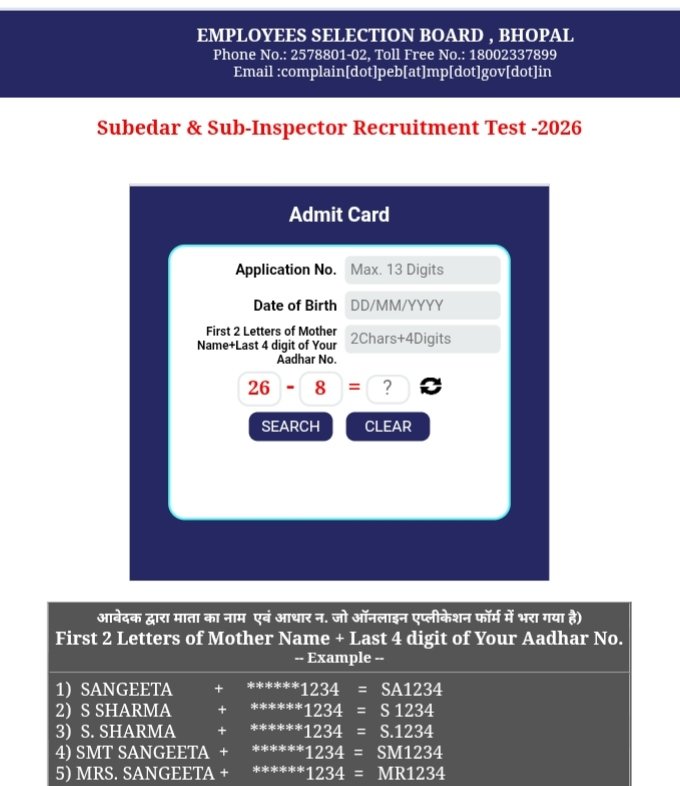
Candidates can access their MP Police SI hall ticket through the official MPESB website by entering the required login credentials such as application number, date of birth and first 2 letters of mother’s name and last 4 digit of aadhar number.

Download Link: MP Police SI Admit Card 2026 Download Link

How to Download MP Police SI Admit Card 2026

Follow these steps to download the admit card from the official portal:

  1. Visit the official website at esb.mp.gov.in.
  2. Open the Test Admit Card section.
  3. Find the link for the Subedar and Sub-Inspector Recruitment Test 2026.
  4. Click the relevant download link.
  5. Enter the login details requested on the official portal.
  6. Submit the information to access your admit card.
  7. Download the hall ticket and take a clear printout.
  8. Check all details printed on the admit card before the examination.

Keep your registration or application details available. Use only the information requested by the official portal.

MP Police SI Admit Card 2026 download

Details to Check on the MP Police SI Hall Ticket 2026

After downloading the MP Police SI Hall Ticket 2026, candidates must carefully verify the following information:

  • Candidate’s name and photograph
  • Roll number or registration details
  • Examination name
  • Examination date and shift
  • Reporting time
  • Examination centre name and address
  • Candidate instructions
  • Any other details printed on the hall ticket

If you find an incorrect detail, contact MPESB through its official contact or grievance facility as soon as possible. Do not wait until the examination day to report a discrepancy.

Documents to Carry to the MP Police SI Exam Centre

Candidates should follow the instructions printed on their admit cards and the official examination notice. Generally, candidates should prepare the following items:

  • A printed copy of the MP Police SI admit card
  • A valid photo identity document accepted under the examination instructions
  • Any additional photograph or document specifically required by MPESB

Check the permitted identity documents and any restrictions on personal belongings in the official instructions. Do not assume that a digital copy of the admit card will be accepted in place of a printed copy.

Important Instructions for Candidates

With the examination scheduled from 30 October to 5 November 2026, candidates should complete their exam-day preparations in advance.

  • Download and print the admit card as soon as it becomes available.
  • Confirm the examination centre address and plan your journey beforehand.
  • Check the reporting time and entry requirements mentioned on the hall ticket.
  • Carry the required identification documents.
  • Follow the instructions regarding electronic devices, bags and other restricted items.
  • Read the examination guidelines before arriving at the centre.
  • Reach the venue according to the reporting time specified on the admit card.

The reporting time and permitted items mentioned in the official instructions should take priority over general advice.

What If the MP Police SI Admit Card Link Is Not Available?

If you cannot find the MP Police SI Admit Card 2026 link, first confirm that you are visiting the official MPESB website. The admit card has been issued on 24 October 2026.

Try the following:

  1. Revisit the official Test Admit Card section.
  2. Check the latest MPESB notices and recruitment updates.
  3. Make sure you have selected the correct examination name and recruitment year.
  4. If the link is active but you cannot log in, verify your application details and follow the portal’s instructions.
  5. Contact MPESB through its official support channels if the problem continues.

Avoid sharing your registration details, passwords or other personal information with unauthorised websites or individuals.

Also, Check:

MP Police SI Admit Card 2026 - FAQs

When will the MP Police SI Admit Card 2026 be released?

The MP Police SI Admit Card 2026 has been officially released on 24 October.

What is the MP Police SI Exam Date 2026?

The Subedar and Sub-Inspector Recruitment Test 2026 is scheduled from 30 October to 5 November 2026. Candidates must check their individual admit cards for their allotted examination date and shift.

Where can I download the MP Police SI Hall Ticket 2026?

Candidates should visit the official MPESB website at esb.mp.gov.in and open the Test Admit Card section when the download link becomes available.

What should I do if there is an error on my admit card?

Contact MPESB through its official support or grievance facility as soon as possible. Follow the board's instructions for correcting discrepancies before the examination.

Can I enter the examination centre without a printed admit card?

Candidates should follow the entry instructions provided by MPESB. Carry a printed copy of the admit card unless the board explicitly announces an alternative arrangement.

MPRDC Management Assistant Recruitment 2026 Notification Out: Apply Online

Madhya Pradesh Road Development Corporation Limited (MPRDC) has announced recruitment for a contract-based Management Assistant position. According to the official notification, online applications opened on 16 October 2026, and the last date to apply is 15 November 2026. Candidates should check the official recruitment rulebook for the complete eligibility criteria, salary, selection process and service conditions before submitting an application.

Also, Check: MP Police SI Admit Card 2026

MPRDC Management Assistant Recruitment 2026: Overview

MPRDC is recruiting for the Management Assistant post through the MPOnline iForms portal. The position is listed as a contractual appointment, not a regular permanent government post.

Particular Details
Recruiting organisation Madhya Pradesh Road Development Corporation Limited (MPRDC)
Post name Management Assistant
Vacancy One
Recruitment type Contract basis
Application mode Online
Application start date 16 October 2026
Last date to apply 15 November 2026
Last date for fee payment 15 November 2026
Official recruitment portal MPOnline iForms
Recruitment Exam ID 285

MPRDC Management Assistant Notification 2026

Madhya Pradesh Road Development Corporation Limited has released an official notification for Management Assistant (Contract) role for one position. Candidates must download and read the notification carefully to understand all essential details like key dates, eligibility requirements, application process, salary and selection procedure.

MPRDC Management Assistant Notification 2026 PDF

MPRDC Management Assistant Recruitment 2026: Important Dates

Candidates should keep track of the application schedule and any further updates issued by MPRDC or MPOnline.

Event Date
Online application begins 16 October 2026
Last date to submit the application 15 November 2026
Fee payment deadline Reported as 15 November 2026; verify in the portal
Interview or selection schedule Check the official rulebook and subsequent notices

Candidates are advised to complete the application well before the deadline to avoid last-minute technical problems.

MPRDC Management Assistant Vacancy 2026

MPRDC has released a recruitment notification for the Management Assistant (Contract) post under Exam ID 285 on the MPOnline portal.

A total one post is available in the unreserved (UR) category.  The vacancy is for a contractual position. Applicants should read the appointment terms carefully rather than assuming that the position offers permanent government employment.

MPRDC Management Assistant Eligibility Criteria 2026

Candidates must meet the educational, age and work-experience requirements stated in the official recruitment rulebook.

Educational Qualification

A candidate must meet the following educational requirements:

  • A graduation degree in any discipline.
  • An MBA in Human Resources (HR) from a recognised university.
  • A one-year computer diploma from a recognised institution.

These details require confirmation against the original rulebook. Candidates should not assume that a general graduation degree alone is sufficient.

Work Experience

Applicants must have at least 10 years of relevant Human Resources experience.

The experience areas include office administration, establishment work, personnel management, recruitment and file processing. It also describes experience at the Manager level or above in government, semi-government, public-sector or limited-company organisations.

Applicants should verify the exact eligible organisations, required designation, experience calculation and documentary proof specified in the official rulebook.

Age Limit

The age limit of applicants should be as follows as of 1 July 2026:

Category Age limit
Minimum age 35 years
Maximum age 55 years
Age calculation date 1 July 2026

The applicable age-relaxation rules, if any, must be checked in the original recruitment document. Candidates should not assume that general age-relaxation provisions apply automatically to this contractual post.

MPRDC Management Assistant Salary 2026

Selected applicants will get a consolidated monthly remuneration of ₹56,100 plus CPI for the Management Assistant position.

CPI stands for Consumer Price Index. Since the appointment is contractual, candidates should read the terms concerning remuneration, contract duration, renewal and termination before accepting the position.

MPRDC Management Assistant Selection Process 2026

According to the official notification, the selection process is based on qualification, professional experience, an interview and document verification.

Selection stage Marks
Professional qualification 30
Professional experience 50
Personal interview 20
Total 100

Candidates must score at least 60 out of 80 marks in the qualification and experience assessment to be shortlisted for an interview. It also mentions shortlisting up to six times the number of vacancies.

How to Apply for MPRDC Management Assistant Recruitment 2026

Candidates can use the official MPOnline iForms portal to locate the recruitment entry and access the application form. The online form will be accepted until November 15, 2026.

MPRDC Management Assistant Apply Online Link

Follow these steps:

  1. Open the official MPOnline iForms recruitment portal.
  2. Locate Recruitment for Management Assistant (Contract) under Exam ID 285.
  3. Open the recruitment rulebook and read the eligibility conditions carefully.
  4. Check whether your educational qualifications, age and work experience meet the stated requirements.
  5. Open the application form through the portal.
  6. Enter your personal details, contact information, educational qualifications and work experience accurately.
  7. Upload the required documents in the prescribed format, if requested by the portal.
  8. Pay the applicable application fee using an available payment method.
  9. Review the completed form before submitting it.
  10. Save or print the submitted application and payment receipt for future reference.

Use only the official recruitment portal to access the application form. Do not rely on unverified third-party download links or agents claiming to guarantee selection.

Documents to Check Before Applying

The exact document requirements must be confirmed from the rulebook and online form. Depending on the prescribed requirements, candidates may need to prepare:

  • Graduation certificate and marksheets.
  • MBA or other prescribed postgraduate qualification documents.
  • Computer diploma certificate.
  • Work-experience certificates showing the employer, designation and duration of service.
  • Date-of-birth proof.
  • Photograph and signature, if requested.
  • Category or domicile certificates, where applicable under the recruitment rules.
  • Any additional declarations or documents required by MPRDC.

Prepare clear, legible copies and ensure that the information matches the details entered in the application form.

Important Instructions for Candidates

Before submitting the MPRDC Management Assistant application, keep these points in mind:

  • Read the official rulebook from beginning to end.
  • Verify the vacancy count, educational qualifications, experience and age criteria.
  • Check the exact application fee and payment deadline on MPOnline.
  • Ensure that your experience certificates support the work history claimed in the form.
  • Check the contractual appointment terms, including remuneration and tenure.
  • Save the application confirmation and payment receipt.
  • Monitor the official portal for changes, shortlisting information and interview notices.
  • Do not treat dates reported by third-party websites as confirmed unless the official authority has announced them.

Also, Check:

MPRDC Management Assistant Recruitment 2026 - FAQs

What is the last date for MPRDC Management Assistant Recruitment 2026?

The last date to apply online is 15 November 2026, according to the official MPOnline recruitment portal.

How can I apply for MPRDC Management Assistant Recruitment 2026?

Visit the official MPOnline iForms portal, locate Management Assistant (Contract) under Exam ID 285, read the rulebook and complete the application form according to the instructions.

How many vacancies are available for MPRDC Management Assistant Recruitment 2026?

As per the official notification, one vacancy is available for Management Assistant (Contract) role in the unreserved category. 

What is the educational qualification for the MPRDC Management Assistant post?

Candidates must completed graduation in any discipline, with MBA in Human Resources and a one-year computer diploma with minimum 10 years of working experience in HR.

What is the salary for MPRDC Management Assistant Recruitment 2026?

Selected candidates will receive a monthly remuneration of ₹56,100 plus CPI. 

MPESB Group 6 Sub Group 1 Recruitment 2026-27: Notification, Vacancy, Exam Date

MPESB Group 6 Sub Group 1 Recruitment 2026-27

The MPESB Group 6 Sub Group 1 Recruitment 2026-27 is an expected recruitment opportunity for candidates seeking government jobs in Madhya Pradesh. According to the revised MPESB calendar 2026, approximately 700 vacancies are expected under this recruitment. However, the exact number of posts, post-wise vacancies, eligibility criteria, application dates and exam schedule will be confirmed only after the official notification is released.

Candidates preparing for MP Vyapam Group 6 Sub Group 1 Bharti 2026-27 should follow the latest updates on the official website and Freejobs247 to check recruitment details, eligibility requirements, the application process and other important information.

Also Check: MP Govt Jobs 2027: 1 Lakh Vacancies

MPESB Group 6 Sub Group 1 Recruitment 2026-27: Overview

Particulars Details
Recruitment Name MPESB Group 6 Sub Group 1 Recruitment 2026-27
Conducting Authority Madhya Pradesh Employees Selection Board (MPESB)
Reported Vacancies Approximately 700 (tentative)
Examination Schedule December 2026 (tentative)
Notification Status Detailed notification not confirmed
Application Start Date Not confirmed
Last Date to Apply Not confirmed
Eligibility Awaiting the official rulebook
Exam Pattern and Syllabus To be confirmed
Official Website MPESB official portal

MPESB Group 6 Sub Group 1 Recruitment 2026-27 Notification

The MPESB Group 6 Sub Group 1 recruitment examination is included in the revised exam calendar issued by the board. The detailed recruitment notification will confirm the final vacancies, post names, qualifications, age limits, application dates and selection procedure.

Candidates should check the official notification for the following information:

  • Total and category-wise vacancies.
  • Post names and department details.
  • Educational qualifications and age limits.
  • Online application and correction dates.
  • Application fee and payment instructions.
  • Examination pattern and syllabus.
  • Selection process and document verification requirements.

Until the detailed advertisement is available, candidates should treat these recruitment conditions as unconfirmed.

MP Group 6 Recruitment 2026-27 Vacancy Details

Approximately 700 vacancies will be announced for the MPESB Group 6 Sub Group 1 Recruitment 2026-27 examination. The final number of posts and their distribution must be verified through the official vacancy notification.

The detailed advertisement is expected to specify the available posts, departments and category-wise vacancy distribution, where applicable.

Which Posts Are Included in Group 6 Sub Group 1?

The actual posts covered by the 2026–27 recruitment will depend on the official advertisement. Candidates should not assume that posts mentioned in previous recruitment cycles will automatically be included in the upcoming examination.

Check the post-wise vacancy list and the corresponding educational qualifications before choosing a post or preparing an application.

MP Vyapam Group 6 Sub Group 1 Bharti 2026-27: Important Dates

Event Date / Status
Notification Release November 2026 (expected)
Online Application Start November 2026 (expected)
Last Date to Apply November 2026 (expected)
Application Correction Window November 2026 (expected)
Exam Month December 2026 (tentative)
Admit Card Release December 2026 (tentative)

Candidates should rely on the official MPESB notice for confirmed dates. The tentative examination month does not mean that the application process has started.

MPESB Group 6 Sub Group 1 Eligibility Criteria 2026-27

The eligibility criteria will be determined by the posts included in the official recruitment notification. Until the detailed rulebook is available, the final educational qualifications, age limits and applicable relaxations cannot be confirmed.

Educational Qualification

The minimum qualification may vary according to the post. Depending on the advertised position, requirements could include a relevant school qualification, ITI certificate, diploma or degree. These are possible qualification categories, not confirmed requirements for this recruitment.

Candidates should verify:

  • Minimum educational qualification.
  • Relevant trade, subject or technical specialisation.
  • Required experience or professional registration, if applicable.
  • Qualification completion cut-off date.
  • Any additional post-specific eligibility conditions.

Age Limit

The minimum and maximum age limits will be specified in the official recruitment rules. Candidates should also check the applicable category-wise age relaxations and the date used to calculate age eligibility.

Do not use age limits from an older examination as a substitute for the new notification.

MPESB Group 6 Sub Group 1 Application Form 2026-27

The online application dates and confirmed application link have not been established in the recruitment information available for this article.

Once the application window opens, candidates should follow the instructions on the designated MPESB application portal. The general process may involve:

  1. Opening the designated application portal.
  2. Completing registration, if required.
  3. Entering personal and educational details.
  4. Uploading the required photograph, signature and documents.
  5. Paying the prescribed application fee, if applicable.
  6. Reviewing the information before final submission.
  7. Saving the submitted application and payment confirmation.

These are general application steps, not confirmation that applications are currently being accepted.

MPESB Group 6 Sub Group 1 Exam Pattern and Syllabus 2026-27

The official examination pattern and syllabus should be checked in the 2026–27 recruitment rulebook.

Candidates should look for the following details before finalising their preparation strategy:

  • Total questions and maximum marks.
  • Examination duration.
  • Subject-wise distribution of questions.
  • Technical or trade-specific subjects.
  • General knowledge and other common subjects, where prescribed.
  • Negative marking and qualifying criteria, if applicable.

The subjects and marking scheme should not be assumed from another recruitment examination. Once MPESB publishes the detailed syllabus, candidates can prepare according to the prescribed subjects and their respective weightage.

MPESB Group 6 Sub Group 1 Selection Process 2026-27

The final selection process will depend on the official recruitment rules and the requirements of the advertised posts.

Candidates should check whether selection involves a written examination, skill or trade test, document verification, or any other prescribed stage. Requirements may differ across posts, so the final notification should be treated as the authoritative source.

FAQs: MPESB Group 6 Sub Group 1 Recruitment 2026-27

1. What is MPESB Group 6 Sub Group 1 Recruitment 2026-27?

It is an upcoming Madhya Pradesh Employees Selection Board recruitment examination. The final post details, eligibility and application conditions must be checked in the official notification.

2. How many vacancies are expected in MPESB Group 6 Sub Group 1 Recruitment 2026-27?

Approximately 700 vacancies have been reported in connection with the examination calendar. The final vacancy count and post-wise distribution require official confirmation.

3. What is the MPESB Group 6 Sub Group 1 exam date 2026-27?

The examination has been reported as tentatively scheduled for December 2026. Candidates should check the official examination notice for the confirmed date.

4. Has the MP Vyapam Group 6 Sub Group 1 notification been released?

The detailed notification could not be confirmed in the official listings checked for this article. Candidates should monitor the MPESB website for the recruitment advertisement and rulebook.

5. What is the eligibility for MP Group 6 Recruitment 2026-27?

Educational qualifications and age limits will depend on the advertised posts. Candidates should verify the post-wise eligibility conditions in the official notification before applying.

6. How can I apply for MPESB Group 6 Sub Group 1 Recruitment 2026-27?

Candidates should apply through the designated application portal once the official application window opens. The application start date and last date have not been confirmed.

7. What is the syllabus for MPESB Group 6 Sub Group 1 Recruitment 2026-27?

The final syllabus must be checked in the official rulebook. Candidates should verify the prescribed subjects, technical topics, examination duration and marking scheme before preparing a final study plan.

8. Where can I find the latest MPESB Group 6 Sub Group 1 updates?

Visit the official MPESB website and check its recruitment examination and rulebook sections for the latest notifications, application dates and examination updates.

MP ADPO Last Minute Revision 2026: Important Topics & Tips

MP ADPO Last-Minute Revision 2026

With the MP ADPO Exam 2026 scheduled for 1 November 2026, candidates should now focus on revising important legal provisions, strengthening Madhya Pradesh General Knowledge, and practising objective questions rather than starting new books.

The Assistant District Public Prosecution Officer examination covers Law and General Studies, so a balanced strategy is essential. This MP ADPO last-minute revision guide highlights the topics to prioritise, a short revision timetable, and exam-day tips to help candidates use their remaining preparation time effectively.

Check: MPPSC ADPO Admit Card 2026 Out: Download Link Active

MP ADPO Exam 2026: Important Details

Particulars Details
Exam Name MP ADPO Examination 2026
Conducting Authority Madhya Pradesh Public Service Commission (MPPSC)
Post Assistant District Public Prosecution Officer
Exam Date 1 November 2026
Exam Timing 12:00 PM to 3:00 PM
Exam Mode OMR-based offline examination
Written Exam Marks 450
Total Questions 150 MCQs

Candidates should follow the revised examination schedule and instructions mentioned on their admit cards.

MP ADPO Last Minute Revision: Which Topics Should You Focus on Most?

The published exam pattern allocates 300 marks to Law and 150 marks to General Studies. Therefore, candidates should devote more revision time to legal subjects while reserving daily time for MP GK and current affairs.

The following priorities are based on syllabus coverage and subject weightage, not guaranteed question predictions.

1. Criminal Laws: BNS, BNSS and BSA

The three new criminal laws deserve particular attention because they form an important part of the criminal-law syllabus.

Focus on:

  • Bharatiya Nyaya Sanhita (BNS): general principles of criminal liability, offences against the human body, property offences, general exceptions, abetment, attempt and common liability concepts.
  • Bharatiya Nagarik Suraksha Sanhita (BNSS): arrest, investigation, bail, cognizance, trial procedures, prosecution-related provisions and appeals.
  • Bharatiya Sakshya Adhiniyam (BSA): relevancy of facts, admissions, confessions, burden of proof, presumptions, documentary evidence and electronic records.

Revise the relevant statutory provisions, definitions, exceptions and distinctions between similar concepts. Avoid relying entirely on summaries when the wording of a provision matters.

2. Constitution of India

Constitutional provisions are important for understanding criminal law and the powers of public authorities.

Prioritise:

  • Fundamental Rights and constitutional remedies.
  • Article 14, Article 19 and Article 21.
  • Constitutional provisions relating to arrest and criminal justice.
  • Powers and jurisdiction of constitutional courts.
  • Union and State executive structures.
  • Constitutional bodies and their functions.

Pay attention to the exact scope of frequently revised Articles rather than memorising article numbers without understanding their meaning.

3. Madhya Pradesh Special Laws

Do not overlook state-specific legislation while revising central criminal laws. Review the Acts included in the official syllabus, particularly their objectives, definitions, enforcement provisions and penalties.

Important areas include:

  • Madhya Pradesh Excise Act.
  • Madhya Pradesh Rajya Suraksha Adhiniyam.
  • Madhya Pradesh Lok Seva Guarantee Adhiniyam.
  • Madhya Pradesh Govansh Vadh Pratishedh Adhiniyam.
  • Madhya Pradesh Vishesh Nyayalaya Adhiniyam.

Use your existing notes and the applicable statutory text to revise key provisions. Do not spend the final days trying to memorise every section of every Act from scratch.

4. Women and Child Protection Laws

Revise the purpose, important definitions, authorities, offences and major provisions of the following laws:

  • Protection of Children from Sexual Offences (POCSO) Act.
  • Juvenile Justice (Care and Protection of Children) Act.
  • Protection of Women from Domestic Violence Act.
  • Dowry Prohibition Act.
  • Sexual Harassment of Women at Workplace Act.

Give particular attention to age-related provisions, the responsibilities of relevant authorities, and the distinction between offences and procedural safeguards.

5. Other Important Special and Criminal Laws

Prepare short revision notes for the remaining Acts listed in the official syllabus. These include:

  • Prevention of Corruption Act.
  • Scheduled Castes and Scheduled Tribes (Prevention of Atrocities) Act.
  • Narcotic Drugs and Psychotropic Substances Act.
  • Arms Act.
  • Information Technology Act.
  • Right to Information Act.
  • Probation of Offenders Act.
  • Essential Commodities Act.
  • Wildlife (Protection) Act.
  • Prevention of Damage to Public Property Act.

Also revise the other prescribed Acts in your official syllabus. For each law, remember its purpose, important definitions, key authorities, major offences and significant penalties where relevant.

MP ADPO GK Revision: Important Madhya Pradesh Topics

General Studies carries 150 marks, so candidates should not leave MP GK until the final day. Prioritise the topics below and use concise notes or MCQs to test recall.

Subject Topics to Revise
MP History Important dynasties, historical places, freedom movement and tribal contributions
MP Geography Rivers, dams, national parks, climate, minerals and natural resources
MP Polity State government, constitutional bodies, local self-government and administration
MP Economy Agriculture, industries, development initiatives and major economic indicators
Tribes and Culture Major tribes, festivals, folk arts, literature and cultural heritage
Current Affairs Major Madhya Pradesh and national events, government schemes, appointments, awards and important developments

For current affairs, revise your existing monthly notes and recent important developments. Avoid trying to cover an entire year’s news in the final few days.

MP ADPO Last Minute Revision Timetable

With the examination approaching, use the remaining days for targeted revision rather than an unrealistic full-syllabus restart.

Revision Day Main Focus
Day 1 BNS and core criminal-law concepts
Day 2 BNSS: investigation, arrest, bail and trial procedures
Day 3 BSA and Constitution of India
Day 4 Madhya Pradesh special laws
Day 5 Women and child protection laws
Day 6 Other prescribed Acts and weak legal topics
Day 7 MP GK, state current affairs and important national events
Day 8 Full-length mock test, error analysis and short notes
Day 9 / Exam Eve Key provisions, factual revision, documents and travel planning

Adjust this schedule according to your preparation level. If you are already strong in a subject, spend more time correcting weaknesses instead of repeating familiar material.

How to Prepare for MPPSC ADPO in the Last Few Days

Revise Bare Acts Instead of Starting New Books

Read the statutory text and your short notes together. Focus on definitions, exceptions, conditions, penalties and procedural distinctions. Where the syllabus covers the new criminal laws, avoid confusing their provisions with corresponding provisions of the repealed laws.

Practise MCQs and Previous-Year Questions

Solve objective questions from the relevant syllabus and analyse every incorrect answer. Maintain a short error list covering legal provisions, confusing definitions and factual GK mistakes.

Take a Full-Length Mock Test

Attempt a mock test under the prescribed three-hour time limit. Practise both sections and check whether you are spending too much time on difficult questions.

Avoid Unverified Predictions

“Most expected questions” lists can help with practice, but they cannot guarantee what MPPSC will ask. Use the official syllabus as your checklist and do not ignore an entire subject based on predictions.

MP ADPO Exam Day Tips for 1 November 2026

The examination is scheduled from 12:00 PM to 3:00 PM. Keep the following points in mind:

  • Download and print your MP ADPO admit card in advance.
  • Check the examination centre address and reporting instructions on the hall ticket.
  • Carry the identity proof and any other documents specified by MPPSC.
  • Follow the instructions for filling the OMR answer sheet.
  • Read each question carefully before marking an answer.
  • Keep track of time and avoid spending too long on one difficult question.
  • Follow the official rules concerning incorrect answers and unanswered questions.

Revise lightly on the morning of the examination instead of trying to learn unfamiliar topics at the last moment.

FAQs: MP ADPO Last Minute Revision 2026

1. Which subjects should I prioritise for MP ADPO 2026?

Prioritise Law because it accounts for 300 of the 450 written-examination marks under the published pattern. Focus on criminal laws, the Constitution, Madhya Pradesh special laws and other prescribed Acts. Continue revising MP GK and current affairs daily.

2. Which law topics are important for the MP ADPO exam?

Focus on BNS, BNSS, BSA, constitutional provisions, Madhya Pradesh special laws, women and child protection laws, and other Acts listed in the official syllabus. Revise important provisions and distinctions rather than relying only on predicted questions.

3. How should I revise MP GK before the MP ADPO exam?

Concentrate on Madhya Pradesh history, geography, polity, economy, tribes, culture and current affairs. Use short notes and MCQs to identify factual gaps.

4. Should I start new books during the last week of MP ADPO preparation?

Generally, avoid starting multiple new books. Revise your existing notes, consult the relevant statutory provisions when necessary, and spend time practising questions and correcting mistakes.

5. What is the MP ADPO Exam Date 2026?

The MP ADPO examination is scheduled for 1 November 2026, from 12:00 PM to 3:00 PM, according to the revised examination schedule.

6. How many hours should I study daily for MP ADPO last-minute revision?

There is no fixed number of hours that works for every candidate. Set realistic study blocks around your current preparation level, prioritise weak topics, take breaks and maintain enough sleep to retain information.

7. What should I do one day before the MP ADPO exam?

Revise short notes and important statutory provisions, review your mock-test errors, arrange the admit card and required documents, confirm travel plans, and get adequate sleep. Avoid attempting to learn the entire syllabus overnight.

How to Choose the Best ITI College in India: 7 Important Tips

Choosing the right ITI college is an important step towards building a career in a technical or vocational field. However, the best ITI college in India is not necessarily the most famous or expensive one.

Students should compare institute affiliation, their preferred trade, workshop facilities, instructor quality, placement opportunities and total course fees before taking admission. This guide explains how to choose the best ITI college in India after Class 10 and what to check before making a final decision.

How to Choose the Best ITI College in India?

To choose the right ITI college, first select a trade that matches your career goals, then verify the institute’s affiliation and compare its practical training facilities, faculty, placement record, fees and location. Do not make your decision based only on advertisements or placement promises.

1. Check ITI College Affiliation and Recognition

Before applying, verify whether the ITI and your chosen trade or unit have the required affiliation and approval for the relevant training session. Recognition and affiliation matter because they determine whether the institute is authorised to offer the particular training and certification.

Check the following details:

  • Whether the institute appears in the official ITI records.
  • Whether your selected trade is affiliated for the relevant session.
  • The institute’s current status and available units.
  • Whether the course follows the applicable NCVT/NCVET framework or the relevant state-level vocational training system.
  • Whether the institute has any recent affiliation or de-affiliation updates.

Do not assume that every trade offered by an institute is automatically approved. Verify the specific course before paying admission fees.

Check: ITI NCVT vs SCVT

2. Choose the Right ITI Trade for Your Career

The right trade is just as important as the college itself. Before comparing institutes, consider which occupation you want to pursue and whether the course provides the skills required for that work.

Some popular ITI trades include:

ITI Trade Related Career Areas
Electrician Electrical maintenance, installation and industrial work
Fitter Manufacturing, machinery and mechanical maintenance
Welder Fabrication, welding and industrial production
Mechanic Diesel Diesel engines, vehicle maintenance and repair
COPA Computer operations, office applications and basic IT support
Electronics Mechanic Electronic equipment servicing and maintenance
Refrigeration and Air Conditioning Technician Cooling systems, HVAC installation and maintenance

Course availability, duration and eligibility depend on the specific trade and applicable training rules.

Tip: Compare the syllabus, practical work and employment requirements of your preferred trade before choosing an ITI. A well-equipped institute offering the right trade may be a better choice than a more popular college offering a course that does not match your goals.

3. Compare Government and Private ITI Colleges

Both government and private ITIs can be suitable choices. The right option depends on training quality, affiliation, facilities, fees and career support.

Factor Government ITI Private ITI
Course fees Often lower Vary by institute and trade
Infrastructure Varies by institute Varies by institute
Practical training Check workshop quality and equipment Check workshop quality and equipment
Placement support Depends on industry connections and institute performance Depends on industry connections and institute performance
Admission Usually follows the applicable state or central admission process Follows the applicable admission process and rules

Government ITIs are often attractive because of their affordability, but government status alone does not guarantee better training or placements. Similarly, a private ITI should not be rejected simply because it charges higher fees.

Compare individual institutes using the same criteria before deciding.

4. Check Workshop Facilities and Practical Training

ITI education is skill-based, so practical training should be a major factor in your decision. A college may have classrooms and equipment listed in its brochure, but the actual condition of its workshops matters more.

Before admission, check:

  • Whether the workshop has the tools and machines required for your trade.
  • Whether the equipment is functional and regularly used for training.
  • Whether students receive sufficient hands-on practice.
  • Whether electrical, mechanical and workshop safety measures are followed.
  • Whether computer labs and other specialised facilities are available where required.

If possible, visit the campus and speak with current students. Ask how often they attend practical sessions and whether instructors provide individual guidance.

5. Check Faculty and Instructor Quality

Qualified and experienced instructors help students understand technical concepts and develop practical skills. Before selecting an ITI, find out whether the institute has sufficient instructors for the trades it offers.

Consider these questions:

  • Are instructors available for your chosen trade?
  • Do they explain practical tasks clearly?
  • Are workshop sessions conducted regularly?
  • Do students receive guidance for trade tests and assessments?
  • Does the institute provide additional support when students struggle with technical concepts?

An institute with suitable equipment but insufficient practical instruction may not provide the training experience you expect.

6. Compare Placement Records and Apprenticeship Opportunities

Placement support is an important consideration when choosing the best ITI college for a job-oriented course. However, do not rely only on claims such as “100% placement” or “guaranteed job.”

Ask the institute for verifiable information about recent student outcomes, including:

  • The number of students who completed the course.
  • The number of students placed and the type of jobs offered.
  • The names of recruiting companies, where disclosure is permitted.
  • The roles, locations and salary ranges offered to graduates.
  • Opportunities for apprenticeships and industry-based training.

An apprenticeship can help students gain workplace experience after or as part of the relevant training pathway, depending on the programme. Check whether the institute has genuine employer connections and whether students have actually benefited from them.

Remember that placement outcomes vary by trade, employer demand, individual performance and location. No institute can guarantee a particular job or salary for every student.

7. Compare ITI College Fees and Other Expenses

Course fees should fit your budget, but choosing the cheapest ITI without checking training quality can be a mistake.

Before admission, ask for the complete fee structure, including:

  • Tuition and admission fees.
  • Examination and registration charges, where applicable.
  • Workshop, uniform and equipment costs.
  • Hostel, transport and other living expenses.
  • Any additional charges during the course.

Compare the total cost of completing the course rather than looking only at the advertised tuition fee. Also, check whether eligible students can access scholarships, fee concessions or other financial assistance under applicable schemes.

8. Consider Location, Hostel and Safety Facilities

A college’s location can affect attendance, daily expenses and access to practical training. Students should consider whether commuting is manageable and whether suitable accommodation is available.

Check the following before taking admission:

  • Distance from home and public transport availability.
  • Hostel facilities and accommodation costs, if needed.
  • Campus security and basic student facilities.
  • Separate or suitable accommodation arrangements for female students, where relevant.
  • Availability of nearby industries for training or apprenticeship opportunities.

Choosing an ITI that is accessible and provides a supportive learning environment can make it easier to complete the course successfully.

9. Check the ITI Grading and Student Feedback

Where available, review the institute’s official grading information and recent student feedback. The Directorate General of Training (DGT) publishes ITI grading information based on defined performance indicators.

Grading can help you compare institutes, but it should not be the only deciding factor. Also consider trade-specific facilities, instructor availability, practical training and local employment opportunities.

Speak with current students or alumni to understand whether classes are conducted regularly, equipment is usable and the institute provides genuine placement or apprenticeship support.

Checklist Before Taking Admission in an ITI College

Use this checklist to compare your shortlisted colleges:

  • The institute and selected trade have the required affiliation.

  • The course matches my career goals.

  • Workshops and practical equipment are suitable.

  • Qualified instructors are available.

  • Placement and apprenticeship claims can be verified.

  • The complete fee structure is clear.

  • Travel, hostel and accommodation arrangements are suitable.

  • Official grading and student feedback have been reviewed.

Shortlist two or three institutes and compare them side by side before paying any admission fee.

Check: Career Options After ITI

Choosing the best ITI college in India requires more than comparing names or advertisements. Students should verify affiliation, select the right trade, inspect workshop facilities, evaluate instructors, review placement outcomes and calculate the complete course cost.

A college that provides recognised training, regular practical sessions and relevant industry exposure can help you develop useful skills for employment or further training. Make your final decision based on verified information and your career goals rather than placement promises alone.

How to Choose the Best ITI College in India: FAQs

1. How do I choose the best ITI college in India?

Check the institute’s affiliation, preferred trade, practical training facilities, instructor quality, placement record, fees and student feedback. Compare several institutes before taking admission.

2. Is a government ITI better than a private ITI?

Not always. Government ITIs often have lower fees, while training quality and facilities vary across both government and private institutes. Compare individual colleges before deciding.

3. How can I check whether an ITI college is recognised?

Search the official ITI records and verify the institute’s current status, selected trade and relevant affiliation details. Do not assume every course offered by an institute is approved.

4. Which ITI trade is best for getting a job?

There is no single best trade for everyone. Electrician, Fitter, Welder, COPA, Electronics Mechanic and other trades can lead to different career paths. Choose according to your interests, aptitude and employment opportunities.

5. What should I check before taking admission to a private ITI?

Verify the institute and trade affiliation, inspect workshops, check instructor availability, request a complete fee breakdown and ask for evidence of placement and apprenticeship outcomes.

6. Does an ITI college guarantee placement after course completion?

No. Placement depends on the trade, employer requirements, local job market and the student’s skills. Evaluate actual placement records rather than relying on guaranteed-job claims.

7. Can I join an ITI after Class 10?

Yes. Many ITI trades accept candidates who have completed Class 10, but eligibility requirements vary by trade. Check the applicable admission notification before applying.

8. Does ITI college ranking matter when choosing an institute?

Rankings and grading can help with comparison, but they should not replace checks of affiliation, practical facilities, instructor quality, trade availability and placement outcomes.

How to Prepare for ITI Semester Exams – Study Tips

How to Prepare for ITI Semester Exams

Preparing for ITI semester exams becomes easier when you follow a clear study plan and balance theoretical learning with practical training. Whether you are studying Electrician, Fitter, Welder, COPA, Mechanic Motor Vehicle or another ITI trade, your preparation should focus on the prescribed syllabus, important trade concepts, workshop skills and regular revision.

ITI students appearing for examinations under the Craftsmen Training Scheme (CTS) can use official learning resources available on the Bharat Skills portal, including study material, e-books, question banks, mock tests and trade-related learning content. The Directorate General of Training (DGT) conducts theory examinations for CTS under the All India Trade Test (AITT) in computer-based test (CBT) mode, while practical examinations are conducted by the respective institutes or establishments.

In this guide, you will learn how to prepare for ITI semester exams, make a practical study timetable, revise trade theory, improve workshop performance and avoid common preparation mistakes.

1. Understand Your ITI Syllabus and Exam Pattern

Before starting your preparation, check the syllabus and examination instructions applicable to your trade, course duration and training session. This will help you decide which subjects need more attention.

Most ITI students need to prepare for a combination of the following areas, depending on their trade and applicable curriculum:

  • Trade Theory: Concepts, tools, equipment, working principles, safety rules and technical knowledge related to your trade.
  • Trade Practical: Workshop procedures, practical tasks, tool handling and safe working methods.
  • Engineering Drawing: Relevant drawing concepts, symbols, dimensions and technical diagrams.
  • Workshop Calculation and Science: Applicable mathematical calculations, measurements and basic scientific principles.
  • Employability Skills: Communication, workplace behaviour, digital skills and other topics included in the prescribed syllabus.

Not every course or examination session has an identical subject combination or assessment structure. Refer to your official trade curriculum and the instructions issued by your ITI.

2. Follow a Daily Study Timetable

A realistic timetable is more useful than studying for long hours without a plan. Divide your available study time between theory, practical revision, calculations and mock tests.

Here is an example of a daily study plan you can adjust according to your college timings and preparation level.

Study session Suggested time What to study
Session 1 45 minutes Trade theory and important concepts
Session 2 45 minutes Workshop calculations or engineering drawing
Session 3 60 minutes Practical procedures and workshop records
Session 4 30 minutes Employability Skills or another theory subject
Session 5 30 minutes MCQs, question bank practice and revision

This schedule provides around 3 hours and 30 minutes of study time. If you have less time, start with shorter sessions and gradually increase them.

Preparation tip: Set a specific target for each session, such as revising one topic, solving 20 MCQs or practising one drawing. Track completed topics instead of measuring preparation only by study hours.

3. Prepare Trade Theory with Short Notes

Trade theory is an important part of ITI exam preparation because it tests your understanding of technical concepts related to your occupation.

Use your official syllabus and prescribed learning material to divide the subject into manageable topics. For each topic, prepare short notes covering:

  • Definitions and technical terms.
  • Functions and uses of tools and equipment.
  • Working principles of machines or electrical components, where applicable.
  • Important formulas, units and measurements.
  • Technical diagrams and symbols.
  • Workshop safety precautions.
  • Differences between related tools, processes or components.

For example, Electrician students can revise electrical symbols, circuit fundamentals and safety practices. Fitter students can focus on measuring instruments, fitting tools, machining basics and workshop procedures. COPA students should revise the computer and software topics specified in their curriculum.

Avoid copying entire chapters into your notebook. Write concise notes in your own words so that you can revise them quickly before the examination.

4. Use Official ITI Study Material and Question Banks

One of the most useful ITI semester exam preparation tips is to practise questions alongside studying the syllabus.

The Government of India’s Bharat Skills portal, managed by DGT, provides learning resources for ITI trainees. Depending on the trade and material available, students can access curriculum-related resources, e-books, question banks, e-learning content and mock tests.

Use these resources to strengthen your preparation:

  1. Open the official Bharat Skills website.
  2. Select the Craftsmen Training Scheme (CTS) section.
  3. Choose your trade, such as Electrician, Fitter, Welder or COPA.
  4. Check the available e-books, learning content and question banks.
  5. Practise relevant questions after completing each topic.
  6. Use available mock tests to check your understanding and identify weak areas.

Official resources:

Always check that the material matches your trade, curriculum and examination session. A question bank is a practice resource, not a guarantee that the same questions will appear in your examination.

5. Practise for the ITI CBT Exam

For CTS theory examinations conducted in computer-based test mode, practising on a computer or a suitable mock-test interface can help you become familiar with answering questions digitally.

Follow these steps to improve your CBT preparation:

  • Solve trade-related multiple-choice questions regularly.
  • Read every question and all answer options carefully.
  • Revise concepts behind incorrect answers rather than memorising only the correct option.
  • Practise mixed-topic tests after completing individual chapters.
  • Check your accuracy and the topics in which you repeatedly make mistakes.
  • Follow the actual examination instructions regarding timing, navigation and question review.

Do not rely entirely on memorised answers. Understanding the underlying concepts helps you answer questions even when their wording or options differ from those in your practice material.

6. Give Equal Attention to Practical Exam Preparation

ITI practical exams assess your ability to perform trade-related tasks, so theoretical knowledge alone is not enough.

Attend workshop sessions regularly and practise tasks under your instructor’s supervision. Follow the prescribed procedure instead of trying to complete work quickly without checking safety or accuracy.

During practical preparation, focus on:

  • Identifying tools, equipment and their correct uses.
  • Understanding the sequence of operations for each task.
  • Using measuring instruments correctly.
  • Following workshop safety procedures and wearing required protective equipment.
  • Maintaining accuracy, neatness and proper handling of materials.
  • Completing practical records or job sheets as instructed by your institute.
  • Explaining the purpose of a task and the precautions involved.

Important: Never operate machinery or electrical equipment without proper training and supervision. Follow your institute’s safety instructions during practice.

7. Revise Engineering Drawing and Workshop Calculations

Students whose curriculum includes Engineering Drawing and Workshop Calculation and Science should practise these subjects throughout their preparation rather than leaving them until the final days.

For Engineering Drawing, revise the relevant symbols, drawing conventions, dimensions, views and other prescribed topics. Practise drawing questions on paper and check your work against the instructions or examples provided by your instructor.

For Workshop Calculation and Science, revise formulas, units, conversions and basic principles included in your syllabus. Solve numerical problems step by step and write down the formula before substituting values.

Maintain a separate revision sheet containing important formulas, units and common mistakes. Review it regularly and solve questions without looking at the answers.

8. Follow a 7-Day ITI Exam Revision Plan

If your ITI semester exam is approaching, use the following sample plan to organise your final revision. Adjust the topics according to your remaining syllabus and examination schedule.

Day Preparation target
Day 1 Review the syllabus and identify weak topics
Day 2 Revise major trade theory concepts
Day 3 Practise trade-related MCQs and question banks
Day 4 Revise Engineering Drawing and Workshop Calculation, where applicable
Day 5 Review practical procedures, tools and safety rules
Day 6 Attempt a mock test and analyse incorrect answers
Day 7 Revise short notes, formulas and difficult topics

If you have not completed the syllabus, prioritise the remaining prescribed topics before spending too much time repeating familiar material. Use the final day for revision and preparation rather than starting several large new chapters.

9. Common Mistakes to Avoid During ITI Exam Preparation

Students can lose valuable preparation time by following ineffective study habits. Avoid these common mistakes:

  • Studying without checking the syllabus: You may spend time on material outside your prescribed course.
  • Ignoring practical training: Reading theory cannot replace hands-on practice.
  • Memorising MCQ answers without understanding concepts: This makes unfamiliar questions harder to solve.
  • Leaving revision until the last day: Regular revision helps you identify gaps earlier.
  • Using outdated or unrelated question banks: Always check trade and curriculum relevance.
  • Ignoring workshop safety: Safe procedures are essential during practical training.
  • Skipping mock-test analysis: Reviewing incorrect answers helps you understand where improvement is needed.

A consistent routine, syllabus-based preparation and regular practice are more useful than relying on last-minute shortcuts.

10. What to Do One Day Before the ITI Semester Exam

Use the day before your examination to revise important material and prepare for the exam calmly.

  • Review short notes, formulas, technical terms and diagrams.
  • Revisit questions you answered incorrectly during practice.
  • Check your examination date, reporting time, venue and admit-card instructions.
  • Keep the required documents and permitted stationery ready.
  • Follow the instructions regarding electronic devices and other restricted items.
  • Get adequate sleep instead of staying awake all night.

On examination day, read the instructions carefully and manage your time according to the actual paper format. If you encounter a difficult question, move on when appropriate and return to it if the examination interface and rules permit.

Frequently Asked Questions (FAQs)

1. How can I prepare for ITI semester exams at home?

Start with your prescribed syllabus, study trade theory daily, revise technical notes, practise question banks and review practical procedures taught at your institute. Use official Bharat Skills resources where relevant to your trade.

2. Which website is best for ITI exam preparation?

Bharat Skills is an official learning portal managed by the Directorate General of Training (DGT). It provides ITI-related curriculum resources, e-books, question banks and other learning materials for supported trades.

3. How should I prepare for the ITI CBT exam?

Practise trade-related MCQs, revise the concepts behind each answer and attempt available mock tests. Become familiar with computer-based question navigation and follow the instructions applicable to your examination.

4. Is practical preparation important for ITI semester exams?

Yes. Practical training is an essential part of vocational education. Attend workshop sessions, practise prescribed tasks under supervision and learn correct tool handling, measurement and safety procedures.

5. Can I prepare for ITI exams in seven days?

You can use seven days for focused revision, question practice and identifying weak areas. However, the time required to prepare adequately depends on your trade, syllabus coverage and current level of understanding.

6. Where can I find ITI trade-wise question banks?

Visit the official Bharat Skills CTS portal and look for resources available for your trade. Check the curriculum and version before using a question bank for revision.

Conclusion

The best way to prepare for ITI semester exams is to combine syllabus-based study, regular revision, question bank practice and hands-on workshop training. Start with the topics you find difficult, make short notes and use official resources to strengthen your understanding.

For students appearing in CTS examinations, the Bharat Skills portal and DGT examination updates are useful starting points for finding relevant learning materials and checking official instructions. Follow a realistic timetable, practise consistently and give appropriate attention to both theory and practical skills to prepare more confidently for your ITI examination.