
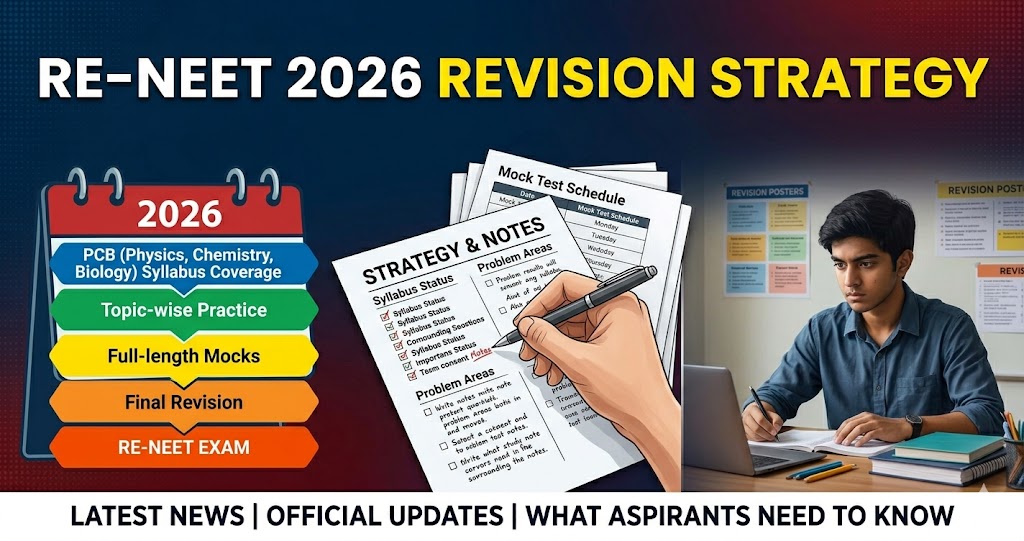
Preparing again for Re-NEET 2026 can feel stressful, confusing, and tiring. Many students are unsure how to restart preparation, what to revise first, and how to use the remaining time effectively.
The good news? You already studied the syllabus once. Now your goal is smart revision, not starting from zero.
This blog gives a complete Re-NEET 2026 revision strategy, covering a daily timetable, subject-wise plan, mock test strategy, and last-month tips.
Latest News – NEET 2026 Cancelled!
Why Revision is the Most Important Step for Re-NEET 2026
NEET is not about learning new topics at the last moment.
It is about recalling quickly, avoiding mistakes, and improving accuracy.
In the final phase, toppers focus on:
- NCERT revision multiple times
- Practising MCQs daily
- Analysing mistakes from mock tests
- Improving speed and accuracy
Your revision should now be exam-oriented, not theory-heavy.
How Many Hours Should You Study Daily for Re-NEET?
Ideal study time during revision phase:
| Student Level | Daily Study Hours |
|---|---|
| Dropper | 8–10 hrs |
| Class 12 Student | 6–8 hrs |
| Weak in concepts | 10 hrs (with breaks) |
Focus more on active revision + questions, not passive reading.
45-Day Re-NEET 2026 Revision Plan
Phase 1 (Day 1–20): Complete Syllabus Revision
Goal → Revise entire syllabus once
Daily pattern:
- Biology → 3 hrs
- Chemistry → 2.5 hrs
- Physics → 2.5 hrs
- MCQs practice → 2 hrs
Focus on weak chapters first.
Phase 2 (Day 21–35): Intensive Practice + Mock Tests
Goal → Improve accuracy & speed
- Alternate day full syllabus mock test
- Analyse mistakes same day
- Revise weak topics next day
Students improve 30–80 marks in this phase.
Phase 3 (Last 10 Days): Final Quick Revision
Goal → Strengthen memory & confidence
Only revise:
- NCERT Biology
- Formula sheets
- Important reactions
- Previous year questions
No new topics.
Subject-Wise Re-NEET 2026 Revision Strategy
Subject-wise Re-NEET 2026 revision strategy helps you revise Biology, Chemistry, and Physics in a balanced, smart, and exam-focused way to maximise marks in limited time.
Biology Revision Strategy (Most Scoring – 50% Paper)
Target → 330+ marks in Biology
How to revise Biology effectively:
- Read NCERT line-by-line
- Highlight important lines
- Revise diagrams daily
- Practise assertion-reason questions
Must-Revise Chapters
Class 11:
- Cell Unit of Life
- Biomolecules
- Human Physiology
- Plant Physiology
Class 12:
- Genetics & Evolution
- Biotechnology
- Ecology
- Human Health & Disease
Golden rule:
👉 Revise NCERT Biology 3–4 times before exam
Chemistry Revision Strategy
Chemistry needs balanced preparation of all 3 parts.
Physical Chemistry
Focus on:
- Formula revision
- Numerical practice
- Short notes
Important chapters:
- Mole Concept
- Thermodynamics
- Equilibrium
- Electrochemistry
Organic Chemistry
Most students lose marks here due to confusion.
Revise in order:
- Reaction mechanisms
- Named reactions
- Conversion questions
Important chapters:
- GOC
- Hydrocarbons
- Haloalkanes
- Alcohol Phenol Ether
- Biomolecules
Tip: Make reaction flowchart sheets.
Inorganic Chemistry
This is pure NCERT based.
Revise:
- Periodic Table trends
- Chemical Bonding
- Coordination Compounds
- p-Block & d-Block
Read NCERT repeatedly.
Physics Revision Strategy (Score Booster Subject)
Students fear Physics, but smart revision can boost 40–60 marks easily.
Physics Revision Formula
Concept → Formula → MCQs → PYQs
Important Chapters
Class 11:
- Laws of Motion
- Work Power Energy
- Thermodynamics
- SHM
Class 12:
- Current Electricity
- Magnetism
- Optics
- Modern Physics
Tip:
Make a one-page formula sheet per chapter.
Revise formulas daily.
Mock Test Strategy for Re-NEET 2026
Mock tests decide your final rank.
How many mock tests to attempt?
- Minimum: 12 full syllabus tests
- Ideal: 15–20 tests
How to analyse mock tests
After every test:
- Write mistakes in notebook
- Identify weak chapters
- Revise those topics next day
Never skip analysis.
Common Mistakes Students Must Avoid
❌ Starting new topics now
❌ Studying without solving MCQs
❌ Ignoring mock test analysis
❌ Not revising NCERT enough
❌ Studying too many books
Stick to limited resources + multiple revisions.
Last 7 Days Strategy for Re-NEET 2026
Final week checklist:
- Revise Biology NCERT twice
- Revise Chemistry reactions & formulas
- Revise Physics formula sheets daily
- Solve 2–3 previous year papers
- Sleep 7 hours daily
Avoid stress and over-study.
Daily Timetable for Re-NEET Aspirants
Sample schedule:
Morning
6:30 – Wake up
7:00–9:00 → Biology revision
9:30–11:30 → Physics concepts + MCQs
Afternoon
12:30–2:30 → Chemistry revision
3:00–5:00 → MCQ practice
Evening
6:00–8:00 → Weak topic revision
9:00–10:00 → Formula + NCERT reading
Final Words for Aspirants
Re-NEET is a second chance, not a setback.
If you revise smartly, practise daily, and analyse mistakes, you can increase your score by 50–150 marks.
Stay consistent.
Stay confident.
Your medical dream is still within reach.