MPESB Group 6 Sub Group 1 Recruitment 2026-27: Notification, Vacancy, Exam Date

MPESB Group 6 Sub Group 1 Recruitment 2026-27

The MPESB Group 6 Sub Group 1 Recruitment 2026-27 is an expected recruitment opportunity for candidates seeking government jobs in Madhya Pradesh. According to the revised MPESB calendar 2026, approximately 700 vacancies are expected under this recruitment. However, the exact number of posts, post-wise vacancies, eligibility criteria, application dates and exam schedule will be confirmed only after the official notification is released.

Candidates preparing for MP Vyapam Group 6 Sub Group 1 Bharti 2026-27 should follow the latest updates on the official website and Freejobs247 to check recruitment details, eligibility requirements, the application process and other important information.

Also Check: MP Govt Jobs 2027: 1 Lakh Vacancies

MPESB Group 6 Sub Group 1 Recruitment 2026-27: Overview

Particulars Details
Recruitment Name MPESB Group 6 Sub Group 1 Recruitment 2026-27
Conducting Authority Madhya Pradesh Employees Selection Board (MPESB)
Reported Vacancies Approximately 700 (tentative)
Examination Schedule December 2026 (tentative)
Notification Status Detailed notification not confirmed
Application Start Date Not confirmed
Last Date to Apply Not confirmed
Eligibility Awaiting the official rulebook
Exam Pattern and Syllabus To be confirmed
Official Website MPESB official portal

MPESB Group 6 Sub Group 1 Recruitment 2026-27 Notification

The MPESB Group 6 Sub Group 1 recruitment examination is included in the revised exam calendar issued by the board. The detailed recruitment notification will confirm the final vacancies, post names, qualifications, age limits, application dates and selection procedure.

Candidates should check the official notification for the following information:

  • Total and category-wise vacancies.
  • Post names and department details.
  • Educational qualifications and age limits.
  • Online application and correction dates.
  • Application fee and payment instructions.
  • Examination pattern and syllabus.
  • Selection process and document verification requirements.

Until the detailed advertisement is available, candidates should treat these recruitment conditions as unconfirmed.

MP Group 6 Recruitment 2026-27 Vacancy Details

Approximately 700 vacancies will be announced for the MPESB Group 6 Sub Group 1 Recruitment 2026-27 examination. The final number of posts and their distribution must be verified through the official vacancy notification.

The detailed advertisement is expected to specify the available posts, departments and category-wise vacancy distribution, where applicable.

Which Posts Are Included in Group 6 Sub Group 1?

The actual posts covered by the 2026–27 recruitment will depend on the official advertisement. Candidates should not assume that posts mentioned in previous recruitment cycles will automatically be included in the upcoming examination.

Check the post-wise vacancy list and the corresponding educational qualifications before choosing a post or preparing an application.

MP Vyapam Group 6 Sub Group 1 Bharti 2026-27: Important Dates

Event Date / Status
Notification Release November 2026 (expected)
Online Application Start November 2026 (expected)
Last Date to Apply November 2026 (expected)
Application Correction Window November 2026 (expected)
Exam Month December 2026 (tentative)
Admit Card Release December 2026 (tentative)

Candidates should rely on the official MPESB notice for confirmed dates. The tentative examination month does not mean that the application process has started.

MPESB Group 6 Sub Group 1 Eligibility Criteria 2026-27

The eligibility criteria will be determined by the posts included in the official recruitment notification. Until the detailed rulebook is available, the final educational qualifications, age limits and applicable relaxations cannot be confirmed.

Educational Qualification

The minimum qualification may vary according to the post. Depending on the advertised position, requirements could include a relevant school qualification, ITI certificate, diploma or degree. These are possible qualification categories, not confirmed requirements for this recruitment.

Candidates should verify:

  • Minimum educational qualification.
  • Relevant trade, subject or technical specialisation.
  • Required experience or professional registration, if applicable.
  • Qualification completion cut-off date.
  • Any additional post-specific eligibility conditions.

Age Limit

The minimum and maximum age limits will be specified in the official recruitment rules. Candidates should also check the applicable category-wise age relaxations and the date used to calculate age eligibility.

Do not use age limits from an older examination as a substitute for the new notification.

MPESB Group 6 Sub Group 1 Application Form 2026-27

The online application dates and confirmed application link have not been established in the recruitment information available for this article.

Once the application window opens, candidates should follow the instructions on the designated MPESB application portal. The general process may involve:

  1. Opening the designated application portal.
  2. Completing registration, if required.
  3. Entering personal and educational details.
  4. Uploading the required photograph, signature and documents.
  5. Paying the prescribed application fee, if applicable.
  6. Reviewing the information before final submission.
  7. Saving the submitted application and payment confirmation.

These are general application steps, not confirmation that applications are currently being accepted.

MPESB Group 6 Sub Group 1 Exam Pattern and Syllabus 2026-27

The official examination pattern and syllabus should be checked in the 2026–27 recruitment rulebook.

Candidates should look for the following details before finalising their preparation strategy:

  • Total questions and maximum marks.
  • Examination duration.
  • Subject-wise distribution of questions.
  • Technical or trade-specific subjects.
  • General knowledge and other common subjects, where prescribed.
  • Negative marking and qualifying criteria, if applicable.

The subjects and marking scheme should not be assumed from another recruitment examination. Once MPESB publishes the detailed syllabus, candidates can prepare according to the prescribed subjects and their respective weightage.

MPESB Group 6 Sub Group 1 Selection Process 2026-27

The final selection process will depend on the official recruitment rules and the requirements of the advertised posts.

Candidates should check whether selection involves a written examination, skill or trade test, document verification, or any other prescribed stage. Requirements may differ across posts, so the final notification should be treated as the authoritative source.

FAQs: MPESB Group 6 Sub Group 1 Recruitment 2026-27

1. What is MPESB Group 6 Sub Group 1 Recruitment 2026-27?

It is an upcoming Madhya Pradesh Employees Selection Board recruitment examination. The final post details, eligibility and application conditions must be checked in the official notification.

2. How many vacancies are expected in MPESB Group 6 Sub Group 1 Recruitment 2026-27?

Approximately 700 vacancies have been reported in connection with the examination calendar. The final vacancy count and post-wise distribution require official confirmation.

3. What is the MPESB Group 6 Sub Group 1 exam date 2026-27?

The examination has been reported as tentatively scheduled for December 2026. Candidates should check the official examination notice for the confirmed date.

4. Has the MP Vyapam Group 6 Sub Group 1 notification been released?

The detailed notification could not be confirmed in the official listings checked for this article. Candidates should monitor the MPESB website for the recruitment advertisement and rulebook.

5. What is the eligibility for MP Group 6 Recruitment 2026-27?

Educational qualifications and age limits will depend on the advertised posts. Candidates should verify the post-wise eligibility conditions in the official notification before applying.

6. How can I apply for MPESB Group 6 Sub Group 1 Recruitment 2026-27?

Candidates should apply through the designated application portal once the official application window opens. The application start date and last date have not been confirmed.

7. What is the syllabus for MPESB Group 6 Sub Group 1 Recruitment 2026-27?

The final syllabus must be checked in the official rulebook. Candidates should verify the prescribed subjects, technical topics, examination duration and marking scheme before preparing a final study plan.

8. Where can I find the latest MPESB Group 6 Sub Group 1 updates?

Visit the official MPESB website and check its recruitment examination and rulebook sections for the latest notifications, application dates and examination updates.

MP ADPO Last Minute Revision 2026: Important Topics & Tips

MP ADPO Last-Minute Revision 2026

With the MP ADPO Exam 2026 scheduled for 1 November 2026, candidates should now focus on revising important legal provisions, strengthening Madhya Pradesh General Knowledge, and practising objective questions rather than starting new books.

The Assistant District Public Prosecution Officer examination covers Law and General Studies, so a balanced strategy is essential. This MP ADPO last-minute revision guide highlights the topics to prioritise, a short revision timetable, and exam-day tips to help candidates use their remaining preparation time effectively.

Check: MPPSC ADPO Admit Card 2026 Out: Download Link Active

MP ADPO Exam 2026: Important Details

Particulars Details
Exam Name MP ADPO Examination 2026
Conducting Authority Madhya Pradesh Public Service Commission (MPPSC)
Post Assistant District Public Prosecution Officer
Exam Date 1 November 2026
Exam Timing 12:00 PM to 3:00 PM
Exam Mode OMR-based offline examination
Written Exam Marks 450
Total Questions 150 MCQs

Candidates should follow the revised examination schedule and instructions mentioned on their admit cards.

MP ADPO Last Minute Revision: Which Topics Should You Focus on Most?

The published exam pattern allocates 300 marks to Law and 150 marks to General Studies. Therefore, candidates should devote more revision time to legal subjects while reserving daily time for MP GK and current affairs.

The following priorities are based on syllabus coverage and subject weightage, not guaranteed question predictions.

1. Criminal Laws: BNS, BNSS and BSA

The three new criminal laws deserve particular attention because they form an important part of the criminal-law syllabus.

Focus on:

  • Bharatiya Nyaya Sanhita (BNS): general principles of criminal liability, offences against the human body, property offences, general exceptions, abetment, attempt and common liability concepts.
  • Bharatiya Nagarik Suraksha Sanhita (BNSS): arrest, investigation, bail, cognizance, trial procedures, prosecution-related provisions and appeals.
  • Bharatiya Sakshya Adhiniyam (BSA): relevancy of facts, admissions, confessions, burden of proof, presumptions, documentary evidence and electronic records.

Revise the relevant statutory provisions, definitions, exceptions and distinctions between similar concepts. Avoid relying entirely on summaries when the wording of a provision matters.

2. Constitution of India

Constitutional provisions are important for understanding criminal law and the powers of public authorities.

Prioritise:

  • Fundamental Rights and constitutional remedies.
  • Article 14, Article 19 and Article 21.
  • Constitutional provisions relating to arrest and criminal justice.
  • Powers and jurisdiction of constitutional courts.
  • Union and State executive structures.
  • Constitutional bodies and their functions.

Pay attention to the exact scope of frequently revised Articles rather than memorising article numbers without understanding their meaning.

3. Madhya Pradesh Special Laws

Do not overlook state-specific legislation while revising central criminal laws. Review the Acts included in the official syllabus, particularly their objectives, definitions, enforcement provisions and penalties.

Important areas include:

  • Madhya Pradesh Excise Act.
  • Madhya Pradesh Rajya Suraksha Adhiniyam.
  • Madhya Pradesh Lok Seva Guarantee Adhiniyam.
  • Madhya Pradesh Govansh Vadh Pratishedh Adhiniyam.
  • Madhya Pradesh Vishesh Nyayalaya Adhiniyam.

Use your existing notes and the applicable statutory text to revise key provisions. Do not spend the final days trying to memorise every section of every Act from scratch.

4. Women and Child Protection Laws

Revise the purpose, important definitions, authorities, offences and major provisions of the following laws:

  • Protection of Children from Sexual Offences (POCSO) Act.
  • Juvenile Justice (Care and Protection of Children) Act.
  • Protection of Women from Domestic Violence Act.
  • Dowry Prohibition Act.
  • Sexual Harassment of Women at Workplace Act.

Give particular attention to age-related provisions, the responsibilities of relevant authorities, and the distinction between offences and procedural safeguards.

5. Other Important Special and Criminal Laws

Prepare short revision notes for the remaining Acts listed in the official syllabus. These include:

  • Prevention of Corruption Act.
  • Scheduled Castes and Scheduled Tribes (Prevention of Atrocities) Act.
  • Narcotic Drugs and Psychotropic Substances Act.
  • Arms Act.
  • Information Technology Act.
  • Right to Information Act.
  • Probation of Offenders Act.
  • Essential Commodities Act.
  • Wildlife (Protection) Act.
  • Prevention of Damage to Public Property Act.

Also revise the other prescribed Acts in your official syllabus. For each law, remember its purpose, important definitions, key authorities, major offences and significant penalties where relevant.

MP ADPO GK Revision: Important Madhya Pradesh Topics

General Studies carries 150 marks, so candidates should not leave MP GK until the final day. Prioritise the topics below and use concise notes or MCQs to test recall.

Subject Topics to Revise
MP History Important dynasties, historical places, freedom movement and tribal contributions
MP Geography Rivers, dams, national parks, climate, minerals and natural resources
MP Polity State government, constitutional bodies, local self-government and administration
MP Economy Agriculture, industries, development initiatives and major economic indicators
Tribes and Culture Major tribes, festivals, folk arts, literature and cultural heritage
Current Affairs Major Madhya Pradesh and national events, government schemes, appointments, awards and important developments

For current affairs, revise your existing monthly notes and recent important developments. Avoid trying to cover an entire year’s news in the final few days.

MP ADPO Last Minute Revision Timetable

With the examination approaching, use the remaining days for targeted revision rather than an unrealistic full-syllabus restart.

Revision Day Main Focus
Day 1 BNS and core criminal-law concepts
Day 2 BNSS: investigation, arrest, bail and trial procedures
Day 3 BSA and Constitution of India
Day 4 Madhya Pradesh special laws
Day 5 Women and child protection laws
Day 6 Other prescribed Acts and weak legal topics
Day 7 MP GK, state current affairs and important national events
Day 8 Full-length mock test, error analysis and short notes
Day 9 / Exam Eve Key provisions, factual revision, documents and travel planning

Adjust this schedule according to your preparation level. If you are already strong in a subject, spend more time correcting weaknesses instead of repeating familiar material.

How to Prepare for MPPSC ADPO in the Last Few Days

Revise Bare Acts Instead of Starting New Books

Read the statutory text and your short notes together. Focus on definitions, exceptions, conditions, penalties and procedural distinctions. Where the syllabus covers the new criminal laws, avoid confusing their provisions with corresponding provisions of the repealed laws.

Practise MCQs and Previous-Year Questions

Solve objective questions from the relevant syllabus and analyse every incorrect answer. Maintain a short error list covering legal provisions, confusing definitions and factual GK mistakes.

Take a Full-Length Mock Test

Attempt a mock test under the prescribed three-hour time limit. Practise both sections and check whether you are spending too much time on difficult questions.

Avoid Unverified Predictions

“Most expected questions” lists can help with practice, but they cannot guarantee what MPPSC will ask. Use the official syllabus as your checklist and do not ignore an entire subject based on predictions.

MP ADPO Exam Day Tips for 1 November 2026

The examination is scheduled from 12:00 PM to 3:00 PM. Keep the following points in mind:

  • Download and print your MP ADPO admit card in advance.
  • Check the examination centre address and reporting instructions on the hall ticket.
  • Carry the identity proof and any other documents specified by MPPSC.
  • Follow the instructions for filling the OMR answer sheet.
  • Read each question carefully before marking an answer.
  • Keep track of time and avoid spending too long on one difficult question.
  • Follow the official rules concerning incorrect answers and unanswered questions.

Revise lightly on the morning of the examination instead of trying to learn unfamiliar topics at the last moment.

FAQs: MP ADPO Last Minute Revision 2026

1. Which subjects should I prioritise for MP ADPO 2026?

Prioritise Law because it accounts for 300 of the 450 written-examination marks under the published pattern. Focus on criminal laws, the Constitution, Madhya Pradesh special laws and other prescribed Acts. Continue revising MP GK and current affairs daily.

2. Which law topics are important for the MP ADPO exam?

Focus on BNS, BNSS, BSA, constitutional provisions, Madhya Pradesh special laws, women and child protection laws, and other Acts listed in the official syllabus. Revise important provisions and distinctions rather than relying only on predicted questions.

3. How should I revise MP GK before the MP ADPO exam?

Concentrate on Madhya Pradesh history, geography, polity, economy, tribes, culture and current affairs. Use short notes and MCQs to identify factual gaps.

4. Should I start new books during the last week of MP ADPO preparation?

Generally, avoid starting multiple new books. Revise your existing notes, consult the relevant statutory provisions when necessary, and spend time practising questions and correcting mistakes.

5. What is the MP ADPO Exam Date 2026?

The MP ADPO examination is scheduled for 1 November 2026, from 12:00 PM to 3:00 PM, according to the revised examination schedule.

6. How many hours should I study daily for MP ADPO last-minute revision?

There is no fixed number of hours that works for every candidate. Set realistic study blocks around your current preparation level, prioritise weak topics, take breaks and maintain enough sleep to retain information.

7. What should I do one day before the MP ADPO exam?

Revise short notes and important statutory provisions, review your mock-test errors, arrange the admit card and required documents, confirm travel plans, and get adequate sleep. Avoid attempting to learn the entire syllabus overnight.

How to Choose the Best ITI College in India: 7 Important Tips

Choosing the right ITI college is an important step towards building a career in a technical or vocational field. However, the best ITI college in India is not necessarily the most famous or expensive one.

Students should compare institute affiliation, their preferred trade, workshop facilities, instructor quality, placement opportunities and total course fees before taking admission. This guide explains how to choose the best ITI college in India after Class 10 and what to check before making a final decision.

How to Choose the Best ITI College in India?

To choose the right ITI college, first select a trade that matches your career goals, then verify the institute’s affiliation and compare its practical training facilities, faculty, placement record, fees and location. Do not make your decision based only on advertisements or placement promises.

1. Check ITI College Affiliation and Recognition

Before applying, verify whether the ITI and your chosen trade or unit have the required affiliation and approval for the relevant training session. Recognition and affiliation matter because they determine whether the institute is authorised to offer the particular training and certification.

Check the following details:

  • Whether the institute appears in the official ITI records.
  • Whether your selected trade is affiliated for the relevant session.
  • The institute’s current status and available units.
  • Whether the course follows the applicable NCVT/NCVET framework or the relevant state-level vocational training system.
  • Whether the institute has any recent affiliation or de-affiliation updates.

Do not assume that every trade offered by an institute is automatically approved. Verify the specific course before paying admission fees.

Check: ITI NCVT vs SCVT

2. Choose the Right ITI Trade for Your Career

The right trade is just as important as the college itself. Before comparing institutes, consider which occupation you want to pursue and whether the course provides the skills required for that work.

Some popular ITI trades include:

ITI Trade Related Career Areas
Electrician Electrical maintenance, installation and industrial work
Fitter Manufacturing, machinery and mechanical maintenance
Welder Fabrication, welding and industrial production
Mechanic Diesel Diesel engines, vehicle maintenance and repair
COPA Computer operations, office applications and basic IT support
Electronics Mechanic Electronic equipment servicing and maintenance
Refrigeration and Air Conditioning Technician Cooling systems, HVAC installation and maintenance

Course availability, duration and eligibility depend on the specific trade and applicable training rules.

Tip: Compare the syllabus, practical work and employment requirements of your preferred trade before choosing an ITI. A well-equipped institute offering the right trade may be a better choice than a more popular college offering a course that does not match your goals.

3. Compare Government and Private ITI Colleges

Both government and private ITIs can be suitable choices. The right option depends on training quality, affiliation, facilities, fees and career support.

Factor Government ITI Private ITI
Course fees Often lower Vary by institute and trade
Infrastructure Varies by institute Varies by institute
Practical training Check workshop quality and equipment Check workshop quality and equipment
Placement support Depends on industry connections and institute performance Depends on industry connections and institute performance
Admission Usually follows the applicable state or central admission process Follows the applicable admission process and rules

Government ITIs are often attractive because of their affordability, but government status alone does not guarantee better training or placements. Similarly, a private ITI should not be rejected simply because it charges higher fees.

Compare individual institutes using the same criteria before deciding.

4. Check Workshop Facilities and Practical Training

ITI education is skill-based, so practical training should be a major factor in your decision. A college may have classrooms and equipment listed in its brochure, but the actual condition of its workshops matters more.

Before admission, check:

  • Whether the workshop has the tools and machines required for your trade.
  • Whether the equipment is functional and regularly used for training.
  • Whether students receive sufficient hands-on practice.
  • Whether electrical, mechanical and workshop safety measures are followed.
  • Whether computer labs and other specialised facilities are available where required.

If possible, visit the campus and speak with current students. Ask how often they attend practical sessions and whether instructors provide individual guidance.

5. Check Faculty and Instructor Quality

Qualified and experienced instructors help students understand technical concepts and develop practical skills. Before selecting an ITI, find out whether the institute has sufficient instructors for the trades it offers.

Consider these questions:

  • Are instructors available for your chosen trade?
  • Do they explain practical tasks clearly?
  • Are workshop sessions conducted regularly?
  • Do students receive guidance for trade tests and assessments?
  • Does the institute provide additional support when students struggle with technical concepts?

An institute with suitable equipment but insufficient practical instruction may not provide the training experience you expect.

6. Compare Placement Records and Apprenticeship Opportunities

Placement support is an important consideration when choosing the best ITI college for a job-oriented course. However, do not rely only on claims such as “100% placement” or “guaranteed job.”

Ask the institute for verifiable information about recent student outcomes, including:

  • The number of students who completed the course.
  • The number of students placed and the type of jobs offered.
  • The names of recruiting companies, where disclosure is permitted.
  • The roles, locations and salary ranges offered to graduates.
  • Opportunities for apprenticeships and industry-based training.

An apprenticeship can help students gain workplace experience after or as part of the relevant training pathway, depending on the programme. Check whether the institute has genuine employer connections and whether students have actually benefited from them.

Remember that placement outcomes vary by trade, employer demand, individual performance and location. No institute can guarantee a particular job or salary for every student.

7. Compare ITI College Fees and Other Expenses

Course fees should fit your budget, but choosing the cheapest ITI without checking training quality can be a mistake.

Before admission, ask for the complete fee structure, including:

  • Tuition and admission fees.
  • Examination and registration charges, where applicable.
  • Workshop, uniform and equipment costs.
  • Hostel, transport and other living expenses.
  • Any additional charges during the course.

Compare the total cost of completing the course rather than looking only at the advertised tuition fee. Also, check whether eligible students can access scholarships, fee concessions or other financial assistance under applicable schemes.

8. Consider Location, Hostel and Safety Facilities

A college’s location can affect attendance, daily expenses and access to practical training. Students should consider whether commuting is manageable and whether suitable accommodation is available.

Check the following before taking admission:

  • Distance from home and public transport availability.
  • Hostel facilities and accommodation costs, if needed.
  • Campus security and basic student facilities.
  • Separate or suitable accommodation arrangements for female students, where relevant.
  • Availability of nearby industries for training or apprenticeship opportunities.

Choosing an ITI that is accessible and provides a supportive learning environment can make it easier to complete the course successfully.

9. Check the ITI Grading and Student Feedback

Where available, review the institute’s official grading information and recent student feedback. The Directorate General of Training (DGT) publishes ITI grading information based on defined performance indicators.

Grading can help you compare institutes, but it should not be the only deciding factor. Also consider trade-specific facilities, instructor availability, practical training and local employment opportunities.

Speak with current students or alumni to understand whether classes are conducted regularly, equipment is usable and the institute provides genuine placement or apprenticeship support.

Checklist Before Taking Admission in an ITI College

Use this checklist to compare your shortlisted colleges:

  • The institute and selected trade have the required affiliation.

  • The course matches my career goals.

  • Workshops and practical equipment are suitable.

  • Qualified instructors are available.

  • Placement and apprenticeship claims can be verified.

  • The complete fee structure is clear.

  • Travel, hostel and accommodation arrangements are suitable.

  • Official grading and student feedback have been reviewed.

Shortlist two or three institutes and compare them side by side before paying any admission fee.

Check: Career Options After ITI

Choosing the best ITI college in India requires more than comparing names or advertisements. Students should verify affiliation, select the right trade, inspect workshop facilities, evaluate instructors, review placement outcomes and calculate the complete course cost.

A college that provides recognised training, regular practical sessions and relevant industry exposure can help you develop useful skills for employment or further training. Make your final decision based on verified information and your career goals rather than placement promises alone.

How to Choose the Best ITI College in India: FAQs

1. How do I choose the best ITI college in India?

Check the institute’s affiliation, preferred trade, practical training facilities, instructor quality, placement record, fees and student feedback. Compare several institutes before taking admission.

2. Is a government ITI better than a private ITI?

Not always. Government ITIs often have lower fees, while training quality and facilities vary across both government and private institutes. Compare individual colleges before deciding.

3. How can I check whether an ITI college is recognised?

Search the official ITI records and verify the institute’s current status, selected trade and relevant affiliation details. Do not assume every course offered by an institute is approved.

4. Which ITI trade is best for getting a job?

There is no single best trade for everyone. Electrician, Fitter, Welder, COPA, Electronics Mechanic and other trades can lead to different career paths. Choose according to your interests, aptitude and employment opportunities.

5. What should I check before taking admission to a private ITI?

Verify the institute and trade affiliation, inspect workshops, check instructor availability, request a complete fee breakdown and ask for evidence of placement and apprenticeship outcomes.

6. Does an ITI college guarantee placement after course completion?

No. Placement depends on the trade, employer requirements, local job market and the student’s skills. Evaluate actual placement records rather than relying on guaranteed-job claims.

7. Can I join an ITI after Class 10?

Yes. Many ITI trades accept candidates who have completed Class 10, but eligibility requirements vary by trade. Check the applicable admission notification before applying.

8. Does ITI college ranking matter when choosing an institute?

Rankings and grading can help with comparison, but they should not replace checks of affiliation, practical facilities, instructor quality, trade availability and placement outcomes.

How to Prepare for ITI Semester Exams – Study Tips

How to Prepare for ITI Semester Exams

Preparing for ITI semester exams becomes easier when you follow a clear study plan and balance theoretical learning with practical training. Whether you are studying Electrician, Fitter, Welder, COPA, Mechanic Motor Vehicle or another ITI trade, your preparation should focus on the prescribed syllabus, important trade concepts, workshop skills and regular revision.

ITI students appearing for examinations under the Craftsmen Training Scheme (CTS) can use official learning resources available on the Bharat Skills portal, including study material, e-books, question banks, mock tests and trade-related learning content. The Directorate General of Training (DGT) conducts theory examinations for CTS under the All India Trade Test (AITT) in computer-based test (CBT) mode, while practical examinations are conducted by the respective institutes or establishments.

In this guide, you will learn how to prepare for ITI semester exams, make a practical study timetable, revise trade theory, improve workshop performance and avoid common preparation mistakes.

1. Understand Your ITI Syllabus and Exam Pattern

Before starting your preparation, check the syllabus and examination instructions applicable to your trade, course duration and training session. This will help you decide which subjects need more attention.

Most ITI students need to prepare for a combination of the following areas, depending on their trade and applicable curriculum:

  • Trade Theory: Concepts, tools, equipment, working principles, safety rules and technical knowledge related to your trade.
  • Trade Practical: Workshop procedures, practical tasks, tool handling and safe working methods.
  • Engineering Drawing: Relevant drawing concepts, symbols, dimensions and technical diagrams.
  • Workshop Calculation and Science: Applicable mathematical calculations, measurements and basic scientific principles.
  • Employability Skills: Communication, workplace behaviour, digital skills and other topics included in the prescribed syllabus.

Not every course or examination session has an identical subject combination or assessment structure. Refer to your official trade curriculum and the instructions issued by your ITI.

2. Follow a Daily Study Timetable

A realistic timetable is more useful than studying for long hours without a plan. Divide your available study time between theory, practical revision, calculations and mock tests.

Here is an example of a daily study plan you can adjust according to your college timings and preparation level.

Study session Suggested time What to study
Session 1 45 minutes Trade theory and important concepts
Session 2 45 minutes Workshop calculations or engineering drawing
Session 3 60 minutes Practical procedures and workshop records
Session 4 30 minutes Employability Skills or another theory subject
Session 5 30 minutes MCQs, question bank practice and revision

This schedule provides around 3 hours and 30 minutes of study time. If you have less time, start with shorter sessions and gradually increase them.

Preparation tip: Set a specific target for each session, such as revising one topic, solving 20 MCQs or practising one drawing. Track completed topics instead of measuring preparation only by study hours.

3. Prepare Trade Theory with Short Notes

Trade theory is an important part of ITI exam preparation because it tests your understanding of technical concepts related to your occupation.

Use your official syllabus and prescribed learning material to divide the subject into manageable topics. For each topic, prepare short notes covering:

  • Definitions and technical terms.
  • Functions and uses of tools and equipment.
  • Working principles of machines or electrical components, where applicable.
  • Important formulas, units and measurements.
  • Technical diagrams and symbols.
  • Workshop safety precautions.
  • Differences between related tools, processes or components.

For example, Electrician students can revise electrical symbols, circuit fundamentals and safety practices. Fitter students can focus on measuring instruments, fitting tools, machining basics and workshop procedures. COPA students should revise the computer and software topics specified in their curriculum.

Avoid copying entire chapters into your notebook. Write concise notes in your own words so that you can revise them quickly before the examination.

4. Use Official ITI Study Material and Question Banks

One of the most useful ITI semester exam preparation tips is to practise questions alongside studying the syllabus.

The Government of India’s Bharat Skills portal, managed by DGT, provides learning resources for ITI trainees. Depending on the trade and material available, students can access curriculum-related resources, e-books, question banks, e-learning content and mock tests.

Use these resources to strengthen your preparation:

  1. Open the official Bharat Skills website.
  2. Select the Craftsmen Training Scheme (CTS) section.
  3. Choose your trade, such as Electrician, Fitter, Welder or COPA.
  4. Check the available e-books, learning content and question banks.
  5. Practise relevant questions after completing each topic.
  6. Use available mock tests to check your understanding and identify weak areas.

Official resources:

Always check that the material matches your trade, curriculum and examination session. A question bank is a practice resource, not a guarantee that the same questions will appear in your examination.

5. Practise for the ITI CBT Exam

For CTS theory examinations conducted in computer-based test mode, practising on a computer or a suitable mock-test interface can help you become familiar with answering questions digitally.

Follow these steps to improve your CBT preparation:

  • Solve trade-related multiple-choice questions regularly.
  • Read every question and all answer options carefully.
  • Revise concepts behind incorrect answers rather than memorising only the correct option.
  • Practise mixed-topic tests after completing individual chapters.
  • Check your accuracy and the topics in which you repeatedly make mistakes.
  • Follow the actual examination instructions regarding timing, navigation and question review.

Do not rely entirely on memorised answers. Understanding the underlying concepts helps you answer questions even when their wording or options differ from those in your practice material.

6. Give Equal Attention to Practical Exam Preparation

ITI practical exams assess your ability to perform trade-related tasks, so theoretical knowledge alone is not enough.

Attend workshop sessions regularly and practise tasks under your instructor’s supervision. Follow the prescribed procedure instead of trying to complete work quickly without checking safety or accuracy.

During practical preparation, focus on:

  • Identifying tools, equipment and their correct uses.
  • Understanding the sequence of operations for each task.
  • Using measuring instruments correctly.
  • Following workshop safety procedures and wearing required protective equipment.
  • Maintaining accuracy, neatness and proper handling of materials.
  • Completing practical records or job sheets as instructed by your institute.
  • Explaining the purpose of a task and the precautions involved.

Important: Never operate machinery or electrical equipment without proper training and supervision. Follow your institute’s safety instructions during practice.

7. Revise Engineering Drawing and Workshop Calculations

Students whose curriculum includes Engineering Drawing and Workshop Calculation and Science should practise these subjects throughout their preparation rather than leaving them until the final days.

For Engineering Drawing, revise the relevant symbols, drawing conventions, dimensions, views and other prescribed topics. Practise drawing questions on paper and check your work against the instructions or examples provided by your instructor.

For Workshop Calculation and Science, revise formulas, units, conversions and basic principles included in your syllabus. Solve numerical problems step by step and write down the formula before substituting values.

Maintain a separate revision sheet containing important formulas, units and common mistakes. Review it regularly and solve questions without looking at the answers.

8. Follow a 7-Day ITI Exam Revision Plan

If your ITI semester exam is approaching, use the following sample plan to organise your final revision. Adjust the topics according to your remaining syllabus and examination schedule.

Day Preparation target
Day 1 Review the syllabus and identify weak topics
Day 2 Revise major trade theory concepts
Day 3 Practise trade-related MCQs and question banks
Day 4 Revise Engineering Drawing and Workshop Calculation, where applicable
Day 5 Review practical procedures, tools and safety rules
Day 6 Attempt a mock test and analyse incorrect answers
Day 7 Revise short notes, formulas and difficult topics

If you have not completed the syllabus, prioritise the remaining prescribed topics before spending too much time repeating familiar material. Use the final day for revision and preparation rather than starting several large new chapters.

9. Common Mistakes to Avoid During ITI Exam Preparation

Students can lose valuable preparation time by following ineffective study habits. Avoid these common mistakes:

  • Studying without checking the syllabus: You may spend time on material outside your prescribed course.
  • Ignoring practical training: Reading theory cannot replace hands-on practice.
  • Memorising MCQ answers without understanding concepts: This makes unfamiliar questions harder to solve.
  • Leaving revision until the last day: Regular revision helps you identify gaps earlier.
  • Using outdated or unrelated question banks: Always check trade and curriculum relevance.
  • Ignoring workshop safety: Safe procedures are essential during practical training.
  • Skipping mock-test analysis: Reviewing incorrect answers helps you understand where improvement is needed.

A consistent routine, syllabus-based preparation and regular practice are more useful than relying on last-minute shortcuts.

10. What to Do One Day Before the ITI Semester Exam

Use the day before your examination to revise important material and prepare for the exam calmly.

  • Review short notes, formulas, technical terms and diagrams.
  • Revisit questions you answered incorrectly during practice.
  • Check your examination date, reporting time, venue and admit-card instructions.
  • Keep the required documents and permitted stationery ready.
  • Follow the instructions regarding electronic devices and other restricted items.
  • Get adequate sleep instead of staying awake all night.

On examination day, read the instructions carefully and manage your time according to the actual paper format. If you encounter a difficult question, move on when appropriate and return to it if the examination interface and rules permit.

Frequently Asked Questions (FAQs)

1. How can I prepare for ITI semester exams at home?

Start with your prescribed syllabus, study trade theory daily, revise technical notes, practise question banks and review practical procedures taught at your institute. Use official Bharat Skills resources where relevant to your trade.

2. Which website is best for ITI exam preparation?

Bharat Skills is an official learning portal managed by the Directorate General of Training (DGT). It provides ITI-related curriculum resources, e-books, question banks and other learning materials for supported trades.

3. How should I prepare for the ITI CBT exam?

Practise trade-related MCQs, revise the concepts behind each answer and attempt available mock tests. Become familiar with computer-based question navigation and follow the instructions applicable to your examination.

4. Is practical preparation important for ITI semester exams?

Yes. Practical training is an essential part of vocational education. Attend workshop sessions, practise prescribed tasks under supervision and learn correct tool handling, measurement and safety procedures.

5. Can I prepare for ITI exams in seven days?

You can use seven days for focused revision, question practice and identifying weak areas. However, the time required to prepare adequately depends on your trade, syllabus coverage and current level of understanding.

6. Where can I find ITI trade-wise question banks?

Visit the official Bharat Skills CTS portal and look for resources available for your trade. Check the curriculum and version before using a question bank for revision.

Conclusion

The best way to prepare for ITI semester exams is to combine syllabus-based study, regular revision, question bank practice and hands-on workshop training. Start with the topics you find difficult, make short notes and use official resources to strengthen your understanding.

For students appearing in CTS examinations, the Bharat Skills portal and DGT examination updates are useful starting points for finding relevant learning materials and checking official instructions. Follow a realistic timetable, practise consistently and give appropriate attention to both theory and practical skills to prepare more confidently for your ITI examination.

Railway Station Master Job Profile 2026: Duties, Salary & Shifts

Railway Station Master Job Profile

The Railway Station Master job profile involves managing train movements, ensuring railway safety, supervising station operations, and coordinating with railway staff. A Station Master plays an important role in the safe and smooth running of trains at an assigned railway station.

Unlike a regular office job, this position involves shift duties, operational responsibilities, and quick decision-making during emergencies. Candidates preparing for the RRB Station Master recruitment should understand the actual duties, working conditions, salary, and career growth before applying.

Also, Check: RRB Station Master Syllabus 2026

Railway Station Master Job Profile: Overview

Particulars Details
Post Name Station Master (SM)
Department Indian Railways, Operating Department
Recruiting Authority Railway Recruitment Boards (RRBs), as per the applicable recruitment notification
Job Type Central Government Railway Service
Main Responsibility Safe and smooth train operations
Work Location Railway stations across India
Duty Schedule Shift-based, including nights, weekends and holidays as rostered
Initial Basic Pay ₹35,400 per month under the applicable Level 6 pay structure
Work Environment Operational, supervisory and safety-sensitive

What Is the Job Profile of a Railway Station Master?

A Railway Station Master is responsible for supervising station operations and ensuring that train movements are carried out safely according to prescribed railway rules. The role includes coordinating train arrivals and departures, monitoring signalling and station equipment, supervising operating staff, maintaining records, and responding to operational disruptions.

The exact responsibilities depend on the station’s size, operational requirements, staff availability, and assigned duties. At smaller stations, the Station Master may handle a wider range of responsibilities, while larger stations may have more specialised staff and supervisory arrangements.

Railway Station Master Duties and Responsibilities

The major duties of a Station Master in Indian Railways include the following.

1. Train Operations Management

A Station Master coordinates the safe reception, dispatch and movement of trains at the station. This includes following prescribed procedures, communicating with railway control and neighbouring stations, and ensuring that train movements comply with the applicable operating rules.

2. Signal and Safety Management

Safety is one of the most important responsibilities of a Station Master. The employee must follow signalling and train-working rules, ensure that relevant safety equipment is functioning correctly, and report defects to the appropriate authorities.

A Station Master must never compromise prescribed safety procedures to improve punctuality.

3. Supervision of Railway Staff

The Station Master supervises staff assigned to station operations and ensures that their duties are performed according to railway rules. The role also involves coordinating with other departments whenever their work affects train operations or station safety.

4. Station Records and Administrative Work

Maintaining operational records, registers, reports and other prescribed documents is another part of the job. The Station Master must ensure that required information is recorded accurately and that relevant instructions and working rules are available to the concerned staff.

5. Emergency and Disruption Management

During accidents, equipment failures, unusual incidents or other operational disruptions, the Station Master must promptly inform the concerned control office and follow prescribed emergency procedures. The employee may also coordinate with relevant railway departments to support relief operations and restore normal train services.

6. Passenger and Station Coordination

Although the role primarily focuses on railway operations and safety, Station Masters may also coordinate with commercial, security, engineering and other departments to address passenger-related issues, station facilities and operational complaints.

RRB Station Master Working Hours and Shift Duty

RRB Station Masters generally work in rotating shifts because railway operations continue around the clock. Depending on the station and roster, duties may include early mornings, evenings, nights, weekends and public holidays.

The exact shift duration and duty roster are determined by the applicable railway rules and local operational arrangements. There is no single shift schedule that applies to every station.

Candidates should be prepared for:

  • Night shifts and irregular working hours.
  • Continuous alertness during operational duty.
  • Responsibility during periods of heavy train traffic.
  • Shift handovers and clear communication with relieving staff.
  • Additional demands during disruptions or emergencies, subject to applicable duty rules.

Railway Station Master Salary 2026

The Railway Station Master post has been associated with Pay Level 6 under the 7th Central Pay Commission, with an initial basic pay of ₹35,400 per month under the applicable recruitment pay structure.

The actual salary includes the basic pay and applicable allowances, while deductions affect the take-home amount.

Salary Component Details
Initial Basic Pay ₹35,400 per month
Dearness Allowance (DA) As applicable under government rules
House Rent Allowance (HRA) As applicable to the employee’s posting and accommodation arrangements
Transport Allowance As admissible under applicable rules
In-hand Salary Depends on allowances, deductions and posting

The gross salary and in-hand salary may vary according to the prevailing allowance rates, posting location, accommodation and deductions. Candidates should refer to the applicable recruitment notification and current railway pay rules for precise figures.

Railway Station Master Career Growth and Promotion

A Station Master can progress to higher supervisory and operational positions through the applicable railway promotion system. Career advancement depends on factors such as service rules, seniority, vacancies, eligibility and departmental selection requirements.

Possible career progression may include:

  • Station Master
  • Senior supervisory positions in station operations
  • Station Superintendent and other eligible higher-level posts

The exact designation and promotion route may vary by railway zone, cadre structure and applicable rules. Promotion to a higher post is not automatic.

Is Railway Station Master a Good Job?

The Railway Station Master post may suit candidates who want a government railway career and are comfortable with operational responsibility, shift duty and safety-sensitive work.

Advantages

  • Central Government railway service.
  • Pay and allowances under applicable government rules.
  • Opportunities for career progression.
  • Experience in railway operations and station management.

Challenges

  • Rotating shifts and night duty.
  • High concentration and responsibility for safe train movements.
  • Pressure during delays, equipment failures and emergencies.
  • Limited flexibility compared with a conventional fixed-hour office job.

Candidates should consider both the career benefits and the demands of the position before choosing this role.

Skills Required for a Railway Station Master

A Station Master needs a combination of operational knowledge and practical workplace skills, including:

  • Quick and accurate decision-making.
  • Strong communication and coordination.
  • Attention to detail and rule compliance.
  • Ability to remain calm under pressure.
  • Leadership and staff supervision.
  • Knowledge of railway operating and safety procedures.

These skills help employees manage routine station operations and respond appropriately when unexpected situations arise.

FAQs: Railway Station Master Job Profile

1. What is the main duty of a Railway Station Master?

The main duty is to ensure the safe and efficient movement of trains at the assigned station while following railway operating and signalling rules.

2. Does a Railway Station Master have night duty?

Yes. Station Masters generally work in rotating shifts, which may include night duty, weekends and public holidays according to the assigned roster.

3. What is the starting salary of a Railway Station Master?

The initial basic pay is ₹35,400 per month under the applicable Level 6 pay structure. Allowances and deductions determine the gross and take-home salary.

4. Is the Railway Station Master job stressful?

The job can be demanding because it requires continuous attention to safety, timely coordination and quick decisions during operational disruptions. The workload depends on the station and its train traffic.

5. Can a Railway Station Master get promoted?

Yes. Eligible employees may progress to higher supervisory and operational positions under the applicable railway promotion rules, subject to eligibility, vacancies and selection requirements.

6. Does a Railway Station Master directly manage all railway departments?

No. The Station Master supervises station operations and coordinates with other departments when required. Each department has its own responsibilities and reporting structure.

7. Is the Station Master job suitable for female candidates?

Yes. Eligible female candidates can apply according to the applicable recruitment notification and medical standards. The shift-based nature of the job should be considered before applying.

8. What is the difference between a Station Master and a Ticket Collector?

A Station Master’s primary responsibility is safe train operations and station working. A Ticket Collector or other commercial staff member primarily performs duties related to ticket checking and passenger fare compliance, according to the assigned post.

How to Make Short Notes for MP Sub Engineer Exam 2026

Preparing for the MP Sub Engineer Exam 2026 involves covering a wide range of technical and non-technical topics. Repeatedly reading the full syllabus can be difficult, especially in the final stages of preparation. Short notes can help candidates revise important concepts quickly without going through entire books or lengthy study material.

However, short notes should not become another set of detailed study material. The purpose is to reduce a large topic to its most important points. Candidates should prepare notes that are easy to read before mock tests and during the final revision.

MP Sub Engineer Civil Solved Papers

Also, Check:

How to Make Short Notes for MP Sub Engineer Exam 2026?

Follow these steps to prepare useful and easy-to-revise short notes.

1. Start With the Official Syllabus

Before making notes, divide the syllabus into individual subjects and topics. This prevents candidates from spending too much time making notes on low-priority topics.

Create a simple checklist such as:

  • Subject
  • Chapter or topic
  • Important concepts
  • Formulas
  • Facts or values to remember
  • Questions requiring repeated practice

Mark each topic after completing its notes and revision.

2. Do Not Write Everything

Short notes should contain only information that you are likely to forget or need to revise quickly.

Include:

  • Important formulas
  • Definitions
  • Key concepts
  • Important technical terms
  • Rules and principles
  • Important differences
  • Common mistakes
  • Frequently confused facts
  • Short tricks for calculations

Avoid copying complete explanations from textbooks or coaching notes.

3. Make Separate Formula Sheets

For technical subjects, formulas should have a separate section.

For example, Civil Engineering candidates can maintain formulas related to:

  • Strength of Materials
  • Fluid Mechanics
  • Soil Mechanics
  • Surveying
  • RCC
  • Hydraulics
  • Engineering Mechanics

Mechanical Engineering candidates can maintain separate formula sheets for:

  • Thermodynamics
  • Fluid Mechanics
  • Strength of Materials
  • Theory of Machines
  • IC Engines
  • Refrigeration
  • Machine Design

Electrical Engineering candidates can organise formulas from:

  • Electrical Circuits
  • Electrical Machines
  • Power Systems
  • Measurements
  • Electronics
  • Electrical Utilisation

Write the formula along with the meaning of each symbol and its unit wherever required.

4. Use Tables for Similar Concepts

Tables are useful when two or more concepts need to be compared.

For example:

Topic Point 1 Point 2 Point 3
AC vs DC Direction Frequency Common applications
Transformer types Construction Voltage ratio Application
Soil types Particle size Properties Engineering use

This format makes differences easier to remember during revision.

5. Prepare Subject-Wise Short Notes

Avoid maintaining one large notebook for the complete syllabus. Divide your notes according to subjects.

A useful structure is:

Non-Technical Subjects

  • General Knowledge
  • General Hindi
  • General English
  • Mathematics
  • Reasoning
  • General Science
  • Computer Knowledge

Technical Subjects

  • Civil Engineering
  • Mechanical Engineering
  • Electrical Engineering

Candidates should prepare notes according to the technical subject applicable to their post.

How to Make Short Notes for Civil Engineering?

Civil Engineering candidates should give greater attention to formulas, definitions, standard concepts, diagrams and design principles.

Important areas for short notes include:

Strength of Materials

Note down:

  • Stress and strain
  • Elastic constants
  • Bending equation
  • Shear force and bending moment
  • Torsion
  • Columns
  • Principal stresses

Fluid Mechanics

Focus on:

  • Fluid properties
  • Pressure
  • Continuity equation
  • Bernoulli equation
  • Reynolds number
  • Pipe losses
  • Flow measurement

Soil Mechanics

Include:

  • Index properties
  • Phase relationships
  • Atterberg limits
  • Permeability
  • Effective stress
  • Compaction
  • Consolidation
  • Shear strength
  • Bearing capacity

Surveying

Prepare quick notes for:

  • Chain surveying
  • Compass surveying
  • Levelling
  • Contouring
  • Theodolite
  • Total station
  • Common surveying errors

How to Make Short Notes for Mechanical Engineering?

Mechanical Engineering notes should focus heavily on formulas, machine components, working principles and numerical concepts.

Important sections include:

  • Engineering Mechanics
  • Strength of Materials
  • Theory of Machines
  • Thermodynamics
  • Fluid Mechanics
  • IC Engines
  • Refrigeration and Air Conditioning
  • Manufacturing Technology
  • Machine Design
  • Engineering Materials

For machines and equipment, use a simple format:

Name → Principle → Construction → Working → Application → Important Formula

This makes technical topics easier to revise.

How to Make Short Notes for Electrical Engineering?

Electrical Engineering candidates should maintain separate formula and concept sheets.

Important areas include:

  • Electrical Circuits
  • Electrical Machines
  • Power Systems
  • Electrical Measurements
  • Electronics
  • Power Electronics
  • Electrical Utilisation

For electrical machines, note down:

  • Construction
  • Working principle
  • EMF equation
  • Torque equation
  • Characteristics
  • Losses
  • Efficiency
  • Applications

For power systems, focus on:

  • Generation
  • Transmission
  • Distribution
  • Protection
  • Switchgear
  • Earthing
  • Load-related terms

How to Make Short Notes for Non-Technical Subjects?

Non-technical notes should be even more concise.

General Knowledge

Prepare topic-wise lists for:

  • Indian History
  • Geography
  • Indian Polity
  • Economy
  • Science and Technology
  • Important national events
  • Current affairs

Mathematics

Maintain a formula sheet covering:

  • Percentage
  • Ratio and proportion
  • Average
  • Profit and loss
  • Simple and compound interest
  • Time and work
  • Time, speed and distance
  • Mensuration
  • Basic algebra

Reasoning

Instead of writing long explanations, record:

  • Important patterns
  • Short methods
  • Formula-based concepts
  • Common question types
  • Mistakes made while solving questions

Hindi and English

Maintain vocabulary and grammar lists rather than lengthy notes.

Include:

  • Synonyms
  • Antonyms
  • One-word substitutions
  • Idioms
  • Grammar rules
  • Common errors
  • Important vocabulary

Use the 1-Page Rule

One useful method is to limit each small topic to one page.

For example:

Topic: Bernoulli Equation

Include only:

  • Definition
  • Assumptions
  • Equation
  • Meaning of terms
  • Applications
  • One important numerical concept
  • Common mistake

If a short topic requires several pages, check whether you are copying too much information.

Use Active Recall While Making Notes

Do not simply read a chapter and copy it.

After completing a topic, close your book and try to recall:

  • What is the main concept?
  • Which formulas are important?
  • What are the key differences?
  • Which facts are difficult to remember?
  • Which questions did I get wrong?

Add only the points that you could not recall easily.

This makes the notes more personalised and useful.

Maintain a Mistake Notebook

A separate mistake notebook can be more useful than adding every mistake to your main notes.

After solving practice questions, record:

Question → My mistake → Correct concept → Correct formula/approach

For example:

Mistake: Used the wrong unit in a numerical question
Correction: Convert all quantities into consistent SI units before calculation.

Revise this notebook before mock tests.

Keep Short Notes Updated

Do not prepare your notes once and leave them unchanged.

After every mock test or practice session:

  1. Identify repeated mistakes.
  2. Add only important corrections.
  3. Remove unnecessary information.
  4. Update formulas if you find an error.
  5. Mark topics that need another revision.

This gradually turns your notes into a personalised revision resource.

How Often Should You Revise Short Notes?

A simple revision cycle can be followed:

Revision Suggested Time
First revision Within 24 hours
Second revision After 3–4 days
Third revision After 7 days
Fourth revision After 15 days
Final revision Before the exam

The exact schedule can be adjusted according to your preparation level and remaining time.

Common Mistakes While Making Short Notes

Avoid these mistakes:

Making Notes Too Long

If your short notes look like a textbook, they will not help with quick revision.

Copying Without Understanding

Writing information does not mean you have learned it. Understand the concept first and then summarise it.

Ignoring Difficult Topics

Do not make notes only for topics you already know. Difficult and frequently forgotten topics deserve more attention.

Using Too Many Colours

Excessive highlighting can make notes difficult to scan. Use a simple and consistent marking system.

Not Revising the Notes

Preparing notes is only the first step. Their real benefit comes from repeated revision.

Not Adding Mistakes

Questions that you repeatedly get wrong should become part of your revision notes.

Best Short-Note Strategy for the Last Few Days

During the final revision, avoid starting new lengthy study material unless necessary.

Prioritise:

  1. Formula sheets
  2. Important definitions
  3. Frequently forgotten facts
  4. Previous mistakes
  5. Important technical concepts
  6. Mock-test errors
  7. Frequently revised topics
  8. Current affairs and factual lists relevant to the exam

Try to make your final revision material short enough to scan multiple times.

FAQs

How to make short notes for MP Sub Engineer Exam 2026?

Start with the official syllabus and divide it into subjects and topics. Write only important formulas, definitions, concepts, facts, differences and mistakes. Keep technical notes formula-focused and non-technical notes concise.

Should I make separate short notes for technical and non-technical subjects?

Yes. Separate notes make revision faster. Technical subjects can be organised around formulas, concepts and numerical methods, while non-technical notes can focus on facts, rules, vocabulary and important question types.

How long should short notes for MP Sub Engineer Exam 2026 be?

There is no fixed page limit. Each topic should contain only the information required for quick revision. A small topic should ideally fit on one page or less.

Should I make handwritten or digital short notes?

Both methods can work. Handwritten notes can improve active recall, while digital notes are easier to edit and organise. Choose the format that allows you to revise quickly and consistently.

MP Government Jobs 2027: 1 Lakh Vacancies & Updates

MP Government Jobs 2027

MP Government Jobs 2027: Madhya Pradesh is preparing a recruitment roadmap covering approximately 1 lakh government posts in 2027, according to recent media reports. The proposed recruitment drive is expected to cover several departments, with school education, the Home Department and the Energy Department among the areas highlighted in the reported plan.

For candidates searching for MP Govt Jobs 2027, the roadmap may bring opportunities in teaching, police, engineering, technical, clerical and other government positions. However, the reported one-lakh figure should not be treated as one confirmed recruitment notification. Final vacancies, eligibility conditions, application dates and examination schedules will be announced through the respective recruitment advertisements.

Quick update: The reported roadmap includes approximately 18,000 school education posts, 18,834 Home Department posts and 3,969 Energy Department posts. These are proposed figures reported in the news, not confirmation that applications for these vacancies are open.

MP Government Jobs 2027: Overview

Particulars Details
Recruitment coverage Madhya Pradesh government departments
Reported recruitment plan Approximately 1 lakh posts
Proposed recruitment year 2027
Major departments highlighted School Education, Home and Energy
Other potential areas Revenue, General Administration, Forest, Transport and other departments
Teaching posts reported Approximately 18,000
Home Department posts reported Approximately 18,834
Energy Department posts reported Approximately 3,969
Main recruitment authorities MPESB, MPPSC and other authorised bodies, depending on the post
Application mode As specified in each recruitment notification
Eligibility Varies by post and recruitment rules
Application dates To be confirmed through individual notifications
Official updates MPESB, MPPSC and the relevant department websites

Important: These figures describe a reported recruitment roadmap. They are not a consolidated list of officially advertised vacancies, and the figures may change when departments publish their recruitment notices.

MP Government Jobs 2027: Latest News and Recruitment Updates

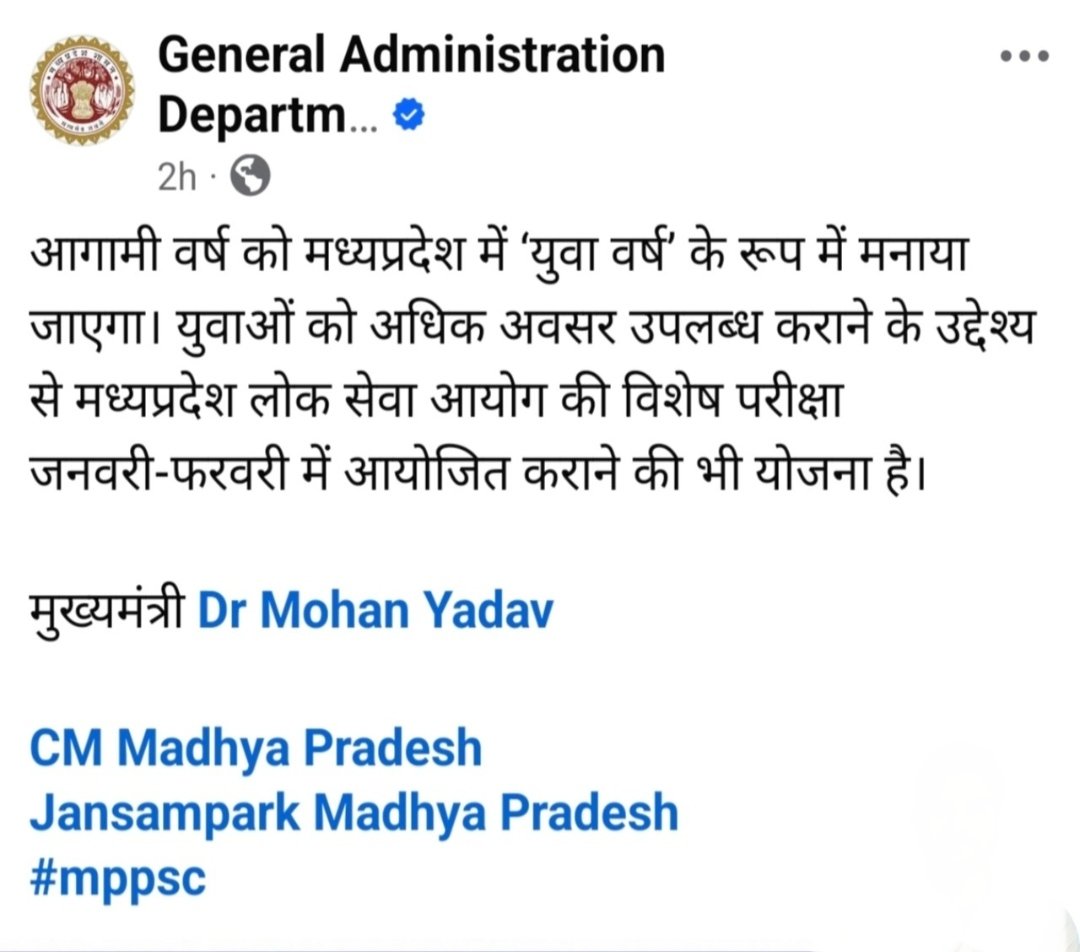
Madhya Pradesh is preparing to observe 2027 as Yuva Varsh (Year of Youth), with a reported plan to recruit approximately one lakh people across government departments during the year. Recent media coverage says the General Administration Department has coordinated with departments to prepare a recruitment roadmap.

The reported plan focuses on filling vacancies across existing and newly sanctioned posts. School education and the Home Department are among the major recruitment areas identified in the coverage.

The state has also discussed a broader target of filling approximately 2.5 lakh government posts by 2028. This wider target should not be confused with the reported one-lakh recruitment plan for 2027 or with vacancies for which applications have already opened.

Candidates should keep these points in mind:

  • The reported one-lakh figure does not mean all vacancies will be advertised together.
  • Different departments may issue separate recruitment notifications and application schedules.
  • Each recruitment can have different educational qualifications, age limits, reservation rules and selection procedures.
  • Only the relevant official notification can confirm the final vacancy count and application dates.

Candidates can begin preparing for suitable examinations now, but should verify the official notification before applying or relying on a particular vacancy figure.

MP Government Vacancy 2027: Department-Wise Expected Vacancies

The following table summarises the department-wise figures reported in connection with the proposed recruitment roadmap.

Department Reported proposed posts Expected recruitment areas
School Education Department Approximately 18,000 Teacher Varg 1, Varg 2 and Varg 3
Home Department Approximately 18,834 Police Constable, Sub-Inspector, Subedar and other related posts
Energy Department Approximately 3,969 Assistant Engineer, Junior Engineer, Testing Assistant and other technical posts
Revenue Department Number not finalised in the report Tehsildar and related cadres
General Administration Department Number not finalised in the report Assistant Grade 3, Stenographer and other posts
Other departments Approximately 1,200 reported posts Forest, Transport, Cooperation, Labour, Urban Development and Housing, among others

Note: These are reported proposed figures, not final vacancies confirmed through individual recruitment advertisements. The department-wise distribution and number of posts may change.

1. MP Teacher Vacancy 2027

The School Education Department is among the major recruitment areas in the reported roadmap, with approximately 18,000 proposed teaching posts.

The reported recruitment areas include Teacher Varg 1, Varg 2 and Varg 3. These categories correspond to different teaching levels and may have different eligibility and selection requirements.

Candidates interested in MP Teacher Vacancy 2027 should monitor official notices for:

  • Educational qualifications and required teacher training.
  • Applicable Teacher Eligibility Test (TET) requirements.
  • Subject-wise and category-wise vacancies.
  • Age limits and applicable relaxations.
  • Examination pattern, syllabus and selection stages.

The final number of posts, recruitment schedule and eligibility conditions must be confirmed through the relevant official advertisement. The reported figure of 18,000 posts should not be treated as a confirmed application opportunity.

2. MP Police Vacancy 2027

The Home Department has approximately 18,834 proposed posts in the reported roadmap. The reported categories include Police Constable, Sub-Inspector, Subedar and other related positions.

This figure covers the Home Department’s reported recruitment plan; it should not be interpreted as 18,834 confirmed police vacancies for a single examination.

The recruitment process will depend on the post. It may include a written examination, physical measurement test, physical proficiency test, document verification or other stages prescribed in the official rules.

Candidates preparing for MP Police Recruitment 2027 can work on general knowledge, reasoning and other relevant examination subjects. Physical preparation may also be important for posts with prescribed fitness standards.

Check the official advertisement for the exact vacancy count, educational qualifications, physical requirements, age limits and selection process.

3. MP Energy Department Vacancy 2027

The reported roadmap includes approximately 3,969 proposed Energy Department posts. Potential recruitment areas mentioned in the reports include Assistant Engineer, Junior Engineer, Testing Assistant and other technical positions.

Engineering graduates, diploma holders and candidates with relevant technical qualifications may find suitable opportunities if their disciplines and qualifications are included in the final advertisements.

Before applying, candidates should verify the required engineering branch or technical qualification, age limit, experience requirements, examination scheme and selection method for the specific post.

4. MP Revenue Department Vacancy 2027

The Revenue Department is another area mentioned in the reported recruitment roadmap. Tehsildar and related cadres are among the potential recruitment areas, but a final department-wise vacancy count has not been established in the reported information.

Candidates interested in revenue and administrative positions should monitor the relevant recruitment authority’s announcements for the post name, eligibility, examination pattern and application schedule.

Do not assume that all revenue-related posts will be recruited through the same examination or authority.

5. MP Assistant Grade 3 and Stenographer Recruitment 2027

The reported plan also mentions Assistant Grade 3, Stenographer and other positions associated with the General Administration Department.

Eligibility can vary considerably between clerical and stenography posts. Depending on the specific recruitment, candidates may need a prescribed educational qualification, computer proficiency, typing skills, shorthand skills or other certificates.

Check the official advertisement before preparing for a skill test or assuming that a particular qualification will be accepted.

6. Other Madhya Pradesh Government Vacancies in 2027

The reported roadmap also refers to approximately 1,200 proposed posts across other departments, including:

  • Forest Department
  • Transport Department
  • Cooperation Department
  • Labour Department
  • Urban Development and Housing Department

The final allocation of vacancies across these departments has not been confirmed in the reported information. Additional recruitment opportunities may be announced through separate notices as departments finalise their requirements.

Which Authorities Conduct MP Government Recruitment?

Not every Madhya Pradesh government vacancy is conducted by the same recruitment authority. Candidates should check the authority named in the relevant notification.

Madhya Pradesh Employee Selection Board (MPESB)

The Madhya Pradesh Employee Selection Board conducts various notified recruitment examinations, including examinations for eligible technical, clerical, police and other posts.

For current advertisements, application forms, examination schedules and rulebooks, visit the official MPESB application portal.

Madhya Pradesh Public Service Commission (MPPSC)

The Madhya Pradesh Public Service Commission conducts examinations for notified state services and other posts under its jurisdiction, including certain professional and engineering recruitments.

Visit the official MPPSC website for recruitment advertisements, examination calendars, syllabi and result updates.

You can also explore these related recruitment updates on FreeJobs247:

Other Recruiting Departments and Authorities

Some vacancies may be advertised directly by government departments, public-sector organisations or other authorised recruitment bodies. The applicable authority and application portal will be specified in the relevant advertisement.

MP Government Jobs 2027: Eligibility Criteria

There is no single eligibility standard for all MP Government Jobs 2027. Educational qualifications, age limits, domicile conditions and other requirements depend on the post and applicable recruitment rules.

Educational Qualification

Depending on the position, candidates may need:

  • Class 10 or Class 12 qualification.
  • A diploma in a relevant technical discipline.
  • A bachelor’s degree from a recognised institution.
  • An engineering degree in the prescribed branch.
  • A recognised teacher training qualification.
  • Computer, typing or shorthand proficiency.
  • A professional qualification or experience where specified.

For example, an engineering post may require a particular engineering degree or diploma, while a clerical position may include a computer or typing test. Teaching posts can have additional training and eligibility-test requirements.

Always check the qualification listed for your target post rather than relying on general eligibility information.

Age Limit

The minimum and maximum age limits will be specified in the relevant recruitment notification. The advertisement will also state the date used to calculate a candidate’s age.

Age relaxations may be available to eligible categories under the applicable rules. Candidates should verify the exact relaxation, required certificates and other conditions in the official advertisement.

Domicile and Reservation

Some recruitments provide reservation benefits under applicable Madhya Pradesh rules. Candidates claiming reservation or other benefits should check the prescribed category, domicile requirements and supporting documents.

Candidates from other states should verify their eligibility and whether any reservation benefits apply to them under the relevant recruitment rules.

Additional Eligibility Requirements

Certain positions may require physical standards, a physical proficiency test, typing or shorthand skills, computer proficiency, professional registration or relevant experience.

Meeting the general educational qualification does not automatically make a candidate eligible. All conditions specified for the particular post must be satisfied.

MP Government Jobs 2027: How to Apply Online

There is no single application form for all proposed MP Government Jobs 2027. Applications will open separately according to the recruitment schedule announced by each authorised body.

Once the official advertisement and application form are available, follow these general steps:

  1. Open the official recruitment website specified in the notification.
  2. Read the complete advertisement and confirm your eligibility.
  3. Complete registration using the required details.
  4. Enter your personal, educational and category information accurately.
  5. Upload your photograph, signature and supporting documents in the prescribed format.
  6. Pay the application fee, if applicable.
  7. Review the form carefully and submit it before the deadline.
  8. Save the submitted application and payment receipt for future reference.

Application fees, correction windows, document formats and registration requirements vary by recruitment. Use only the official application portal specified in the relevant notice, and do not pay fees through unverified links.

MP Government Jobs 2027: Selection Process

The selection process depends on the post, recruiting authority and applicable rules. Common stages may include:

Selection stage Purpose
Written examination Assesses general knowledge, reasoning, technical subjects or other prescribed areas
Skill test May assess typing, shorthand, computer or job-specific skills
Physical test May apply to police, forest and other posts with physical requirements
Interview Conducted where specified in the recruitment rules
Document verification Checks educational qualifications, identity and eligibility documents
Medical examination Required for certain posts under applicable rules
Final merit list Prepared according to the notified selection criteria

Not every recruitment includes all these stages. The official notification and applicable rulebook determine the actual selection process.

How to Prepare for MP Government Jobs 2027

Candidates can start preparing before individual recruitment notifications are released. The most effective approach is to choose a target post and prepare according to its relevant syllabus.

1. Choose jobs that match your qualification. Identify whether you are eligible for teaching, police, engineering, clerical, technical or administrative positions.

2. Study the relevant syllabus. Do not rely on one common syllabus for every Madhya Pradesh government examination. Subject requirements and exam patterns vary by recruitment.

3. Revise Madhya Pradesh General Knowledge. Where relevant to the examination, study the state’s history, geography, culture, economy, administration and current affairs.

4. Practise reasoning and quantitative aptitude. If these subjects are part of your target examination, regular practice can help improve accuracy and time management.

5. Focus on technical or professional subjects. Candidates preparing for engineering and specialised technical posts should prioritise the subjects required for their discipline.

6. Prepare for skill or physical tests. Candidates targeting relevant posts should practise typing, shorthand, computer skills or physical activities where these are required.

7. Solve previous-year papers and mock tests. Use practice material that matches your target examination’s syllabus and pattern.

8. Track official updates. Check the relevant recruitment authority’s website for notifications, application deadlines, examination dates and changes to the selection process.

Recommended Books & Study Resources for MP Government Exams

Preparing for Madhya Pradesh government exams? The right study materials can help you revise important topics, practise questions, and prepare more systematically.

Before choosing a book, check whether it matches your target examination, such as MPPSC, MPESB, or another Madhya Pradesh recruitment exam. Compare the syllabus, edition, and language to find a resource suited to your preparation.

Explore MPPSC Exam Preparation Books on Amazon

MPESB Exam Preparation Books on Amazon

Browse relevant exam preparation books and practice materials on Amazon and choose the resources that match your examination.

Where to Check the Latest MP Govt Jobs 2027 Updates

For reliable updates, use official recruitment websites and the individual department’s notifications.

  • MPESB application portal: Recruitment advertisements, application forms and examination-related information.
  • MPPSC official website: Commission recruitment notifications, examination calendars, syllabi and results.
  • Relevant department website: For vacancies advertised directly by a department or another authorised body.

News reports can help candidates understand the proposed recruitment roadmap, but they should not replace official notifications. Before applying, confirm the advertisement number, vacancy count, eligibility criteria, application dates and official application link.

Important Points About MP Government Vacancy 2027

  • Approximately one lakh posts form part of a reported recruitment roadmap, not a single confirmed recruitment advertisement.
  • The reported figures for teaching, Home Department and Energy Department posts are proposed estimates.
  • Final vacancies may change when individual departments issue recruitment notices.
  • Eligibility, age limits, reservation benefits and selection stages vary by post.
  • Application dates and examination schedules will be announced separately.
  • MPESB, MPPSC and other authorised bodies may conduct different recruitments.
  • Candidates should rely on the official notification when making application decisions.

Frequently Asked Questions (FAQs)

1. How many government vacancies are expected in Madhya Pradesh in 2027?

Recent media reports describe a recruitment roadmap covering approximately one lakh government posts in Madhya Pradesh during 2027. The figure is a reported plan, and final vacancies will be confirmed through individual recruitment advertisements.

2. Which departments may have the most vacancies under MP Government Jobs 2027?

The reported roadmap includes approximately 18,000 School Education Department posts and 18,834 Home Department posts. These figures are proposed and should not be treated as final vacancies for a single recruitment.

3. Will there be 18,000 vacancies in MP Teacher Recruitment 2027?

Approximately 18,000 teaching posts have been reported as part of the proposed recruitment plan. The final number of vacancies, teaching categories, eligibility conditions and application dates must be confirmed through the relevant official notification.

4. How many MP Police vacancies are expected in 2027?

The reported roadmap lists approximately 18,834 posts under the Home Department, including police and other related categories. The exact number of vacancies specifically for police recruitment has not been confirmed by this figure alone.

5. Which authorities conduct Madhya Pradesh government recruitment?

MPESB and MPPSC conduct various recruitments under their respective jurisdictions. Other vacancies may be handled by departments or authorised recruiting bodies, as specified in each official advertisement.

6. What is the qualification for MP Government Jobs 2027?

Eligibility varies by post. Depending on the recruitment, candidates may need Class 10, Class 12, a diploma, a bachelor’s degree, an engineering qualification, teacher training or other prescribed skills and qualifications.

7. When will MP Government Jobs 2027 applications start?

There is no single application date for all proposed vacancies. Each recruitment authority or department will publish its own schedule. Candidates should check the relevant official notification for the opening and closing dates.

8. How can I check the latest MP Sarkari Naukri 2027 updates?

Check the official MPESB and MPPSC websites and the relevant department’s recruitment notices. Verify the vacancy count, eligibility, application deadline and selection process before applying.

9. Is the one-lakh MP Government Jobs 2027 vacancy figure confirmed?

It has been reported as part of the state’s recruitment roadmap for 2027. It should not be interpreted as a final consolidated vacancy notification. The official advertisements for individual recruitments will establish the confirmed vacancies and application conditions.

MPPSC AE Recruitment 2027: Notification, Eligibility, Exam Date & Syllabus

MPPSC AE Recruitment 2027

MPPSC AE Recruitment 2027 is an upcoming recruitment opportunity for engineering graduates who want to work as Assistant Engineers in Madhya Pradesh government departments. The Madhya Pradesh Public Service Commission (MPPSC) is expected to announce the next recruitment cycle through an official notification. However, the MPPSC AE 2027 notification, vacancy count, application dates, eligibility conditions and examination schedule have not yet been confirmed.

Candidates preparing for the Madhya Pradesh Public Service Commission Assistant Engineer examination should start their preparation early and monitor official recruitment updates.

This page covers the expected notification, previous recruitment details, eligibility criteria, age limit, application process, selection procedure, syllabus preparation, salary and other important information. All details specific to the 2027 recruitment will be updated after the official notification is released.

Also, Check:

MPPSC AE Recruitment 2027: Overview

The MPPSC Assistant Engineer recruitment is conducted to fill eligible engineering positions in Madhya Pradesh government departments, according to the vacancies and disciplines included in the relevant recruitment notification.

Particulars Details
Recruitment MPPSC AE Recruitment 2027
Conducting Authority Madhya Pradesh Public Service Commission (MPPSC)
Examination State Engineering Services / Assistant Engineer recruitment, as specified in the notification
Post Name Assistant Engineer (AE) and other notified engineering posts
Job Location Madhya Pradesh
Recruitment Year 2027
Notification Status Awaited
Total Vacancies To be announced
Engineering Branches To be confirmed in the notification
Application Start Date To be announced
Last Date to Apply To be announced
Admit Card Date To be announced
Examination Date To be announced
Selection Process To be confirmed through the official notification
Application Mode Online
Official Authority Madhya Pradesh Public Service Commission

MPPSC AE Notification 2027

The MPPSC AE Recruitment 2027 notification is awaited. The official advertisement will provide the information candidates need before applying, including the number of vacancies, engineering disciplines, department-wise posts, educational qualifications, age limits, category-wise relaxations, application fees and examination scheme.

Candidates should read the complete notification carefully before submitting an application. Eligibility conditions and selection procedures can vary according to the post and recruitment cycle.

The notification is expected to clarify the following details:

  • Number of Assistant Engineer vacancies.
  • Engineering branches eligible to apply.
  • Department-wise and category-wise vacancy distribution.
  • Educational qualifications and any required registration or experience.
  • Minimum and maximum age limits.
  • Age relaxation for eligible categories.
  • Online application dates and correction window, if applicable.
  • Examination pattern, syllabus and marking scheme.
  • Selection stages and interview requirements, if any.
  • Application fee and payment method.
  • Examination centres, document verification and appointment conditions.

Once MPPSC releases the official advertisement, candidates should use it as the final reference for all eligibility and application-related decisions.

MPPSC AE Vacancy 2027

The total number of vacancies under MPPSC AE Recruitment 2027 has not been announced. The final vacancy count will depend on the posts reported by the concerned departments and included in the official recruitment advertisement.

The notification may provide separate vacancy details for different engineering disciplines, departments, reservation categories and other applicable classifications.

Expected Engineering Branches

Depending on the posts notified by MPPSC, the recruitment may include engineering disciplines such as:

  • Civil Engineering
  • Mechanical Engineering
  • Electrical Engineering
  • Agricultural Engineering

These are possible disciplines based on previous Assistant Engineer recruitment patterns, not a confirmed list of MPPSC AE Recruitment 2027 vacancies. Candidates should apply only for the branches specifically mentioned in the new notification.

Previous MPPSC Assistant Engineer Vacancy Details 2026

The previous State Engineering Services recruitment advertised under Advertisement No. 08/2025 included 32 Assistant Engineer and Assistant Agricultural Engineer vacancies. The recruitment covered engineering positions in disciplines including Civil, Mechanical, Electrical and Agricultural Engineering, as specified in the advertisement.

The written examination for that recruitment was scheduled for 22 March 2026.

This historical information provides context for candidates preparing for the next recruitment cycle. It does not establish the number of MPPSC AE vacancies expected in 2027.

MPPSC AE Recruitment 2027: Important Dates

The MPPSC AE 2027 notification date and examination schedule are yet to be announced. The commission will publish the applicable dates through its official recruitment announcements.

Event Expected / Current Status
MPPSC AE Notification 2027 Awaited
Online Application Begins To be announced
Last Date for Registration To be announced
Application Correction Window To be announced, if applicable
Admit Card Release To be announced
MPPSC AE Exam Date 2027 To be announced
Answer Key To be announced, if applicable
Result Declaration To be announced
Interview / Further Selection Stage To be confirmed

Candidates should not assume that the 2027 application window or examination will follow the same schedule as the previous recruitment. Keep checking the latest updates on this page and the official MPPSC announcements.

MPPSC AE Eligibility Criteria 2027

Candidates planning to apply for MPPSC AE Recruitment 2027 should check the educational qualification, age limit, domicile conditions and other eligibility requirements before submitting the application form. The official MPPSC AE 2027 notification has not yet been released, so the final eligibility criteria are awaited.

The previous recruitment information provides a preliminary reference for engineering graduates preparing for the next Assistant Engineer recruitment cycle.

MPPSC AE Educational Qualification 2027

As per the eligibility details reported for MPPSC AE Recruitment 2026, candidates were required to hold a Bachelor’s degree in the relevant engineering discipline from a recognised university. The eligible engineering branches included Civil, Mechanical, Electrical and other disciplines specified in the recruitment advertisement.

Candidates preparing for MPPSC AE 2027 should keep the following points in mind:

  • A relevant engineering degree may be required for the advertised Assistant Engineer post.
  • The accepted engineering branches will depend on the vacancies announced by MPPSC.
  • Candidates should verify whether their degree discipline matches the post for which they intend to apply.
  • Final-year engineering students should not assume they are eligible. The 2027 notification must clarify whether provisional applications are permitted and by what date the degree must be completed.
  • Applicants may need to produce their degree certificate, marksheets and other prescribed documents during verification.

The final educational qualification requirements, including the eligibility of final-year students and the deadline for obtaining the degree, will be determined by the official MPPSC AE Recruitment 2027 notification.

MPPSC AE Age Limit 2027

The age limit for MPPSC AE Recruitment 2027 has not been announced. The reference article reports an age range of 21 to 40 years for the 2026 recruitment. Candidates can use this information for preliminary planning but should not treat it as the confirmed age limit for 2027.

The upcoming notification is expected to clarify the minimum age, maximum age, age-calculation date and applicable upper-age relaxations.

MPPSC AE Age Relaxation

Eligible candidates may receive upper-age relaxation under the applicable Madhya Pradesh government recruitment rules. The categories covered and the extent of relaxation for MPPSC AE 2027 will need to be verified in the official advertisement.

Candidates belonging to reserved categories and other eligible groups should check the specific conditions, required certificates and applicable age-calculation rules before applying.

MPPSC AE Domicile Requirements

The reference article identifies Madhya Pradesh domicile as an eligibility consideration for the 2026 recruitment. However, candidates should check the exact domicile, reservation and category-related conditions in the official advertisement rather than assuming that the same requirements will apply unchanged in 2027.

Applicants from other states should pay particular attention to the eligibility rules and the availability of reservation benefits before completing the application form.

MPPSC AE Application Form 2027

The MPPSC AE application form 2027 is expected to be made available online if the next recruitment follows the previous application process. The registration link, application dates, fee and detailed instructions will be announced by the commission.

Candidates should complete the form only after checking their eligibility and reading the relevant instructions.

How to Apply Online for MPPSC AE Recruitment 2027

Once registration opens, candidates can follow the instructions below, subject to the process specified in the official notification.

  1. Visit the official Madhya Pradesh Public Service Commission website.
  2. Open the recruitment or application section.
  3. Find the advertisement for MPPSC AE Recruitment 2027 or the relevant State Engineering Services recruitment.
  4. Read the notification and confirm that you meet the eligibility requirements.
  5. Complete the registration process using the required details.
  6. Fill in the application form with accurate personal, educational and category information.
  7. Upload the photograph, signature and other documents in the prescribed format.
  8. Pay the application fee using an available payment method, if applicable.
  9. Review the complete form before final submission.
  10. Submit the application and save or print the confirmation page for future reference.

These are general preparation steps. The final application process may differ according to the instructions issued by MPPSC for the 2027 recruitment.

Documents to Keep Ready

Candidates can prepare the following documents in advance, subject to the requirements of the official notification:

  • Recent photograph and signature.
  • Engineering degree certificate or provisional certificate, where accepted.
  • Semester-wise or consolidated marksheets.
  • Class 10 certificate or another accepted document for date of birth.
  • Valid identity proof.
  • Category certificate, where applicable.
  • Madhya Pradesh domicile or other prescribed documents, if required.
  • PwBD certificate, where applicable.
  • Experience certificate or professional registration, if required for the advertised post.
  • Other documents specified in the application instructions.

Ensure that names, dates of birth and other personal details are consistent across the application and supporting documents. The commission’s prescribed document requirements will take precedence over this general checklist.

MPPSC AE Application Fee 2027

The application fee for MPPSC AE Recruitment 2027 has not been announced. The official notification will specify the fee for each applicable category, any portal or service charges, payment methods and refund conditions.

Candidates should not rely on fees from previous recruitment cycles when completing the 2027 application. Check the fee table in the current advertisement and retain the payment receipt after submission.

MPPSC AE Selection Process 2027

The MPPSC AE selection process 2027 has not yet been officially announced. Based on the previous State Engineering Services recruitment, the selection process consisted of a written examination followed by an interview/personality test. Candidates should use this as a reference and confirm the final selection procedure in the MPPSC AE Recruitment 2027 notification.

The previous recruitment process included the following stages:

  1. Written Examination
  2. Interview / Personality Test
  3. Document Verification and completion of other prescribed formalities

Stage 1: MPPSC AE Written Examination

The written examination is the first major stage of the MPPSC Assistant Engineer selection process. In the previous recruitment, the examination was conducted in offline, OMR-based mode and assessed candidates’ general knowledge and technical knowledge relevant to their engineering discipline.

Candidates preparing for MPPSC AE 2027 should focus on their core engineering subjects and the general knowledge topics included in the applicable syllabus. The official notification and examination scheme should be checked for the confirmed question format, marks distribution, duration, negative marking and qualifying requirements.

Candidates who meet the prescribed requirements in the written examination may be shortlisted for the interview stage, according to the applicable recruitment rules.

Stage 2: MPPSC AE Interview / Personality Test

Candidates shortlisted after the written examination may be called for an interview or personality test. In the previous recruitment pattern, the interview formed part of the selection process and assessed candidates’ suitability for Assistant Engineer positions.

The interview may evaluate relevant technical understanding, communication, problem-solving ability, professional judgement and overall suitability for the advertised post. Candidates should prepare to explain fundamental engineering concepts and apply their technical knowledge to practical situations.

The number of candidates shortlisted for the interview, interview marks and other applicable conditions for MPPSC AE Recruitment 2027 will be confirmed in the new notification.

Stage 3: Document Verification

Candidates participating in the later stages of recruitment may be required to produce original documents for verification. The commission checks whether the candidate meets the prescribed educational, age and other eligibility requirements and whether the information submitted in the application is supported by valid documents.

Candidates should keep the following documents ready, subject to the official instructions:

  • Engineering degree certificate and marksheets.
  • Class 10 certificate or other prescribed proof of date of birth.
  • Valid photo identity proof.
  • Category certificate, if applicable.
  • Domicile certificate, if required.
  • PwBD certificate, where applicable.
  • Other certificates or documents specified in the notification.

Document verification requirements and their timing will be governed by the official recruitment rules. Candidates should follow the instructions issued with the relevant call letter or notice.

MPPSC AE Final Merit List 2027

The final merit list for MPPSC AE Recruitment 2027 will be prepared according to the selection rules published by MPPSC. Under the previous recruitment pattern, the written examination and interview were the principal selection stages.

Candidates should check the new notification to understand how written examination marks and interview marks will be considered, along with applicable reservation rules and vacancy availability. Qualifying the written examination alone does not guarantee final selection.

MPPSC AE Exam Pattern 2027

The MPPSC AE exam pattern 2027 has not been officially announced. Candidates can refer to the previous State Engineering Services Examination 2025 pattern to understand the written examination structure, marks distribution, duration and interview stage.

As per the previous examination pattern, the written exam carried 450 marks, while the interview carried 50 marks, taking the total to 500 marks. The written examination consisted of two parts: General Studies and the relevant engineering subject.

MPPSC AE Written Exam Pattern: Previous Recruitment

Exam Particulars Previous Exam Pattern
Examination Mode Offline (OMR-based)
Question Type Objective-type multiple-choice questions (MCQs)
Total Questions 150
Total Written Exam Marks 450
Exam Duration 3 hours
Part A General Studies
Part A Questions 50
Part A Marks 150
Part B Relevant Engineering Subject
Part B Questions 100
Part B Marks 300
Negative Marking 1 mark deducted for each incorrect answer
Interview Marks 50
Total Marks, Including Interview 500

Note: This table reflects the previous recruitment examination pattern. The MPPSC AE Recruitment 2027 notification may prescribe changes to the exam structure or marking scheme.

MPPSC AE Exam Pattern: Part A – General Studies

Part A of the previous written examination consisted of 50 questions carrying 150 marks. It covered general knowledge related to Madhya Pradesh, India and the world.

The General Studies syllabus included topics such as:

  • History, culture and heritage of Madhya Pradesh.
  • Geography, rivers, climate and natural resources of Madhya Pradesh.
  • Madhya Pradesh’s political system and economy.
  • National and international current affairs.
  • Important contemporary events.
  • Information and Communication Technology (ICT), as prescribed in the syllabus.

Candidates should use the detailed syllabus applicable to the relevant recruitment cycle to identify the exact topics and their scope.

MPPSC AE Exam Pattern: Part B – Engineering Subject

Part B of the previous examination consisted of 100 questions carrying 300 marks. Questions were based on the engineering discipline relevant to the advertised post.

The technical subjects depended on the candidate’s eligible branch. These could include Civil, Mechanical, Electrical or Agricultural Engineering where the relevant discipline was included in the recruitment.

Candidates should prioritise core engineering concepts, numerical problems and technical topics listed in the official syllabus. The engineering branches available under MPPSC AE Recruitment 2027 will be known only after the new notification is released.

MPPSC AE Marking Scheme

According to the previous examination pattern, each correct answer carried 3 marks, while 1 mark was deducted for every incorrect answer.

Response Type Marks
Correct Answer +3
Incorrect Answer −1
Maximum Written Exam Marks 450
Maximum Interview Marks 50

Candidates should practise accuracy alongside speed because incorrect responses can reduce the overall score. The marking scheme above should be reconfirmed against the 2027 notification before candidates use it for final exam planning.

MPPSC AE Exam Language

In the previous examination pattern, the General Studies section was available in Hindi and English, while the technical engineering section was set in English. Candidates should check the instructions for the next recruitment cycle to confirm the language options and any examination-specific rules.

MPPSC AE Interview Pattern

The previous recruitment pattern included an interview or personality test carrying 50 marks. Candidates shortlisted after the written examination could proceed to this stage according to the applicable selection rules.

The written examination and interview together accounted for 500 marks under the previous pattern. The final merit-list calculation and qualifying requirements for MPPSC AE Recruitment 2027 will depend on the rules announced by MPPSC.

How Should Candidates Use the Previous Exam Pattern?

Candidates can use the previous MPPSC AE exam pattern to begin their preparation, but should avoid treating it as a guarantee of the 2027 examination structure.

  1. Revise General Studies topics related to Madhya Pradesh, India and the world.
  2. Strengthen the core subjects of the relevant engineering discipline.
  3. Practise objective questions and numerical problems.
  4. Use previous papers to understand question styles and time management.
  5. Confirm the final exam duration, marking scheme, syllabus and interview rules when the MPPSC AE Recruitment 2027 notification is released.

Important: The MPPSC AE 2027 exam pattern is still awaited. Candidates should rely on the new official notification for the final examination scheme.

MPPSC AE Syllabus 2027

The official MPPSC AE syllabus 2027 is awaited. The final syllabus will depend on the engineering disciplines and examination scheme included in the notification.

Candidates can begin their preparation with the core concepts from their engineering branch while keeping their study plan flexible until the official syllabus is available.

Civil Engineering

Candidates targeting Civil Engineering posts can revise foundational subjects such as:

  • Engineering Mechanics and Strength of Materials.
  • Structural Analysis and Design.
  • Building Materials and Construction.
  • Surveying.
  • Geotechnical Engineering and Soil Mechanics.
  • Fluid Mechanics and Hydraulics.
  • Irrigation Engineering.
  • Environmental Engineering.
  • Transportation Engineering.
  • Water Supply and Wastewater Engineering.
  • Estimation, Costing and Construction Management.

These topics form a general Civil Engineering revision checklist. The official MPPSC AE syllabus may include a different selection, scope or distribution of subjects.

Mechanical Engineering

Candidates preparing for Mechanical Engineering posts can revise core subjects such as:

  • Engineering Mechanics.
  • Strength of Materials.
  • Theory of Machines and Machine Design.
  • Thermodynamics.
  • Heat Transfer.
  • Fluid Mechanics and Machinery.
  • Manufacturing Processes.
  • Industrial Engineering.
  • Engineering Materials.
  • Refrigeration and Air Conditioning.
  • Power Plant Engineering.
  • Engineering Drawing and related fundamentals.

The final subject list should be matched against the syllabus published for the relevant post.

Electrical Engineering

Candidates preparing for Electrical Engineering positions can revise the following broad subject areas:

  • Electrical Circuit Theory.
  • Electrical Machines.
  • Power Systems.
  • Electrical Measurements and Instrumentation.
  • Control Systems.
  • Power Electronics.
  • Electrical and Electronic Fundamentals.
  • Generation, Transmission and Distribution.
  • Electrical Utilisation.
  • Basic Electrical Design and Protection.

The official syllabus will determine which subjects and subtopics are relevant to the 2027 examination.

Agricultural Engineering

If Agricultural Engineering vacancies are included, candidates should check the notified syllabus for the relevant technical subjects. Depending on the prescribed course content, preparation may involve agricultural machinery, soil and water conservation, irrigation and drainage, farm power, post-harvest technology and related engineering topics.

This is a general revision guide, not a confirmed subject list for MPPSC AE Recruitment 2027.

General Studies and Madhya Pradesh General Knowledge

If the examination includes a General Studies or state-specific knowledge component, candidates should prepare only the topics prescribed in the official syllabus.

Useful areas to review may include Madhya Pradesh’s geography, history, culture, economy, government initiatives, current affairs and relevant general knowledge. The weightage and inclusion of these topics must be verified after the examination scheme is released.

How to Prepare for MPPSC AE Recruitment 2027

Starting early can help engineering graduates build a strong foundation before the official examination schedule is announced. A structured approach also makes it easier to adapt when MPPSC publishes the syllabus and exam pattern.

1. Review the Previous Recruitment Pattern

Study the previous State Engineering Services advertisement and any available examination materials to understand the general nature of the recruitment. Use these resources for orientation, not as a substitute for the 2027 notification.

2. Strengthen Your Engineering Fundamentals

Begin with the core subjects of your engineering branch. Focus on conceptual understanding, formulas, numerical problems and the application of engineering principles.

3. Prepare Topic-Wise Notes

Maintain concise notes for important concepts, formulas, definitions and frequently practised problem types. This will make revision easier closer to the examination.

4. Practise Previous-Year Questions

Use relevant previous examination papers to become familiar with question styles and identify weak areas. Confirm that the paper relates to the relevant engineering discipline and recruitment examination.

5. Follow Current Affairs Where Relevant

If General Studies or Madhya Pradesh-related knowledge forms part of the notified syllabus, follow reliable current-affairs material and revise state-specific topics regularly.

6. Take Mock Tests After Checking the Exam Pattern

Mock tests can help improve accuracy, time management and confidence. Choose tests that match the official syllabus and marking scheme once these details become available.

7. Track the Official Notification

Do not delay checking eligibility, document requirements and application deadlines until the examination is close. The official advertisement should guide your final preparation and application decisions.

MPPSC AE Salary 2027

The MPPSC AE salary for 2027 has not been officially announced. As per the previous recruitment, MPPSC AE receives a pay scale of ₹15,600–₹39,100 with Grade Pay of ₹5,400, along with applicable allowances.

The pay structure for the 2027 recruitment cycle should be verified against the official notification and the applicable service rules.

MPPSC AE Pay Scale and Allowances

The previous recruitment reference reports the following salary details:

Salary Component Details Reported for the Previous Recruitment
Pay Scale ₹15,600–₹39,100
Grade Pay ₹5,400
Dearness Allowance (DA) As applicable under government rules
House Rent Allowance (HRA) As applicable under government rules
Travel Allowance (TA) As applicable under government rules

The allowances and final salary depend on the applicable government rules, posting and service conditions. The figures above should be treated as reference information only until MPPSC publishes the 2027 recruitment details.

MPPSC AE Admit Card 2027

The MPPSC AE admit card 2027 will be released according to the examination schedule announced by the commission. The release date has not been confirmed.

Candidates should follow the instructions issued for downloading the admit card and check the details printed on it, including their name, roll number, examination date, reporting time and centre information.

Before the examination, candidates should also review the permitted identity documents, reporting instructions and prohibited items mentioned in the official exam guidelines.

MPPSC AE Answer Key 2027

The availability and release schedule of the MPPSC AE answer key 2027 will depend on the examination process adopted by the commission.

If an answer key is published, candidates should review the instructions concerning provisional answers, objections, supporting evidence, fees and submission deadlines, where applicable. Any challenge must be submitted through the prescribed process within the notified period.

Candidates should not rely on unofficial answer keys for submitting formal objections.

MPPSC AE Result 2027

The MPPSC AE result 2027 has not been announced. The result will be released after the relevant examination and evaluation process, according to the commission’s schedule.

Candidates should use the official result notice to check their qualifying status, marks or merit position where published, and instructions for any subsequent selection stage.

A result or shortlist should not be treated as a final appointment unless the commission’s recruitment rules and subsequent selection process establish that status.

MPPSC AE Cut-Off 2027

The MPPSC AE cut-off for 2027 is not available before the examination and official result process. The cut-off may depend on factors such as the number of vacancies, examination difficulty, candidate performance, category-wise rules and the applicable selection criteria.

Previous-year cut-offs, if available, can be used as a reference for preparation, but they cannot guarantee the cut-off for the next recruitment cycle.

Candidates should focus on thorough syllabus coverage, consistent practice and improving accuracy rather than targeting an unverified cut-off figure.

MPPSC AE Recruitment 2027: FAQs

1. When will the MPPSC AE 2027 notification be released?

The MPPSC AE 2027 notification date has not been announced yet.

2. How many vacancies are expected in MPPSC AE 2027?

The vacancy count is yet to be announced by MPPSC.

3. What is the eligibility for MPPSC AE Recruitment 2027?

A relevant engineering degree is expected to be required. Final eligibility criteria are awaited.

4. What is the age limit for MPPSC AE 2027?

The previous recruitment reference reports an age range of 21–40 years. The 2027 age limit is yet to be confirmed.

5. What is the selection process for MPPSC AE 2027?

The previous recruitment pattern included a written examination and an interview. The 2027 process is awaited.

6. What is the MPPSC AE exam pattern?

The previous pattern comprised a 450-mark written examination and a 50-mark interview. The 2027 pattern is not confirmed.

7. What is the MPPSC AE salary?

The previous recruitment reference reports a pay scale of ₹15,600–₹39,100 with Grade Pay of ₹5,400. The 2027 salary is yet to be confirmed.

8. How can I apply for MPPSC AE Recruitment 2027?

Apply through the official MPPSC website once the 2027 application process opens.

MPPSC Special Exam 2027: Exam Plan for January–February

Madhya Pradesh Government is planning to celebrate 2027 as ‘Yuva Varsh’ (Year of Youth) to provide more opportunities to young people in the state. According to a social media post shared by the General Administration Department of Madhya Pradesh, the state government is also planning to organise a special examination conducted by the Madhya Pradesh Public Service Commission (MPPSC) in January–February 2027.

Chief Minister Dr. Mohan Yadav has highlighted the initiative’s objective of providing greater opportunities to the youth of Madhya Pradesh. The proposed examination could be important news for candidates preparing for state-level competitive examinations and government jobs.

Also, Check: MP Govt Jobs 2027: 1 Lakh Upcoming Vacancies

MPPSC Special Exam 2027

MPPSC Special Exam 2027: Key Highlights

Particulars Details
News Proposed MPPSC Special Examination 2027
State Madhya Pradesh
Chief Minister Dr. Mohan Yadav
Proposed year 2027 – Yuva Varsh
Expected examination period January–February 2027
Conducting body mentioned Madhya Pradesh Public Service Commission (MPPSC)
Main objective Expanding opportunities for young candidates

What Is the MPPSC Special Examination 2027?

As per the MP GAD’s announcement, the Madhya Pradesh government plans to organise a special MPPSC examination during January–February 2027. The initiative is intended to provide additional opportunities to young candidates aspiring to secure government jobs in the state.

However, details regarding the examination name, number of vacancies, eligibility criteria, application dates, syllabus and selection process have not been specified in the available post. Candidates should wait for an official notification before making assumptions about the recruitment process.

Also, Check: MPPSC AE Recruitment 2027

What Should MPPSC Aspirants Do Now?

Candidates preparing for MPPSC and other Madhya Pradesh government examinations should continue their preparation and keep track of official announcements.

  • Regularly check the official MPPSC website for recruitment notifications.
  • Revise Madhya Pradesh General Knowledge, current affairs and other relevant subjects.
  • Keep educational certificates and category documents ready, where applicable.
  • Check the official notification for eligibility, vacancies and application deadlines once released.

Where to Check the Official MPPSC Notification?

Candidates can visit the official website of the Madhya Pradesh Public Service Commission for updates, examination schedules and recruitment notifications.

Official website: MPPSC Official Website

Frequently Asked Questions (FAQs)

1. Will MPPSC conduct a special examination in 2027?

A social media post attributed to the Madhya Pradesh General Administration Department mentions a plan to conduct a special MPPSC examination in January–February 2027. Candidates should wait for official examination details and confirmation.

2. When is the proposed MPPSC Special Exam 2027?

The proposed period mentioned in the post is January–February 2027. This should not be treated as a confirmed examination date.

3. What is Yuva Varsh 2027 in Madhya Pradesh?

Yuva Varsh refers to the proposed celebration of 2027 as the Year of Youth in Madhya Pradesh, with an emphasis on providing more opportunities for young people.

4. How many vacancies will be announced under MPPSC Special Exam 2027?

The available post does not mention the number of vacancies. Candidates should refer to the official notification for confirmed vacancy details.

5. Where can candidates find MPPSC recruitment updates?

Candidates can check https://mppsc.mp.gov.in/ for official notifications and examination-related announcements.

Important Notice: This report is based on the MP GAD social media post. The examination schedule, vacancies, eligibility criteria and application process should be considered confirmed only after the relevant official notification is published.

How to Prepare for BHEL Artisan Exam 2026? Strategy and Tips

Bharat Heavy Electricals Limited (BHEL) has announced 660 tentative Artisan Grade IV vacancies under Advertisement No. 01/2026. Candidates preparing for this recruitment should start with the relevant ITI trade syllabus, understand the examination pattern and follow a consistent study schedule.

The BHEL Artisan Computer-Based Test (CBT) is tentatively scheduled for 11th December 2026. A focused preparation strategy can help candidates strengthen their technical knowledge, improve accuracy and revise important concepts before the examination.

This guide explains how to prepare for the BHEL Artisan Exam 2026, including trade theory, engineering drawing, workshop calculations, reasoning and mock-test practice.

Also Check: BHEL Artisan Recruitment 2026 | BHEL Artisan Syllabus 2026

BHEL Artisan Exam Pattern 2026

Before starting your preparation, understand the exam pattern available for the BHEL Artisan examination. The referenced pattern contains three sections and specifies a total of 120 questions. However, candidates should confirm that these details apply to the 2026 recruitment by checking the applicable official instructions when the detailed notification is available.

Exam Particulars Details
Recruiting organisation Bharat Heavy Electricals Limited (BHEL)
Post Artisan Grade IV
Vacancies 660 tentative
Exam mode Computer-Based Examination (CBE)
Total questions 120
Total marks 120
Exam duration 90 minutes
Trade Theory 70 questions
Engineering Drawing and Workshop Calculation 30 questions
Test of Reasoning 20 questions
Negative marking 0.25 marks per incorrect answer, as specified in the referenced pattern
Tentative exam date 11 December 2026

How to Prepare for BHEL Artisan Exam 2026

An effective BHEL Artisan preparation strategy should combine technical study, regular question practice, revision and mock tests. Follow these steps to make your preparation more organised.

1. Understand the BHEL Artisan Syllabus

Start by reviewing the syllabus for your specific ITI trade. BHEL Artisan recruitment covers seven trades:

  • Fitter
  • Welder
  • Turner
  • Machinist
  • Electrician
  • Electronics Mechanic
  • Foundryman

The technical topics differ according to the trade. Avoid preparing from a generic technical syllabus without checking whether its topics are relevant to your qualification and examination.

Download and review the BHEL Artisan Syllabus 2026 before preparing your timetable. Mark the topics you already understand, the topics that need revision and those that require more practice.

2. Give Priority to Trade Theory

Trade Theory accounts for 70 out of 120 questions in the referenced exam pattern. Therefore, candidates should give substantial attention to their relevant technical subject while maintaining regular practice in the other sections.

Use your ITI notes, textbooks and reliable practice material to revise basic concepts, definitions, tools, equipment, processes and trade-specific applications.

A useful approach is to:

  • Study one topic at a time rather than switching between unrelated chapters.
  • Revise the underlying concepts before attempting objective questions.
  • Practise MCQs immediately after completing each topic.
  • Maintain a notebook of formulas, technical terms and commonly confused concepts.
  • Revisit questions answered incorrectly during practice.

For example, Fitter candidates should concentrate on their prescribed fitter-trade syllabus, while Electrician candidates should focus on the topics specified for the electrician trade. The same principle applies to Welder, Turner, Machinist, Electronics Mechanic and Foundryman candidates.

3. Practise Engineering Drawing and Workshop Calculations

The referenced pattern allocates 30 questions to Engineering Drawing and Workshop Calculation. Candidates should prepare this section alongside their trade subjects instead of leaving it until the final weeks.

For engineering drawing, practise reading and interpreting drawings, identifying standard symbols and understanding dimensions and views wherever these topics appear in the applicable syllabus.

For workshop calculations, revise the mathematical concepts and formulas included in your syllabus. Solve numerical questions regularly and check each calculation carefully.

Preparation tips:

  • Keep a separate formula sheet for quick revision.
  • Solve calculation-based questions without immediately checking the answers.
  • Practise drawing-related questions using diagrams where helpful.
  • Review the method behind each incorrect answer.
  • Repeat difficult questions until you can solve them accurately.

4. Prepare for the Test of Reasoning

Reasoning carries 20 questions in the referenced exam pattern. Consistent practice can help you become more familiar with question formats and improve your ability to solve them within a limited time.

Begin with basic questions and gradually move to more challenging problems. Practise topics included in the applicable syllabus, such as analogies, similar pairs, Venn diagrams, logical relationships and data interpretation.

To improve your reasoning performance:

  • Solve a short set of questions every day.
  • Learn the logic behind each answer rather than memorising solutions.
  • Track the time taken to complete each practice set.
  • Identify recurring mistakes and revise those question types.
  • Practise mixed-topic sets after completing individual topics.

Do not spend too much time on a single difficult question during practice. Learn to recognise when to move on and return to an unanswered question later.

5. Create a Realistic Study Plan

A practical timetable helps you cover the syllabus systematically while leaving enough time for revision. Divide your available study hours among technical subjects, engineering drawing, workshop calculations and reasoning according to your strengths and weaknesses.

The following is a sample daily schedule. Adjust it according to your current preparation level and available time.

Study Activity Suggested Time
Trade Theory 2 hours
Engineering Drawing and Workshop Calculation 1 hour
Reasoning practice 30 minutes
MCQs and error analysis 30 minutes
Revision of previous topics 30 minutes
Total 4 hours 30 minutes

If you have less time available, shorten the sessions but maintain regular practice. Consistency is more useful than following an unrealistic timetable for only a few days.

6. Solve Previous Papers and Practice Questions

Previous-year papers, where available and relevant, can help you understand question formats and assess your preparation. Use them alongside topic-wise practice questions and mock tests.

Do not assume that every question from an older examination will be repeated. Instead, use practice papers to identify knowledge gaps and improve your approach to solving objective questions.

After each practice test, review:

  • Questions you answered incorrectly.
  • Questions you left unanswered.
  • Questions that took too long to solve.
  • Topics where you repeatedly lose marks.
  • Errors caused by misunderstanding a concept or reading a question too quickly.

Maintain an error notebook and revisit it regularly. This turns practice into a structured revision process.

7. Take Mock Tests and Improve Time Management

Mock tests help you practise working within the examination time limit. If the 90-minute pattern is confirmed for your recruitment cycle, use timed practice sessions to become comfortable with the pace required.

Initially, focus on accuracy and understanding. Once your fundamentals improve, gradually work on solving questions faster.

After each mock test, compare your performance with previous attempts. Look for improvement in accuracy, completion time and performance across the three sections.

Avoid taking multiple mock tests without reviewing the answers. Analysing mistakes is an essential part of effective exam preparation.

8. Revise Regularly Instead of Studying Everything at the Last Minute

Revision helps you retain concepts and recall important information during the examination. Reserve time each week to revisit topics completed earlier.

Use short notes for formulas, technical definitions, drawing symbols and difficult concepts. Reattempt questions that you previously answered incorrectly.

In the final phase of preparation, prioritise:

  • Important concepts from your trade syllabus.
  • Formulas and calculation methods.
  • Frequently misunderstood technical topics.
  • Reasoning questions that require additional practice.
  • Review of mock-test mistakes.

Avoid starting large amounts of unfamiliar material at the last minute unless it is an essential syllabus topic you have not yet covered.

BHEL Artisan Preparation Plan for 30 Days

Candidates who already have a foundation in their ITI trade can use the following sample 30-day plan. If you have not completed the syllabus, extend the learning phase rather than rushing through important topics.

Preparation Period Main Focus
Days 1–7 Review the syllabus, assess your current level and begin core trade topics
Days 8–14 Continue trade theory and practise engineering drawing and workshop calculations
Days 15–21 Revise remaining topics, practise reasoning and solve topic-wise MCQs
Days 22–26 Attempt timed mock tests and analyse mistakes
Days 27–30 Revise short notes, formulas, difficult concepts and previous errors

This is a suggested schedule, not an official BHEL preparation plan. Adapt it to your trade, preparation level and the final examination date.

Common Mistakes to Avoid During BHEL Artisan Exam Preparation

Candidates can make their preparation more effective by avoiding these common mistakes:

  1. Ignoring the official syllabus: Studying unrelated topics can waste valuable preparation time.
  2. Focusing only on trade theory: The other sections also require regular practice.
  3. Skipping revision: Reading a topic once does not guarantee that you will remember it during the exam.
  4. Taking mock tests without analysis: Review errors to understand why you lost marks.
  5. Using unverified exam-pattern information: Confirm the applicable pattern and marking scheme from the official notification.
  6. Neglecting accuracy: Practise reading questions carefully and checking calculations.
  7. Relying entirely on last-minute study: A consistent schedule is easier to maintain and review.

Final Tips for BHEL Artisan Exam 2026

To prepare effectively for the BHEL Artisan Grade IV examination, focus on your relevant ITI trade, practise engineering drawing and workshop calculations, and build reasoning skills through regular question-solving sessions.

Keep your study plan realistic, revise completed topics and use mock tests to identify areas that need improvement. Most importantly, confirm the final examination pattern and syllabus through the official BHEL Careers website before the examination.

For recruitment updates and preparation resources, visit FreeJobs247.com and check the BHEL Artisan Syllabus 2026 page.

Frequently Asked Questions (FAQs)

1. How should I start preparing for the BHEL Artisan Exam 2026?

Start by reviewing the syllabus for your ITI trade and checking the applicable examination pattern. Then prepare a timetable covering trade theory, engineering drawing, workshop calculations, reasoning, practice questions and revision.

2. Which subjects should I study for the BHEL Artisan Exam 2026?

The referenced exam pattern includes Trade Theory, Engineering Drawing and Workshop Calculation, and Test of Reasoning. The technical syllabus depends on the relevant ITI trade. Confirm the final 2026 syllabus through the official recruitment instructions.

3. How many questions are there in the BHEL Artisan exam?

The referenced pattern specifies 120 questions for 120 marks, with a duration of 90 minutes. Candidates should verify these details against the examination scheme applicable to BHEL Artisan Recruitment 2026.

4. Is there negative marking in the BHEL Artisan Exam 2026?

The referenced examination pattern specifies a deduction of 0.25 marks for each incorrect answer. Check the official instructions for the 2026 recruitment to confirm whether this marking scheme applies.

5. How many hours should I study daily for the BHEL Artisan exam?

There is no fixed number of study hours that guarantees success. A candidate may use a structured schedule of around four to five hours daily if practical, adjusting the duration according to their preparation level, remaining syllabus and other commitments.

6. Are mock tests useful for BHEL Artisan preparation?

Yes. Mock tests can help you practise time management, assess topic-wise performance and identify recurring mistakes. Review your answers after every test and use the results to guide your revision.

7. When will the BHEL Artisan Exam 2026 be conducted?

The examination is tentatively scheduled for 11th December 2026 according to the current recruitment information.