MP Sub Engineer Admit Card 2026: Release Date, Download Link, Exam Date

MP Sub Engineer Admit Card 2026

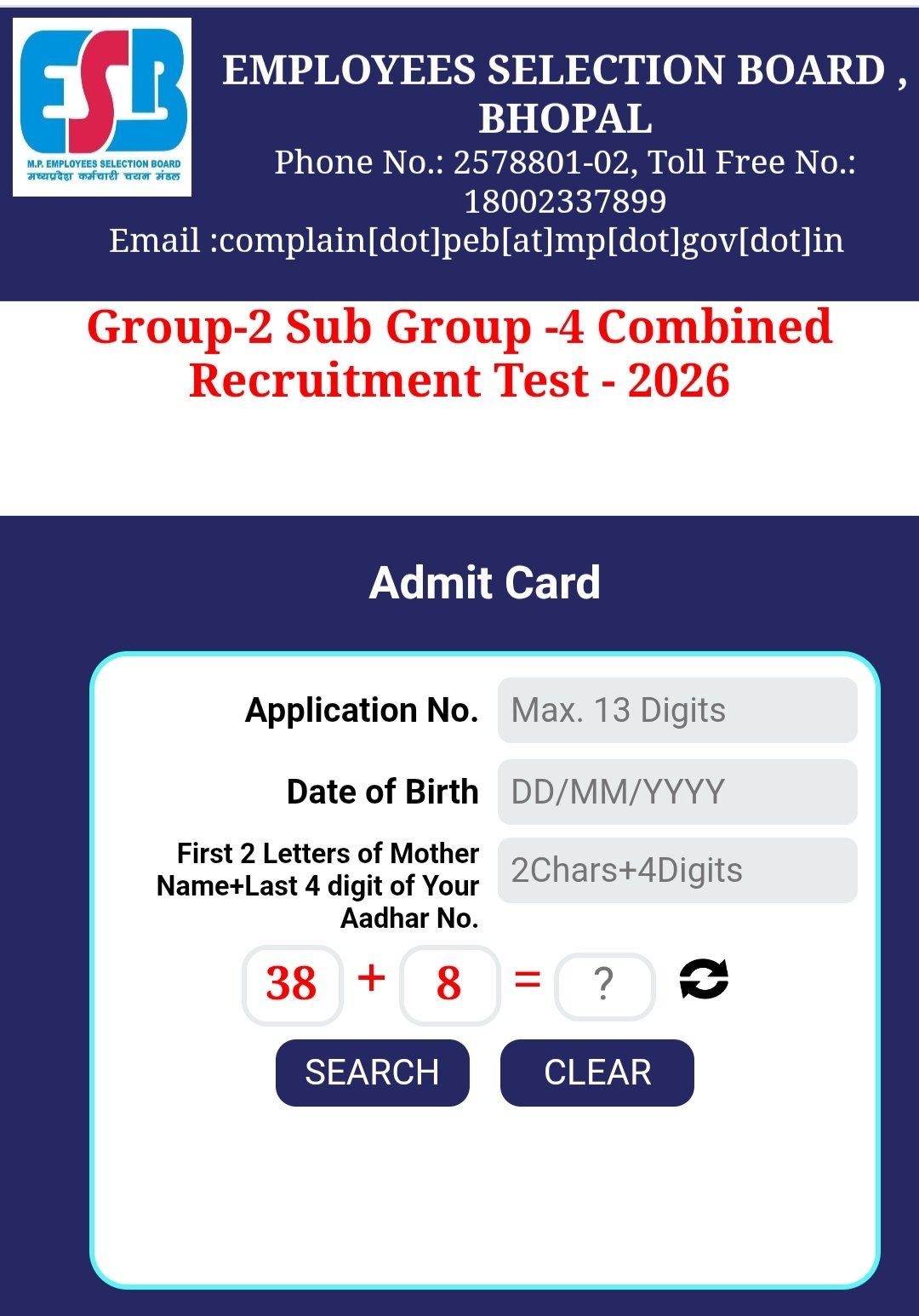
The Madhya Pradesh Employees Selection Board (MPESB) will release the Test Admit Card (TAC) for the Group 3 Sub Engineer and Other Post Combined Recruitment Test 2026 (Second) on its official website, esb.mp.gov.in.

As per the revised rulebook, the examination is scheduled to begin on 20 January 2027.

The MPESB has also reopened the online application window from October 13 to October 27, 2026, allowing candidates to apply under the revised recruitment schedule. The application correction facility will remain available until October 28, 2026.

The MP Sub Engineer Admit Card 2026 release date is yet to be announced. Candidates will be able to download their TAC once the board activates the official link.

Also, Read: MP Sub Engineer Exam 2026 Postponed & Form Reopens from Oct 13

MP Sub Engineer Admit Card 2026: Overview

The MPESB Group 3 Combined Recruitment Test 2026 is being conducted for Sub Engineer, Draftsman, Laboratory Technician and other equivalent posts.

The board has revised the examination schedule and reopened the application process following changes in the reservation roster and an increase in the number of posts.

Particulars

Details

Exam name

Group 3 Sub Engineer and Other Post Combined Recruitment Test 2026 (Second)

Conducting authority

Madhya Pradesh Employees Selection Board (MPESB)

Recruitment

Sub Engineer and other equivalent posts

Exam date

20 January 2027

Previous proposed exam date

October 7, 2026

Admit card

To be announced

Admit card name

Test Admit Card (TAC)

Application reopening date

October 13, 2026

Last date to apply

October 27, 2026

Form correction window

October 13–28, 2026

Exam mode

Online

Official website

MP Sub Engineer Admit Card 2026 Release Date

The MP Sub Engineer Admit Card 2026 release date has not yet been officially announced by MPESB. The board is expected to publish the Test Admit Card (TAC) before the examination through its official website.

Since the examination has been rescheduled to 20 January 2027, candidates should not rely on earlier expectations of admit card release.

Once the TAC link is activated, candidates will be able to access their admit cards by following the instructions provided on the MPESB portal. Applicants should keep their registration and application details readily available.

MP Sub Engineer Exam Date 2026: Latest Update

The MPESB Group 3 Combined Recruitment Test 2026 (Second) was initially proposed to begin on October 7, 2026. However, the board issued a revised notification announcing exam date for 20 January 2027.

Candidates should regularly visit the official website for further updates regarding the examination date, admit card and other recruitment-related announcements.

MP Sub Engineer Admit Card 2026 Download Link

The MPESB will activate the MP Sub Engineer Admit Card 2026 download link on its official portal before the examination. Candidates will be able to download the Test Admit Card after the link becomes available.

MP Sub Engineer TAC 2026 Download link will be available after official activation Candidates should download their TAC only from the official MPESB website and avoid relying on unofficial links or websites.

How to Download MP Sub Engineer Admit Card 2026?

Once the admit card link is activated, candidates can follow these steps to download their MPESB Group 3 TAC.

Visit the official MPESB website at esb.mp.gov.in.

  1. Navigate to the Test Admit Card (TAC) or admit card section.
  2. Find the link for the Group 3 Sub Engineer and Other Post Combined Recruitment Test 2026 (Second).
  3. Click on the relevant TAC download link.
  4. Enter the required application or login details as instructed on the portal.
  5. Submit the information to access the admit card.
  6. Download and save the MP Sub Engineer Admit Card 2026.
  7. Check all the details and take a clear printout as instructed by MPESB.

Details Mentioned on MP Sub Engineer Hall Ticket 2026

After downloading the admit card, candidates should carefully verify all the information printed on it. The TAC is expected to include relevant examination and candidate details, such as:

  • Candidate’s name

  • Roll number or application number

  • Photograph and signature

  • Examination name

  • Recruitment or post details

  • Examination date and shift

  • Reporting time

  • Examination centre name

  • Complete examination centre address

  • Candidate instructions

The exact details will be as displayed on the official TAC. If candidates find any discrepancy, they should contact MPESB through its official communication channels promptly.

MP Sub Engineer Exam Centre 2026

The examination centre details for the MP Sub Engineer Exam 2026 will be mentioned on the Test Admit Card. Candidates should check the complete address, reporting time and other instructions before travelling to the examination venue.

Candidates travelling from other cities or districts should plan their journey in advance to avoid last-minute difficulties. They should also confirm the permitted entry time and any identity verification requirements mentioned on the TAC.

Documents Required for MP Sub Engineer Exam 2026

Candidates should carry the documents specified in the official examination instructions. These may include:

  • A printed copy of the MP Sub Engineer Test Admit Card 2026

  • A valid photo identity proof accepted by MPESB

  • Any additional documents specifically required by the board

Candidates should refer to the final TAC for the accepted identity documents, photograph requirements and any other instructions applicable to the examination.

MP Sub Engineer Exam Day Instructions

Candidates appearing for the MPESB Group 3 examination should carefully follow the instructions printed on the TAC.

  • Reach the examination centre within the reporting time.

  • Carry the printed admit card and prescribed identity proof.

  • Verify the examination centre address in advance.

  • Follow the instructions given by the examination staff.

  • Avoid carrying prohibited electronic devices or other restricted items.

  • Follow the applicable security and identity verification procedures.

  • Read the complete examination instructions before the test.

Candidates should follow the official instructions on their admit card, as these will take precedence over general examination-day guidance.

What to Do If the MP Sub Engineer Admit Card 2026 Is Not Downloading?

Candidates may occasionally face technical problems when accessing their TAC. If the admit card link is active but the document is not downloading, they can try the following steps:

  1. Check whether the official TAC link has been activated.

  2. Verify the application or login details entered on the portal.

  3. Try accessing the website using a different browser.

  4. Clear the browser cache and cookies.

  5. Check the official website for any technical announcements.

  6. Try again later if the portal is experiencing heavy traffic.

  7. Contact MPESB through its official helpdesk or communication channels if the issue persists.

Candidates should not share their login credentials with unofficial websites or individuals claiming to provide admit cards.

MP Sub Engineer Admit Card 2026: Important Dates

Event

Date

Original application start date

August 29, 2026

Original application last date

September 12, 2026

Reopened application start date

October 13, 2026

Reopened application last date

October 27, 2026

Application correction starts

October 13, 2026

Application correction ends

October 28, 2026

Previous proposed exam date

October 7, 2026

Revised examination date

20 January 2027

Admit card release

January 2027

Result date

To be announced

The application and examination dates above reflect the revised schedule stated in the October 1, 2026 official notice. The admit card release date, exact exam date and result date are yet to be announced.

Frequently Asked Questions (FAQs)

1. When will MP Sub Engineer Admit Card 2026 be released?

MPESB has not announced the exact release date of the MP Sub Engineer Admit Card 2026. Candidates can download the Test Admit Card from the official website once the link is activated.

2. What is the new MP Sub Engineer Exam Date 2026?

The MP Sub Engineer Exam 2026 will be conducted on 20 January 2027, according to the official revised rulebook.

3. Has the MP Sub Engineer Exam 2026 been postponed?

Yes. The examination was previously proposed for October 7, 2026, but MPESB has postponed it to 20 January 2027.

4. How can I download the MP Sub Engineer Hall Ticket 2026?

Candidates can download their hall ticket from the official MPESB website by accessing the TAC section and entering the required application or login details once the link is available.

5. What is TAC in MPESB exams?

TAC stands for Test Admit Card. It is the examination admit card issued by MPESB, containing important candidate and examination details.

6. When will the MP Sub Engineer application form reopen?

The application form will reopen on October 13, 2026, and the last date to submit the application is October 27, 2026.

7. What is the last date for MP Sub Engineer application form correction?

The correction facility is scheduled to remain open from October 13 to October 28, 2026, subject to the instructions in the revised rulebook.

General Science MCQs for SSC, Railway and State Exams

General Science MCQs for SSC, Railway and State Exams

General Science is an important part of the General Awareness or General Studies sections of many competitive examinations, including SSC CGL, SSC CHSL, SSC MTS, RRB NTPC, RRB Group D, railway recruitment examinations and various State Government exams.

A good understanding of Physics, Chemistry, Biology and Environmental Science can help candidates prepare for these examinations more effectively.

Here, you will find General Science MCQs with answers. The questions cover fundamental scientific concepts, human physiology, chemical reactions, motion, energy, diseases, plant biology, environmental science and everyday applications of science.

Whether you are preparing for SSC, Railway, Police, State PSC or other competitive examinations, use these practice questions to revise important concepts and identify topics that require further study.

Also, Read: MPESB Sub Engineer Thermodynamics Notes

General Science Syllabus for SSC, Railway and State Exams

Before practising the questions, review the major General Science topics commonly relevant to competitive examinations. The exact syllabus and depth of questions vary by examination.

Subject Important topics
Physics Motion, force, work, energy, power, heat, sound, light, electricity, magnetism and scientific instruments
Chemistry Elements, compounds, atoms, acids, bases, salts, metals, non-metals, chemical reactions and everyday chemistry
Biology Cells, tissues, nutrition, respiration, reproduction, genetics, plants and classification of living organisms
Human Physiology Digestive system, respiratory system, blood, heart, kidneys, hormones, vitamins and deficiency diseases
Environment Ecosystems, food chains, pollution, biodiversity, conservation and climate change
Everyday Science Household chemicals, common diseases, scientific discoveries, measurement and practical applications

Section 1: Physics MCQs for SSC, Railway and State Exams

Q1. Which physical quantity is measured in newtons?

A. Work
B. Force
C. Power
D. Pressure

Correct Answer: B. Force

Explanation: The newton (N) is the SI unit of force. One newton is the force required to give a mass of one kilogram an acceleration of one metre per second squared. Work and energy are measured in joules, power in watts, and pressure in pascals.

Q2. Which law states that an object remains at rest or in uniform straight-line motion unless acted upon by a net external force?

A. Newton’s first law of motion
B. Newton’s second law of motion
C. Newton’s third law of motion
D. Law of universal gravitation

Correct Answer: A. Newton’s first law of motion

Explanation: Newton’s first law is also called the law of inertia. An object’s state of rest or uniform straight-line motion does not change unless a net external force acts on it.

Q3. What is the SI unit of power?

A. Joule
B. Newton
C. Watt
D. Pascal

Correct Answer: C. Watt

Explanation: Power is the rate at which work is done or energy is transferred. One watt equals one joule per second. The SI unit of energy and work is the joule.

Q4. Which type of mirror is commonly used as a rear-view mirror in vehicles?

A. Plane mirror
B. Concave mirror
C. Convex mirror
D. Parabolic mirror only

Correct Answer: C. Convex mirror

Explanation: A convex mirror provides an upright, virtual and diminished image and a wider field of view than a plane mirror. This allows drivers to see a larger area behind their vehicles.

Q5. Which phenomenon explains the splitting of white light into its constituent colours by a prism?

A. Reflection
B. Dispersion
C. Diffraction
D. Polarisation

Correct Answer: B. Dispersion

Explanation: Dispersion occurs because different wavelengths of light are refracted by different amounts in a material such as glass. White light separates into its constituent colours, commonly represented as violet, indigo, blue, green, yellow, orange and red.

Q6. Which medium allows sound to travel?

A. Perfect vacuum
B. Solid only
C. Gases only
D. Solids, liquids and gases

Correct Answer: D. Solids, liquids and gases

Explanation: Sound is a mechanical wave that requires a material medium. It can propagate through solids, liquids and gases but cannot travel through a perfect vacuum because there are no particles to transmit the disturbance.

Q7. Which instrument measures electric current?

A. Voltmeter
B. Ammeter
C. Barometer
D. Hydrometer

Correct Answer: B. Ammeter

Explanation: An ammeter measures electric current, expressed in amperes. It is generally connected in series with the circuit element whose current is being measured. A voltmeter measures potential difference.

Q8. What happens to the resistance of a metallic conductor when its temperature increases, assuming other relevant conditions remain unchanged?

A. It generally increases
B. It always becomes zero
C. It generally decreases
D. It remains exactly constant

Correct Answer: A. It generally increases

Explanation: In metals, higher temperatures generally cause stronger lattice vibrations, which impede the movement of conduction electrons. Consequently, electrical resistance usually increases with temperature over ordinary operating ranges.

Q9. Which form of energy is associated with an object because of its motion?

A. Chemical energy
B. Potential energy
C. Kinetic energy
D. Nuclear energy

Correct Answer: C. Kinetic energy

Explanation: Kinetic energy is the energy possessed by an object due to its motion. For an object of mass (m) moving at speed (v), its translational kinetic energy is (KE = \frac{1}{2}mv^2).

Q10. Why does a metal spoon feel colder than a wooden spoon when both have been kept in the same room for a long time?

A. Metal always has a lower temperature than wood
B. Wood contains no thermal energy
C. Metal conducts heat away from the hand more quickly
D. Wood produces heat when touched

Correct Answer: C. Metal conducts heat away from the hand more quickly

Explanation: When both objects are at the same room temperature, metal generally transfers heat away from the skin more rapidly because of its higher thermal conductivity. The difference in sensation does not mean the metal is necessarily at a lower temperature.

Section 2: Chemistry MCQs for Competitive Exams

Q11. What is the chemical symbol for sodium?

A. So
B. S
C. Na
D. N

Correct Answer: C. Na

Explanation: The symbol for sodium is Na, derived from the Latin name natrium. Sodium is an alkali metal and reacts readily with water, producing sodium hydroxide and hydrogen gas.

Q12. A solution with a pH of 3 is generally classified as:

A. Acidic
B. Neutral
C. Basic
D. Always saturated

Correct Answer: A. Acidic

Explanation: At approximately 25°C, a dilute aqueous solution with pH below 7 is acidic, pH 7 is neutral, and pH above 7 is basic. A pH of 3 indicates an acidic solution.

Q13. Which gas is released when an ordinary carbonate reacts with a suitable dilute acid?

A. Oxygen
B. Carbon dioxide
C. Nitrogen
D. Hydrogen

Correct Answer: B. Carbon dioxide

Explanation: Carbonates generally react with dilute acids to produce a salt, water and carbon dioxide. For example, calcium carbonate reacts with hydrochloric acid to form calcium chloride, water and carbon dioxide.

Q14. Which of the following is a noble gas?

A. Chlorine
B. Nitrogen
C. Oxygen
D. Argon

Correct Answer: D. Argon

Explanation: Argon belongs to Group 18 of the periodic table. Noble gases have relatively low chemical reactivity under ordinary conditions because of their stable valence-shell electron configurations.

Q15. What is the chemical formula of baking soda?

A. Na₂CO₃
B. NaHCO₃
C. CaCO₃
D. NaOH

Correct Answer: B. NaHCO₃

Explanation: Baking soda is sodium hydrogen carbonate, also called sodium bicarbonate. It is used in baking and can release carbon dioxide when it reacts with an acid or decomposes on heating.

Q16. Rusting of iron requires which conditions to proceed under ordinary circumstances?

A. Oxygen only, without moisture
B. Moisture only, without oxygen
C. Oxygen and moisture
D. Carbon dioxide alone

Correct Answer: C. Oxygen and moisture

Explanation: Ordinary rusting of iron generally requires both oxygen and water. Salts and other environmental conditions can accelerate corrosion. Rust is a mixture of hydrated iron oxides and related compounds rather than a single substance with one fixed composition.

Q17. Which method is commonly used to separate insoluble sand from water?

A. Filtration
B. Distillation
C. Sublimation
D. Chromatography

Correct Answer: A. Filtration

Explanation: Filtration separates an insoluble solid from a liquid by passing the mixture through a porous material. Sand is retained by the filter, while water passes through.

Q18. Which of the following is an example of a chemical change?

A. Melting of ice
B. Breaking a glass bottle
C. Dissolving sugar in water
D. Burning of paper

Correct Answer: D. Burning of paper

Explanation: Burning paper produces new substances, including gases and solid residues, through chemical reactions. Melting ice and breaking glass are physical changes, while dissolving sugar in water is generally a physical process.

Q19. Which particle determines the atomic number of an element?

A. Neutron
B. Proton
C. Electron
D. Proton plus neutron

Correct Answer: B. Proton

Explanation: The atomic number equals the number of protons in an atom’s nucleus. Atoms of the same element have the same atomic number, although they may have different numbers of neutrons and therefore be different isotopes.

Q20. Which gas is commonly used in fire extinguishers because it does not support ordinary combustion and can help displace oxygen around a fire?

A. Hydrogen
B. Oxygen
C. Carbon dioxide
D. Acetylene

Correct Answer: C. Carbon dioxide

Explanation: Carbon dioxide is used in certain fire extinguishers because it can displace oxygen near the fire and is non-flammable. Its suitability depends on the fire type and environment; it is not appropriate for every fire and can create an asphyxiation hazard in confined spaces.

Section 3: Biology MCQs for SSC, Railway and State Exams

Q21. Which cell organelle is primarily responsible for producing ATP through aerobic cellular respiration?

A. Ribosome
B. Mitochondrion
C. Golgi apparatus
D. Lysosome

Correct Answer: B. Mitochondrion

Explanation: Mitochondria are the main sites of most ATP production during aerobic cellular respiration in eukaryotic cells. ATP serves as a readily usable energy carrier for many cellular processes.

Q22. Which pigment absorbs light energy for photosynthesis in green plants?

A. Haemoglobin
B. Melanin
C. Chlorophyll
D. Keratin

Correct Answer: C. Chlorophyll

Explanation: Chlorophyll absorbs light energy used in photosynthesis. In plants, photosynthesis converts light energy into chemical energy and uses carbon dioxide and water to produce carbohydrates, releasing oxygen under oxygenic photosynthesis.

Q23. Which organ produces insulin in the human body?

A. Liver
B. Pancreas
C. Kidney
D. Thyroid gland

Correct Answer: B. Pancreas

Explanation: Insulin is produced by beta cells in the pancreatic islets. It helps regulate blood glucose by promoting glucose uptake in certain tissues and supporting glucose storage and metabolism.

Q24. Which component of blood is primarily responsible for transporting oxygen?

A. Platelets
B. Plasma proteins
C. Red blood cells
D. White blood cells

Correct Answer: C. Red blood cells

Explanation: Red blood cells contain haemoglobin, a protein that binds oxygen in the lungs and transports it to body tissues. Plasma carries many dissolved substances, white blood cells help defend against infection, and platelets are important in blood clotting.

Q25. Deficiency of vitamin C causes which disease?

A. Rickets
B. Scurvy
C. Beriberi
D. Night blindness

Correct Answer: B. Scurvy

Explanation: Vitamin C is necessary for normal collagen synthesis and connective-tissue maintenance. Severe deficiency can cause scurvy, which may involve bleeding gums, easy bruising and impaired wound healing.

Q26. Which part of the human brain is particularly important for balance and coordination of voluntary movement?

A. Cerebellum
B. Hypothalamus
C. Medulla oblongata
D. Cerebrum’s occipital lobe

Correct Answer: A. Cerebellum

Explanation: The cerebellum helps coordinate movement, maintain balance and regulate posture. It fine-tunes motor activity rather than independently initiating every voluntary movement.

Q27. What is the functional unit of the kidney?

A. Neuron
B. Alveolus
C. Nephron
D. Villus

Correct Answer: C. Nephron

Explanation: The nephron is the basic structural and functional unit of the kidney. It filters blood, reabsorbs useful substances, secretes selected substances into the tubule and contributes to urine formation.

Q28. Which type of blood vessel generally carries blood away from the heart?

A. Artery
B. Vein
C. Capillary only
D. Lymphatic vessel

Correct Answer: A. Artery

Explanation: Arteries carry blood away from the heart, while veins carry blood towards it. The oxygen content is not the defining feature: pulmonary arteries carry oxygen-poor blood, and pulmonary veins carry oxygen-rich blood.

Q29. Which process allows green plants to lose water vapour mainly through their leaves?

A. Translocation
B. Germination
C. Transpiration
D. Pollination

Correct Answer: C. Transpiration

Explanation: Transpiration is the loss of water vapour from a plant, mainly through stomata in the leaves. It contributes to water movement through the plant and helps regulate leaf temperature.

Q30. Which blood group is considered the universal red-cell donor type in routine transfusion terminology?

A. AB positive
B. O negative
C. A positive
D. B negative

Correct Answer: B. O negative

Explanation: O-negative red blood cells lack A, B and RhD antigens, making them the usual emergency universal red-cell donor type when compatibility cannot immediately be established. Crossmatching and clinical transfusion protocols remain important; this does not mean O-negative whole blood or plasma is universally compatible.

Section 4: Human Physiology, Diseases and Nutrition MCQs

Q31. Which enzyme in human saliva begins the digestion of starch?

A. Pepsin
B. Salivary amylase
C. Trypsin
D. Lipase only

Correct Answer: B. Salivary amylase

Explanation: Salivary amylase begins the breakdown of starch into smaller carbohydrates in the mouth. Further carbohydrate digestion occurs in the small intestine, where pancreatic amylase and other enzymes play important roles.

Q32. Which vitamin is essential for normal blood clotting and is required for the synthesis of several clotting factors?

A. Vitamin C
B. Vitamin D
C. Vitamin K
D. Vitamin B₁₂

Correct Answer: C. Vitamin K

Explanation: Vitamin K is required for the normal functioning of several blood-clotting proteins. A severe deficiency can impair clotting and increase bleeding risk.

Q33. Which microorganism causes tuberculosis?

A. Mycobacterium tuberculosis
B. Plasmodium falciparum
C. Influenza virus
D. Entamoeba histolytica

Correct Answer: A. Mycobacterium tuberculosis

Explanation: Tuberculosis is an infectious disease caused primarily by Mycobacterium tuberculosis, a bacterium. It most commonly affects the lungs but can also affect other organs.

Q34. Malaria is transmitted to humans primarily through the bite of an infected:

A. Female Anopheles mosquito
B. Male Anopheles mosquito
C. Housefly
D. Sandfly

Correct Answer: A. Female Anopheles mosquito

Explanation: Malaria is caused by Plasmodium parasites, which are transmitted to humans through the bites of infected female Anopheles mosquitoes. Houseflies do not transmit malaria in this way.

Q35. Which hormone plays a major role in regulating the body’s metabolic rate?

A. Insulin
B. Thyroxine
C. Adrenaline alone
D. Melatonin

Correct Answer: B. Thyroxine

Explanation: Thyroxine (T4), produced by the thyroid gland, is converted in tissues partly into the more active thyroid hormone T3. Thyroid hormones influence basal metabolic rate, growth and development.

Q36. Which part of the digestive system absorbs most nutrients from digested food?

A. Oesophagus
B. Stomach
C. Small intestine
D. Large intestine

Correct Answer: C. Small intestine

Explanation: Most nutrient absorption takes place in the small intestine. Its inner surface has folds, villi and microvilli that increase the surface area available for absorption.

Q37. Which deficiency is classically associated with rickets in children?

A. Vitamin C deficiency
B. Vitamin D deficiency
C. Vitamin K deficiency
D. Vitamin B₁ deficiency

Correct Answer: B. Vitamin D deficiency

Explanation: Vitamin D helps the body absorb calcium and phosphate, which are important for bone mineralisation. Deficiency during childhood can cause rickets, leading to weak or poorly mineralised bones. Other nutritional and medical factors can also contribute.

Q38. Which organ filters blood to remove many metabolic waste products and helps maintain water and electrolyte balance?

A. Kidney
B. Gallbladder
C. Spleen
D. Pancreas

Correct Answer: A. Kidney

Explanation: The kidneys filter blood plasma and regulate water, electrolytes and acid-base balance. They remove wastes such as urea through urine and also perform important hormonal functions.

Section 5: Environment and Everyday Science MCQs

Q39. Which gas is a major contributor to human-caused global warming?

A. Helium
B. Carbon dioxide
C. Neon
D. Argon

Correct Answer: B. Carbon dioxide

Explanation: Carbon dioxide is a major greenhouse gas emitted through fossil-fuel combustion, deforestation and several industrial processes. It absorbs and emits infrared radiation, contributing to the warming of Earth’s climate. Other greenhouse gases, including methane and nitrous oxide, also contribute.

Q40. Which layer of Earth’s atmosphere contains most of the ozone layer?

A. Troposphere
B. Stratosphere
C. Mesosphere
D. Exosphere

Correct Answer: B. Stratosphere

Explanation: Most atmospheric ozone is concentrated in the stratosphere. This ozone layer absorbs much of the Sun’s harmful ultraviolet radiation, helping protect life on Earth.

Q41. Which process converts atmospheric nitrogen into chemical forms that plants can ultimately use?

A. Nitrogen fixation
B. Transpiration
C. Photosynthesis alone
D. Evaporation

Correct Answer: A. Nitrogen fixation

Explanation: Nitrogen fixation converts atmospheric nitrogen gas into biologically usable nitrogen compounds. Certain bacteria perform this process, and industrial processes can also fix nitrogen. Plants generally absorb nitrogen through their roots in forms such as nitrate or ammonium.

Q42. Which of the following is a renewable source of energy?

A. Coal
B. Petroleum
C. Solar energy
D. Natural gas

Correct Answer: C. Solar energy

Explanation: Solar energy is replenished continuously by sunlight on human timescales. Coal, petroleum and natural gas are fossil fuels that form over geological timescales and are not replenished rapidly enough to be considered renewable.

Q43. What is the main purpose of biodegradable waste composting?

A. To convert organic waste into a more stable, useful material
B. To increase plastic production
C. To produce radioactive waste
D. To prevent all microbial activity permanently

Correct Answer: A. To convert organic waste into a more stable, useful material

Explanation: Composting uses microorganisms to break down suitable organic waste into a more stable material that can improve soil structure and supply nutrients. Effective composting depends on conditions such as moisture, oxygen, temperature and the waste mixture.

Q44. Which scientific instrument is used to measure atmospheric pressure?

A. Thermometer
B. Barometer
C. Hygrometer
D. Calorimeter

Correct Answer: B. Barometer

Explanation: A barometer measures atmospheric pressure. A thermometer measures temperature, a hygrometer measures humidity, and a calorimeter is used to measure heat exchanged in a process.

Q45. Which instrument is used to measure relative humidity?

A. Hygrometer
B. Ammeter
C. Seismograph
D. Speedometer

Correct Answer: A. Hygrometer

Explanation: A hygrometer measures humidity, including relative humidity. Relative humidity expresses the amount of water vapour in the air relative to the maximum amount the air could hold at the same temperature, usually as a percentage.

Q46. Which of the following is an example of an ecosystem?

A. A single mineral crystal
B. A community of organisms interacting with its physical environment
C. A single chemical element
D. A collection of unrelated laboratory instruments

Correct Answer: B. A community of organisms interacting with its physical environment

Explanation: An ecosystem consists of a biological community and its physical environment, including interactions involving energy flow and nutrient cycling. Examples include forests, ponds, grasslands and deserts.

Q47. Which human activity is a major source of sulphur dioxide emissions in many industrial regions?

A. Burning sulphur-containing fossil fuels
B. Collecting rainwater
C. Using solar panels
D. Planting native trees

Correct Answer: A. Burning sulphur-containing fossil fuels

Explanation: Burning coal or oil containing sulphur can release sulphur dioxide. This gas contributes to air pollution and can form sulphate particles and acids in the atmosphere. Emissions depend on fuel composition and pollution-control measures.

Q48. Which part of a plant primarily absorbs water and dissolved minerals from the soil?

A. Flower petals
B. Root system
C. Fruit skin
D. Pollen grains

Correct Answer: B. Root system

Explanation: Roots absorb water and mineral nutrients from the soil. Root hairs increase the surface area available for absorption, while xylem transports water and dissolved minerals to other parts of the plant.

Q49. What is the main reason soap is less effective at forming lather in hard water?

A. Hard water contains dissolved calcium and magnesium ions
B. Hard water contains no oxygen
C. Hard water has no dissolved minerals
D. Hard water always has a pH of exactly 7

Correct Answer: A. Hard water contains dissolved calcium and magnesium ions

Explanation: Calcium and magnesium ions react with many conventional soaps to form poorly soluble compounds called soap scum. This reduces lather formation and wastes soap. Synthetic detergents generally perform better in hard water.

Q50. Which energy transformation occurs in a simple electric bulb when it is switched on?

A. Electrical energy into light and thermal energy
B. Chemical energy into nuclear energy
C. Sound energy into gravitational energy
D. Nuclear energy into chemical energy

Correct Answer: A. Electrical energy into light and thermal energy

Explanation: An electric bulb converts electrical energy into light and heat. An incandescent bulb produces substantial heat, while LED bulbs generally convert a larger proportion of their electrical input into useful light.

How to Prepare General Science for SSC, Railway and State Exams

Solving MCQs is useful, but candidates should also understand why each answer is correct. A structured approach can help you retain information and recognise concepts when questions are presented differently.

1. Study one science subject at a time

Start with the basics of Physics, Chemistry and Biology. Study fundamental concepts before moving to fact-based questions. For example, understand force and motion before memorising their units and laws.

2. Practise topic-wise MCQs

Complete practice sets on individual topics such as electricity, acids and bases, human physiology, vitamins, diseases and environmental science. This makes it easier to identify weak areas.

3. Maintain a revision notebook

Record important formulas, scientific units, chemical symbols, vitamin deficiencies, diseases and their causative organisms. Keep explanations short and revise them regularly.

4. Solve previous year question papers

Use previous year papers from the relevant examination to understand its actual syllabus, question style and difficulty level. Prefer authentic papers and clearly labelled solutions, and distinguish official questions from newly created practice material.

5. Analyse mistakes

After each practice session, review every incorrect answer. Identify whether the mistake resulted from a forgotten fact, an unclear concept or misreading the question. Revisit the relevant topic before attempting another test.

MPESB Group 2 Sub Group 4 Answer Key 2026 Out, Raise Objections by Oct 9

MPESB Group 2 Sub Group 4 Answer Key 2026

The Madhya Pradesh Employees Selection Board (MPESB) conducted the Group 2 Sub Group 4 Combined Recruitment Test 2026 from September 23 to October 5, 2026. The examination was conducted for various posts covered under the recruitment test.

The board has officially released the MPESB Group 2 Sub Group 4 Answer Key 2026 on October 6 at esb.mp.gov.in. Candidates can download the answer key to check their answers and estimate their marks.

The objection window to raise objections will remain open from 6 October to 9 October 2026.

MPESB Group 2 Sub Group 4 Answer Key 2026: Overview

Particular Details
Exam Name Group 2 Sub Group 4 Combined Recruitment Test 2026
Conducting Body Madhya Pradesh Employees Selection Board (MPESB)
Exam Date September 23 to October 5, 2026
Exam Mode Online/Computer-Based Test
Answer Key Status Released
Answer Key Mode Online
Official Website esb.mp.gov.in

MPESB Group 2 Sub Group 4 Answer Key 2026 Link

The official answer key link is now available at MPESB website. Candidates can download the answer key by providing their application number, TAC code and date of birth, followed by captcha code. A direct link to access the response sheet is attached here.

MPESB Group 2 Sub Group 4 Answer Key 2026 Link

How to Download MPESB Group 2 Sub Group 4 Answer Key 2026?

Candidates can follow these steps to access the answer key from the official MPESB portal:

  1. Visit the official MPESB website.
  2. Open the Student Dashboard or examination-related section.
  3. Find Group-2 Sub Group-4 Combined Recruitment Test 2026.
  4. Look for the answer key link./objection
  5. Open the link for the relevant examination.
  6. Check the answer key and candidate response details, if provided.
  7. Download or save the answer key for reference.
  8. Compare the answers with the responses marked in the examination.

Candidates should carefully check their shift, question paper and question number before calculating their probable score.

How to Calculate Marks Using MPESB Group 2 Sub Group 4 Answer Key?

After downloading the official answer key, candidates can compare each answer with the response they marked during the examination.

A simple calculation method is:

Probable Score = Marks for Correct Answers − Applicable Marks for Incorrect Answers

However, candidates should check the official examination instructions for the applicable marking scheme before calculating their final expected score.

If there is no negative marking, the calculation will generally depend on the number of correct responses and marks assigned to each question. Candidates should not assume a marking scheme unless it is mentioned in the official examination rules.

MPESB Group 2 Sub Group 4 Answer Key Objection 2026

Along with the answer key release, MPESB has activated a link to raise objections for candidates who disagree with an answer can submit an objection within the specified period, 6-9 October 2026. For objection raise, candidates need to pay the applicable online fee per question.

Before raising an objection, candidates should:

  • Check the official answer carefully.
  • Verify the question and response option.
  • Refer to a reliable textbook or official source.
  • Provide a clear explanation for the objection.
  • Upload supporting evidence if required.
  • Submit the objection before the deadline.
  • Pay the prescribed objection fee, if applicable.

Candidates should follow the instructions mentioned in the official MPESB objection notice.

What Happens After the MPESB Group 2 Sub Group 4 Answer Key?

The answer key is an important stage in the recruitment process, but it is not the final result.

The process may broadly progress through these stages:

Examination → Model Answer → Objection Window → Final Answer Key → Result → Further Selection Process

MPESB’s official dashboard separately provides fields for Model Answer, Result and Final Answer, showing that these stages can be published separately for recruitment examinations.

Candidates should therefore avoid treating the provisional answer key as the final basis for selection.

MPESB Group 2 Sub Group 4 Answer Key 2026: Why Should Candidates Check It?

Checking the answer key can help candidates:

  • Estimate their probable marks.
  • Identify incorrect answers.
  • Review difficult questions.
  • Decide whether an objection is justified.
  • Assess their expected performance.
  • Prepare for the next stage of the recruitment process.

Candidates should remember that the estimated score may differ from the final marks depending on the official evaluation process and final answer key.

MPESB Group 2 Sub Group 4 Response Sheet 2026

Candidates may also need their MPESB Group 2 Sub Group 4 response sheet or recorded responses to calculate their probable score accurately.

The MPESB website has a dedicated Question Paper and Candidate Responses section for online examination objections and response-related information.

As the Group 2 Sub Group 4 response sheet issued, candidates can compare their recorded answers with the official model answers.

MPESB Group 2 Sub Group 4 Result 2026

The MPESB Group 2 Sub Group 4 Result 2026 will be released separately after the examination and answer-key process.

Candidates should wait for the official result rather than considering their estimated score as the final score. The MPESB results section publishes recruitment-test results separately after they are officially hosted.

The result is expected to contain the candidate’s qualifying status and other relevant details as prescribed by the Board.

What Should Candidates Do After Checking the Answer Key?

After calculating their probable marks, candidates should avoid spending too much time comparing unofficial cut-off predictions.

Instead, they should:

  1. Save a copy of the official answer key.
  2. Check whether any answer appears incorrect.
  3. Raise objections if the official objection window is available.
  4. Keep the application and examination details safe.
  5. Follow MPESB updates regarding the result and subsequent process.

Candidates who expect to qualify should also keep their required documents ready for the next stage, as applicable to their post.

FAQs

When will the MPESB Group 2 Sub Group 4 Answer Key 2026 be released?

The MPESB Group 2 Sub Group 4 answer key release date is 6th October 2026. The answer key is now available for download at esb.mp.gov.in.

Where can I download the MPESB Group 2 Sub Group 4 Answer Key 2026?

Candidates can download the answer key from the official MPESB website at esb.mp.gov.in using the required login details.

What was the MPESB Group 2 Sub Group 4 Exam Date 2026?

The MPESB Group 2 Sub Group 4 Combined Recruitment Test 2026 was conducted from September 23 to October 5, 2026.

When will the MPESB Group 2 Sub Group 4 Result 2026 be released?

The result date has not been officially announced. Candidates should check the MPESB result section and official dashboard for the result notification.

How to Make Short Notes for MP Sub Engineer Exam 2026

Preparing for the MP Sub Engineer Exam 2026 involves covering a wide range of technical and non-technical topics. Repeatedly reading the full syllabus can be difficult, especially in the final stages of preparation. Short notes can help candidates revise important concepts quickly without going through entire books or lengthy study material.

However, short notes should not become another set of detailed study material. The purpose is to reduce a large topic to its most important points. Candidates should prepare notes that are easy to read before mock tests and during the final revision.

Also, Check:

How to Make Short Notes for MP Sub Engineer Exam 2026?

Follow these steps to prepare useful and easy-to-revise short notes.

1. Start With the Official Syllabus

Before making notes, divide the syllabus into individual subjects and topics. This prevents candidates from spending too much time making notes on low-priority topics.

Create a simple checklist such as:

  • Subject
  • Chapter or topic
  • Important concepts
  • Formulas
  • Facts or values to remember
  • Questions requiring repeated practice

Mark each topic after completing its notes and revision.

2. Do Not Write Everything

Short notes should contain only information that you are likely to forget or need to revise quickly.

Include:

  • Important formulas
  • Definitions
  • Key concepts
  • Important technical terms
  • Rules and principles
  • Important differences
  • Common mistakes
  • Frequently confused facts
  • Short tricks for calculations

Avoid copying complete explanations from textbooks or coaching notes.

3. Make Separate Formula Sheets

For technical subjects, formulas should have a separate section.

For example, Civil Engineering candidates can maintain formulas related to:

  • Strength of Materials
  • Fluid Mechanics
  • Soil Mechanics
  • Surveying
  • RCC
  • Hydraulics
  • Engineering Mechanics

Mechanical Engineering candidates can maintain separate formula sheets for:

  • Thermodynamics
  • Fluid Mechanics
  • Strength of Materials
  • Theory of Machines
  • IC Engines
  • Refrigeration
  • Machine Design

Electrical Engineering candidates can organise formulas from:

  • Electrical Circuits
  • Electrical Machines
  • Power Systems
  • Measurements
  • Electronics
  • Electrical Utilisation

Write the formula along with the meaning of each symbol and its unit wherever required.

4. Use Tables for Similar Concepts

Tables are useful when two or more concepts need to be compared.

For example:

Topic Point 1 Point 2 Point 3
AC vs DC Direction Frequency Common applications
Transformer types Construction Voltage ratio Application
Soil types Particle size Properties Engineering use

This format makes differences easier to remember during revision.

5. Prepare Subject-Wise Short Notes

Avoid maintaining one large notebook for the complete syllabus. Divide your notes according to subjects.

A useful structure is:

Non-Technical Subjects

  • General Knowledge
  • General Hindi
  • General English
  • Mathematics
  • Reasoning
  • General Science
  • Computer Knowledge

Technical Subjects

  • Civil Engineering
  • Mechanical Engineering
  • Electrical Engineering

Candidates should prepare notes according to the technical subject applicable to their post.

How to Make Short Notes for Civil Engineering?

Civil Engineering candidates should give greater attention to formulas, definitions, standard concepts, diagrams and design principles.

Important areas for short notes include:

Strength of Materials

Note down:

  • Stress and strain
  • Elastic constants
  • Bending equation
  • Shear force and bending moment
  • Torsion
  • Columns
  • Principal stresses

Fluid Mechanics

Focus on:

  • Fluid properties
  • Pressure
  • Continuity equation
  • Bernoulli equation
  • Reynolds number
  • Pipe losses
  • Flow measurement

Soil Mechanics

Include:

  • Index properties
  • Phase relationships
  • Atterberg limits
  • Permeability
  • Effective stress
  • Compaction
  • Consolidation
  • Shear strength
  • Bearing capacity

Surveying

Prepare quick notes for:

  • Chain surveying
  • Compass surveying
  • Levelling
  • Contouring
  • Theodolite
  • Total station
  • Common surveying errors

How to Make Short Notes for Mechanical Engineering?

Mechanical Engineering notes should focus heavily on formulas, machine components, working principles and numerical concepts.

Important sections include:

  • Engineering Mechanics
  • Strength of Materials
  • Theory of Machines
  • Thermodynamics
  • Fluid Mechanics
  • IC Engines
  • Refrigeration and Air Conditioning
  • Manufacturing Technology
  • Machine Design
  • Engineering Materials

For machines and equipment, use a simple format:

Name → Principle → Construction → Working → Application → Important Formula

This makes technical topics easier to revise.

How to Make Short Notes for Electrical Engineering?

Electrical Engineering candidates should maintain separate formula and concept sheets.

Important areas include:

  • Electrical Circuits
  • Electrical Machines
  • Power Systems
  • Electrical Measurements
  • Electronics
  • Power Electronics
  • Electrical Utilisation

For electrical machines, note down:

  • Construction
  • Working principle
  • EMF equation
  • Torque equation
  • Characteristics
  • Losses
  • Efficiency
  • Applications

For power systems, focus on:

  • Generation
  • Transmission
  • Distribution
  • Protection
  • Switchgear
  • Earthing
  • Load-related terms

How to Make Short Notes for Non-Technical Subjects?

Non-technical notes should be even more concise.

General Knowledge

Prepare topic-wise lists for:

  • Indian History
  • Geography
  • Indian Polity
  • Economy
  • Science and Technology
  • Important national events
  • Current affairs

Mathematics

Maintain a formula sheet covering:

  • Percentage
  • Ratio and proportion
  • Average
  • Profit and loss
  • Simple and compound interest
  • Time and work
  • Time, speed and distance
  • Mensuration
  • Basic algebra

Reasoning

Instead of writing long explanations, record:

  • Important patterns
  • Short methods
  • Formula-based concepts
  • Common question types
  • Mistakes made while solving questions

Hindi and English

Maintain vocabulary and grammar lists rather than lengthy notes.

Include:

  • Synonyms
  • Antonyms
  • One-word substitutions
  • Idioms
  • Grammar rules
  • Common errors
  • Important vocabulary

Use the 1-Page Rule

One useful method is to limit each small topic to one page.

For example:

Topic: Bernoulli Equation

Include only:

  • Definition
  • Assumptions
  • Equation
  • Meaning of terms
  • Applications
  • One important numerical concept
  • Common mistake

If a short topic requires several pages, check whether you are copying too much information.

Use Active Recall While Making Notes

Do not simply read a chapter and copy it.

After completing a topic, close your book and try to recall:

  • What is the main concept?
  • Which formulas are important?
  • What are the key differences?
  • Which facts are difficult to remember?
  • Which questions did I get wrong?

Add only the points that you could not recall easily.

This makes the notes more personalised and useful.

Maintain a Mistake Notebook

A separate mistake notebook can be more useful than adding every mistake to your main notes.

After solving practice questions, record:

Question → My mistake → Correct concept → Correct formula/approach

For example:

Mistake: Used the wrong unit in a numerical question
Correction: Convert all quantities into consistent SI units before calculation.

Revise this notebook before mock tests.

Keep Short Notes Updated

Do not prepare your notes once and leave them unchanged.

After every mock test or practice session:

  1. Identify repeated mistakes.
  2. Add only important corrections.
  3. Remove unnecessary information.
  4. Update formulas if you find an error.
  5. Mark topics that need another revision.

This gradually turns your notes into a personalised revision resource.

How Often Should You Revise Short Notes?

A simple revision cycle can be followed:

Revision Suggested Time
First revision Within 24 hours
Second revision After 3–4 days
Third revision After 7 days
Fourth revision After 15 days
Final revision Before the exam

The exact schedule can be adjusted according to your preparation level and remaining time.

Common Mistakes While Making Short Notes

Avoid these mistakes:

Making Notes Too Long

If your short notes look like a textbook, they will not help with quick revision.

Copying Without Understanding

Writing information does not mean you have learned it. Understand the concept first and then summarise it.

Ignoring Difficult Topics

Do not make notes only for topics you already know. Difficult and frequently forgotten topics deserve more attention.

Using Too Many Colours

Excessive highlighting can make notes difficult to scan. Use a simple and consistent marking system.

Not Revising the Notes

Preparing notes is only the first step. Their real benefit comes from repeated revision.

Not Adding Mistakes

Questions that you repeatedly get wrong should become part of your revision notes.

Best Short-Note Strategy for the Last Few Days

During the final revision, avoid starting new lengthy study material unless necessary.

Prioritise:

  1. Formula sheets
  2. Important definitions
  3. Frequently forgotten facts
  4. Previous mistakes
  5. Important technical concepts
  6. Mock-test errors
  7. Frequently revised topics
  8. Current affairs and factual lists relevant to the exam

Try to make your final revision material short enough to scan multiple times.

FAQs

How to make short notes for MP Sub Engineer Exam 2026?

Start with the official syllabus and divide it into subjects and topics. Write only important formulas, definitions, concepts, facts, differences and mistakes. Keep technical notes formula-focused and non-technical notes concise.

Should I make separate short notes for technical and non-technical subjects?

Yes. Separate notes make revision faster. Technical subjects can be organised around formulas, concepts and numerical methods, while non-technical notes can focus on facts, rules, vocabulary and important question types.

How long should short notes for MP Sub Engineer Exam 2026 be?

There is no fixed page limit. Each topic should contain only the information required for quick revision. A small topic should ideally fit on one page or less.

Should I make handwritten or digital short notes?

Both methods can work. Handwritten notes can improve active recall, while digital notes are easier to edit and organise. Choose the format that allows you to revise quickly and consistently.

MPPSC ITI Principal Recruitment 2027: Eligibility, Vacancy, Exam Pattern

MPPSC ITI Principal Recruitment 2027 is expected to be an important government job opportunity for eligible engineering graduates and diploma holders looking for senior-level positions in Industrial Training Institutes (ITIs) under Madhya Pradesh’s Technical Education, Skill Development & Employment Department.

At present, MPPSC has not officially announced the ITI Principal Recruitment 2027 notification. Therefore, the vacancy, application dates, exam date, eligibility conditions, syllabus, fee and other recruitment details should be treated as expected information based primarily on the previous MPPSC ITI Principal recruitment pattern.

Candidates preparing for MPPSC ITI Principal Vacancy 2027 can use this page as a preparation and information guide. Once the official notification is released, candidates should verify all eligibility and recruitment conditions against the latest advertisement.

MPPSC ITI Principal Recruitment 2027 – Overview

Particular Details
Recruitment MPPSC ITI Principal Recruitment 2027
Recruiting Body Madhya Pradesh Public Service Commission (MPPSC)
Department Technical Education, Skill Development & Employment, Madhya Pradesh
Post ITI Principal
Recruitment Year 2027
Vacancy To be announced
Notification Not officially announced yet
Application Mode Expected to be Online
Exam Mode Expected to be Offline/OMR Based
Selection Process Expected Written Examination + Interview
Educational Qualification Expected Engineering Degree/Diploma with prescribed experience
Age Limit Expected to be notified
Exam Date To be announced
Official Notification Awaited

MPPSC ITI Principal Recruitment 2027 Notification

The MPPSC ITI Principal Recruitment 2027 notification is expected to contain complete information about vacancies, post-wise eligibility, age limit, educational qualification, experience requirements, application dates, examination pattern, syllabus, application fee and selection process.

As of now, there is no confirmed MPPSC ITI Principal Notification 2027 details. Candidates should therefore avoid relying on unofficial vacancy numbers or tentative exam dates circulating on social media.

The previous recruitment included posts such as Deputy Director, Assistant Director (Technical) and ITI Principal under the Technical Education, Skill Development & Employment Department. The ITI Principal post was part of a 15-post recruitment cycle in that notification.

For 2027, the number of ITI Principal vacancies may be different.

MPPSC ITI Principal Vacancy 2027

The MPPSC ITI Principal Vacancy 2027 has not been announced yet.

The exact number of vacancies will depend on the requirements communicated by the concerned department and the recruitment notification issued by MPPSC.

Candidates should not consider any unofficial vacancy figure as final until the official advertisement is released.

Expected Vacancy Details

Post 2027 Vacancy
ITI Principal To be announced
Category-wise vacancies To be announced
Total vacancies To be announced

The final vacancy distribution may include reservation categories such as UR, EWS, OBC, SC and ST, subject to the rules and vacancy position mentioned in the official notification.

MPPSC ITI Principal Recruitment 2027 Important Dates

The MPPSC ITI Principal Recruitment 2027 important dates have not been announced.

The following schedule is therefore only an expected framework:

Event Expected Status
Notification Release To be announced
Online Application Start To be announced
Last Date to Apply To be announced
Application Correction To be announced
Admit Card To be announced
MPPSC ITI Principal Exam Date 2027 To be announced
Result To be announced
Interview To be announced
Final Selection To be announced

Candidates should wait for the official MPPSC notification before treating any date as confirmed.

MPPSC ITI Principal Eligibility Criteria 2027

The MPPSC ITI Principal eligibility criteria 2027 are expected to include educational qualification, relevant professional experience and age requirements.

However, the exact eligibility conditions can change from one recruitment cycle to another. Candidates should therefore use the previous recruitment criteria only as a preparation reference.

Educational Qualification

Based on the previous MPPSC ITI Principal recruitment pattern, candidates for the ITI Principal position were required to have an engineering/technology qualification from a recognised university or institution.

The previous recruitment allowed candidates with a relevant Bachelor’s Degree or Diploma in Engineering/Technology, with prescribed experience requirements for eligible diploma holders.

For MPPSC ITI Principal Recruitment 2027, the final qualification will be confirmed only through the official notification.

Candidates should carefully check:

  • Required engineering/technology discipline
  • Degree or diploma requirement
  • Recognition of the qualification
  • Required professional experience
  • Experience calculation date
  • Whether equivalent qualifications are accepted

Experience Requirement

Relevant professional experience is an important eligibility component for the ITI Principal position.

In the previous recruitment pattern, diploma candidates applying for the ITI Principal post were required to have 5 years of relevant experience.

For 2027, candidates should not assume that the same experience requirement will remain unchanged. The official notification may specify the qualifying experience, nature of work, experience calculation date and acceptable organisations.

Age Limit

The previous MPPSC recruitment mentioned an age range beginning at 21 years, with the upper age limit specified according to the applicable recruitment rules.

For MPPSC ITI Principal Recruitment 2027, the minimum and maximum age, cut-off date and relaxation rules are yet to be confirmed.

Age relaxation, wherever applicable, will depend on the category and Madhya Pradesh government recruitment rules mentioned in the official advertisement.

MPPSC ITI Principal Application Form 2027

The MPPSC ITI Principal application form 2027 is expected to be available online after the release of the official recruitment notification.

Candidates should be prepared with the following information and documents:

  • Personal details
  • Educational qualification details
  • Engineering/Diploma information
  • Professional experience details
  • Category certificate, wherever applicable
  • Domicile-related documents, if required
  • Photograph
  • Signature
  • Valid identity document
  • Other documents specified by MPPSC

Candidates should enter all information carefully because incorrect educational, category or experience information can affect eligibility.

How to Apply for MPPSC ITI Principal Recruitment 2027

Once the recruitment is officially announced, candidates can generally expect the application process to follow these steps:

  1. Visit the MPPSC online application portal.
  2. Read the official ITI Principal recruitment notification carefully.
  3. Complete the registration process, if required.
  4. Log in using the required credentials.
  5. Select the ITI Principal recruitment/application option.
  6. Enter personal, educational and professional details.
  7. Upload the required documents.
  8. Pay the applicable application fee.
  9. Review the complete application form.
  10. Submit the application.
  11. Save or download the submitted application for future reference.

Candidates should complete the application before the prescribed deadline rather than waiting until the final day.

MPPSC ITI Principal Application Fee 2027

The MPPSC ITI Principal application fee 2027 has not been announced.

The fee structure can change depending on the recruitment notification and candidate category. Therefore, candidates should not rely on the previous recruitment’s fee structure for the 2027 application.

The official notification will specify:

  • Category-wise application fee
  • Portal/service charges, if applicable
  • Payment methods
  • Fee exemption provisions
  • Correction charges, if applicable

MPPSC ITI Principal Selection Process 2027

The MPPSC ITI Principal selection process 2027 is expected to consist of a written examination followed by an interview, based on the previous recruitment pattern.

The previous recruitment used:

Written Examination → Interview → Document Verification/Final Selection

The final process for 2027 will be confirmed only after MPPSC releases the official notification.

Expected Selection Stages

Stage 1: Written Examination

Candidates are expected to appear for an objective-type examination covering general knowledge and professional/technical subjects.

Stage 2: Interview

Candidates qualifying for the next stage may be called for an interview according to the rules specified in the recruitment notification.

Stage 3: Document Verification

Candidates shortlisted for final selection may be required to produce original educational, experience, category and other relevant documents.

MPPSC ITI Principal Exam Pattern 2027

The MPPSC ITI Principal exam pattern 2027 has not been officially released.

However, the previous examination pattern can be used as a preparation reference.

The previous paper consisted of two major sections:

Section Subject Questions Marks
Part A General Knowledge of Madhya Pradesh, National & International Level and Basic Computer Knowledge 50 150
Part B Engineering, Skill Development & Vocational Training 100 300
Total — 150 450

The previous examination had a 3-hour duration, with each question carrying 3 marks. A negative marking of 1 mark for an incorrect answer was also mentioned.

Important Note About the 2027 Exam Pattern

The above pattern is not a confirmed MPPSC ITI Principal Exam Pattern 2027.

MPPSC may retain, modify or completely revise the structure, number of questions, marks, duration or negative-marking system in the 2027 recruitment.

Candidates should therefore use this pattern for preliminary preparation and check the official notification once released.

MPPSC ITI Principal Syllabus 2027

The MPPSC ITI Principal syllabus 2027 is expected to cover two broad areas:

Part A – General Knowledge and Computer

The previous syllabus included topics related to:

  • Madhya Pradesh history
  • Madhya Pradesh culture
  • Madhya Pradesh geography
  • Madhya Pradesh literature
  • Important personalities
  • State-level current affairs
  • National and international general knowledge
  • Basic computer knowledge
  • Other topics prescribed by the Commission

Part B – Engineering, Skill Development and Vocational Training

The technical section is expected to focus on professional knowledge related to engineering, industrial training, skill development and vocational education.

Candidates should particularly focus on:

  • Engineering fundamentals
  • Technical concepts related to their discipline
  • Industrial training
  • Vocational education
  • Skill development
  • Training methodologies
  • Industrial management-related concepts
  • Technical education system
  • Relevant government initiatives and programmes

The detailed 2027 syllabus should be prepared only after the official syllabus is released.

MPPSC ITI Principal Exam 2027 Preparation Strategy

Candidates preparing for MPPSC ITI Principal Exam 2027 should start with the previous syllabus and examination structure rather than waiting for the notification.

1. Understand the Technical Syllabus

The technical section is expected to have substantial weightage. Engineering fundamentals and professional subjects should therefore receive priority during preparation.

2. Prepare Madhya Pradesh General Knowledge

Revise:

  • MP history
  • Geography
  • Culture
  • Tribes
  • Literature
  • Economy
  • Important personalities
  • Current affairs
  • Government schemes

3. Practise Objective Questions

The previous pattern was objective-based, making regular MCQ practice important.

Candidates should practise questions under time limits and analyse incorrect answers.

4. Focus on Negative Marking

If the previous negative-marking system is retained, random guessing can reduce the overall score.

Candidates should develop an attempt strategy based on accuracy.

5. Revise Engineering Concepts

Prepare short notes for formulas, definitions, technical concepts and frequently tested topics.

6. Follow Official Updates

Because recruitment conditions can change, candidates should verify the notification, syllabus, vacancy and examination pattern when MPPSC announces the recruitment.

MPPSC ITI Principal Salary 2027

The MPPSC ITI Principal salary 2027 will be confirmed through the official recruitment notification and applicable government pay rules.

In the previous recruitment information, the ITI Principal post was listed with a pay scale of ₹56,100–₹1,77,500.

However, candidates should treat this figure as a previous-recruitment reference, not as the confirmed 2027 salary.

The final salary may include applicable allowances and benefits according to Madhya Pradesh government rules.

MPPSC ITI Principal Job Profile

An ITI Principal is responsible for the overall administration and effective functioning of an Industrial Training Institute.

The responsibilities may include:

  • Managing institute administration
  • Supervising training and academic activities
  • Monitoring instructors and staff
  • Ensuring effective delivery of vocational training
  • Maintaining institutional records
  • Monitoring infrastructure and facilities
  • Coordinating examinations and assessments
  • Supporting skill-development initiatives
  • Ensuring compliance with departmental instructions
  • Coordinating with relevant government departments

The exact duties will depend on the applicable service rules and departmental requirements.

MPPSC ITI Principal 2027: Who Should Apply?

The recruitment can be particularly relevant for candidates who have:

  • Engineering qualifications
  • Relevant diploma qualifications
  • Required professional experience
  • Interest in technical education
  • Experience in industrial or vocational training
  • An interest in government administration and skill development

However, possessing a degree or diploma alone may not be sufficient if the final notification prescribes specific experience, branch or other conditions.

MPPSC ITI Principal Recruitment 2027 – FAQs

Is MPPSC ITI Principal Recruitment 2027 confirmed?

No. As of now, MPPSC ITI Principal Recruitment 2027 has not been officially confirmed. The vacancy, notification date and examination schedule are awaited.

When will the MPPSC ITI Principal Notification 2027 be released?

The exact notification date has not been announced. Candidates should wait for an official recruitment advertisement from MPPSC.

How many vacancies will be available for MPPSC ITI Principal Recruitment 2027?

The number of MPPSC ITI Principal vacancies 2027 has not been announced. The final vacancy will be known only after the recruitment notification is released.

What is the qualification for MPPSC ITI Principal Recruitment 2027?

The exact 2027 qualification is yet to be confirmed. Based on the previous recruitment, engineering degree/diploma qualifications with prescribed experience requirements were considered for the ITI Principal post. Candidates must check the 2027 notification for the final eligibility criteria.

What is the age limit for MPPSC ITI Principal Recruitment 2027?

The 2027 age limit has not been announced. Candidates should check the official notification for the minimum age, maximum age, cut-off date and applicable relaxation.

What is the MPPSC ITI Principal Exam Pattern?

The 2027 exam pattern is yet to be released. In the previous pattern, the written examination consisted of 150 objective questions carrying 450 marks and was conducted for 3 hours. The paper had General Knowledge/Computer and Engineering, Skill Development & Vocational Training sections.

Is there negative marking in the MPPSC ITI Principal Exam?

The previous examination pattern included 1 mark negative marking for every incorrect answer. Whether the same system will apply in 2027 will be confirmed by MPPSC.

What is the MPPSC ITI Principal selection process?

The previous recruitment followed a written examination followed by an interview, with document verification as part of the final recruitment process. The 2027 selection process will be confirmed in the official notification.

What is the salary of an MPPSC ITI Principal?

The previous recruitment listed the ITI Principal pay scale as ₹56,100–₹1,77,500. The applicable salary and pay structure for 2027 should be verified from the new notification.

Can diploma holders apply for MPPSC ITI Principal?

Diploma holders were eligible under the previous recruitment subject to the prescribed experience and other conditions. Whether the same eligibility will apply in 2027 will depend on the official notification.

Is MPPSC ITI Principal a government job?

Yes, the ITI Principal position is associated with the Madhya Pradesh government’s Technical Education, Skill Development & Employment Department. The exact post, service conditions and recruitment rules applicable to the 2027 cycle will be specified in the official notification.

Where can candidates get MPPSC ITI Principal Recruitment 2027 updates?

Candidates should monitor official MPPSC announcements for the notification, application dates, syllabus, admit card, examination schedule and results. This page can also be updated as confirmed information becomes available.

Final Word

MPPSC ITI Principal Recruitment 2027 can be an important opportunity for eligible engineering and experienced diploma candidates seeking a government career in technical education and vocational training in Madhya Pradesh.

However, the 2027 recruitment should not be treated as officially announced at this stage. The vacancy, eligibility, application dates, exam pattern, syllabus, salary and selection process presented above are either based on the previous recruitment or marked as expected.

Candidates can begin preparation using the previous examination structure, particularly the technical subjects, Madhya Pradesh general knowledge and objective-question practice. Once MPPSC releases the official ITI Principal Recruitment 2027 notification, candidates should use the latest advertisement as the final authority for all recruitment-related decisions.

MP Sub Engineer Exam 2026 Postponed, Application Form Reopens from October 13; Check Revised Dates

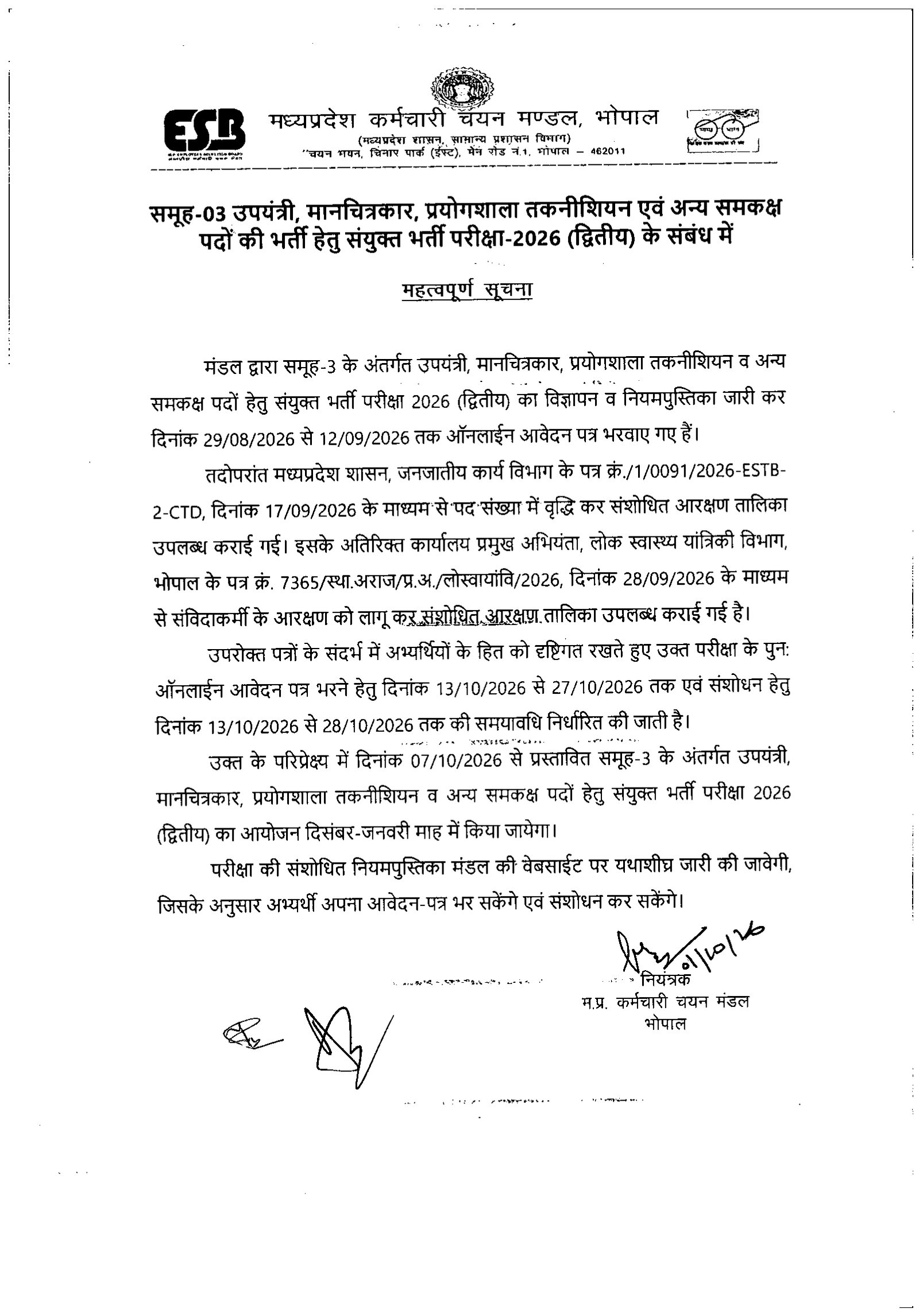
The Madhya Pradesh Employees Selection Board (MPESB), Bhopal, has announced changes to the Group 3 Combined Recruitment Test 2026 (Second), conducted for Sub Engineer, Draftsman, Laboratory Technician and other equivalent posts.

According to the latest official notice dated October 1, 2026, the examination has been postponed and is now proposed to be conducted in December 2026–January 2027.

The board has also reopened the online application window from October 13 to October 27, 2026, allowing eligible candidates to submit their applications. Candidates who need to make corrections to their submitted forms can do so from October 13 to October 28, 2026.

The revised schedule follows changes to the reservation roster and an increase in the number of vacancies, as communicated by the concerned Madhya Pradesh government departments. Candidates are advised to check the revised notification and updated rulebook on the official MPESB website.

MP Sub Engineer Exam 2026 Postponed

MPESB Group 3 Recruitment 2026: Revised Dates

The MPESB Group 3 Combined Recruitment Test 2026 (Second) was initially scheduled to be conducted from October 7, 2026. However, the board has now revised the examination schedule and announced that the test will be held in December 2026–January 2027.

Candidates can check the revised schedule and important dates below.

Event Revised dates
Recruitment examination MPESB Group 3 Combined Recruitment Test 2026 (Second)
Conducting authority Madhya Pradesh Employees Selection Board (MPESB)
Posts Sub Engineer, Draftsman, Laboratory Technician and equivalent posts
Original application dates August 29 to September 12, 2026
Reopened application window October 13 to October 27, 2026
Application correction window October 13 to October 28, 2026
Previous proposed exam date October 7, 2026
Revised examination schedule December 2026–January 2027
Application mode Online
Official website esb.mp.gov.in
Latest notice date October 1, 2026

Why Was the MP Sub Engineer Exam 2026 Postponed?

As per the latest notice issued by MPESB, the recruitment process has been revised following changes to the reservation roster and an increase in the number of posts.

The Madhya Pradesh Government’s Tribal Affairs Department issued a communication dated September 17, 2026, regarding the revised reservation roster and increased post count. Additionally, the Office of the Chief Engineer, Public Health Engineering Department, Bhopal, submitted a communication dated September 28, 2026, concerning the revised reservation roster for contractual employees.

In view of these changes, the board has revised the recruitment arrangements, reopened the application process and rescheduled the examination to December 2026–January 2027.

Also Read: MP Sub Engineer Thermodynamics Notes

MP Sub Engineer Application Form 2026 Reopens

MPESB has announced a fresh application window for candidates interested in the Group 3 Combined Recruitment Test 2026 (Second). The online application process will reopen on October 13, 2026, and eligible candidates can submit their forms until October 27, 2026.

Candidates should refer to the revised rulebook before applying to ensure that they meet the updated eligibility conditions and follow the revised reservation details.

Application dates: October 13 to October 27, 2026

Application mode: Online

Official application portal: esb.mp.gov.in

Candidates should complete the application process within the revised deadline and save a copy of the submitted application form for future reference.

MPESB Group 3 Application Correction Dates 2026

The board has also provided a correction window for candidates who need to modify the details entered in their application forms.

The correction facility will be available from October 13 to October 28, 2026. Candidates should review their personal, educational and other application details carefully and make the necessary corrections within the specified period.

The updated rulebook will provide the applicable instructions regarding form corrections.

MP Sub Engineer Exam 2026 New Exam Date

The MPESB Group 3 Combined Recruitment Test 2026 (Second), which was previously proposed to begin on October 7, 2026, has been postponed. According to the latest official notice, the examination is now scheduled to take place in December 2026–January 2027.

The board has not specified the exact examination date in the notice. Candidates should regularly check the official MPESB website for the detailed examination schedule, admit card release date and further instructions.

How to Apply for MPESB Group 3 Recruitment 2026?

Candidates can follow these steps to submit their applications during the reopened registration window:

  1. Visit the official MPESB website at esb.mp.gov.in.
  2. Navigate to the Group 3 Combined Recruitment Test 2026 (Second) recruitment section.
  3. Open the revised notification and rulebook and read the instructions carefully.
  4. Click on the application link and complete the required registration details.
  5. Fill in the application form with the necessary personal, educational and other information.
  6. Upload the required documents and pay the applicable examination fee, as instructed.
  7. Review the application form and submit it.
  8. Download and save the confirmation page for future reference.

Candidates who have already applied should also check the revised instructions to understand whether they need to submit a fresh application or update their existing details.

Important Instructions for Candidates

  • The online application window will reopen on October 13, 2026.
  • The last date to submit the application form is October 27, 2026.
  • The application correction window will remain open until October 28, 2026.
  • The examination is now proposed to be held in December 2026–January 2027.
  • Candidates should refer to the revised rulebook for updated eligibility, vacancy and reservation information.
  • The exact examination date and admit card schedule are yet to be specified in the notice.

Candidates should rely on the official MPESB website for further updates and avoid depending solely on older recruitment notifications or previously published examination schedules.

MPESB Sub Engineer Thermodynamics Notes 2026, Download PDF

MPESB Sub Engineer Thermodynamics Notes 2026 are useful for Mechanical Engineering candidates preparing for the MPESB Group 3 Sub Engineer examination. Thermodynamics is an important part of the Mechanical Engineering technical syllabus, covering concepts such as thermodynamic systems, laws of thermodynamics, ideal gases, thermodynamic processes, cycles, steam, heat transfer and refrigeration.

To make revision easier, we have provided handwritten Thermodynamics notes in PDF format covering important concepts, formulas, diagrams and exam-oriented points in a crisp format.

Also, Check: MP Sub Engineer Admit Card 2026

MP Sub Engineer Thermodynamics Notes PDF

The PDF is designed for quick revision rather than lengthy textbook-style study. It brings important Thermodynamics concepts together on handwritten-style pages so that candidates can revise formulas, definitions, processes and cycles before the examination.

What is Covered in the Thermodynamics Notes?

The MPESB Sub Engineer Thermodynamics Notes PDF 2026 covers the following major areas:

  • Basic concepts and definitions of Thermodynamics
  • Thermodynamic systems and surroundings
  • Properties of thermodynamic systems
  • Intensive and extensive properties
  • Properties of pure substances
  • Phase diagrams
  • Ideal gas and real gas
  • Gas laws and gas constant
  • First Law of Thermodynamics
  • Heat, work and internal energy
  • Thermodynamic processes
  • Isothermal process
  • Adiabatic process
  • Isobaric process
  • Isochoric process
  • Polytropic process
  • Second Law of Thermodynamics
  • Kelvin-Planck and Clausius statements
  • Entropy and entropy change
  • Air-standard cycles
  • Otto cycle
  • Diesel cycle
  • Dual cycle
  • Important formulas and revision points

The broader Mechanical Engineering syllabus also connects Thermodynamics with steam generators, nozzles, condensers, turbines, IC engines, heat transfer and refrigeration, so candidates should study those related thermal-engineering topics separately as required by the complete syllabus.

Download MPESB Sub Engineer Thermodynamics Notes PDF 2026

Candidates can download the MP Sub Engineer Thermodynamics Handwritten Notes PDF from the link below.

MPESB Sub Engineer Thermodynamics Notes 2026 PDF

Important Thermodynamics Topics for MPESB Sub Engineer

For effective preparation, candidates should give special attention to the following areas:

1. Basic Thermodynamics

Understand the meaning of system, surroundings, boundary, state, process, cycle and thermodynamic equilibrium. Also revise the difference between open, closed and isolated systems.

2. Properties of Pure Substances

Focus on pressure, temperature, volume, specific volume, internal energy, enthalpy and entropy. Phase-change concepts and phase diagrams are also important for understanding later topics.

3. Ideal Gas

Revise the ideal gas equation:

PV = mRT

Candidates should also remember the relationship between specific heats:

Cp − Cv = R

and

γ = Cp/Cv

These formulas are frequently useful in numerical-based questions.

4. First Law of Thermodynamics

The First Law is based on conservation of energy. Candidates should understand the relationship between heat, work and change in internal energy.

For a closed system:

Q − W = ΔU

Numerical questions can involve heat supplied, work done and changes in internal energy.

5. Thermodynamic Processes

The major processes that should be revised are:

  • Isothermal
  • Adiabatic
  • Isobaric
  • Isochoric
  • Polytropic

Remember the condition, P-V relationship and work-done formula associated with each process.

6. Second Law and Entropy

The Second Law introduces the direction of natural thermodynamic processes and the concept of entropy. Candidates should revise the Kelvin-Planck and Clausius statements along with entropy change for common processes.

7. Thermodynamic Cycles

Air-standard cycles are particularly useful for Mechanical Engineering preparation. Revise the sequence of processes, P-V diagrams and efficiency formulas of:

  • Otto Cycle
  • Diesel Cycle
  • Dual Cycle

How to Use These Notes for MPESB Preparation

These handwritten notes are best used as a revision resource, not as a replacement for the complete syllabus or detailed numerical practice.

A practical approach is:

  1. Read the concept from your main study material.
  2. Use the PDF to revise definitions and formulas.
  3. Practice numerical questions based on each process.
  4. Draw important P-V diagrams yourself.
  5. Revise cycle processes and efficiency formulas repeatedly.
  6. Solve previous-year and practice MCQs after completing each topic.

The MP Sub Engineer technical paper covers branch-specific engineering subjects, so Thermodynamics should be prepared alongside other Mechanical Engineering subjects such as Strength of Materials, Applied Mechanics, Fluid Mechanics, Theory of Machines, Machine Design and Manufacturing Technology.

MPESB Sub Engineer Thermodynamics Notes – Quick Revision Checklist

Before the examination, make sure you can recall:

  • Basic thermodynamic terminology
  • System classification
  • Intensive and extensive properties
  • Gas laws
  • Ideal gas equation
  • Specific heat relations
  • First Law
  • Heat and work
  • Internal energy and enthalpy
  • Isothermal process
  • Adiabatic process
  • Isobaric process
  • Isochoric process
  • Polytropic process
  • Second Law
  • Entropy
  • Otto Cycle
  • Diesel Cycle
  • Dual Cycle
  • Important thermodynamic formulas

FAQs

Are these MPESB Sub Engineer Thermodynamics Notes free?

Yes. The handwritten PDF provided on this page is available for free download.

Are these notes enough for the complete Mechanical Engineering syllabus?

No. These notes focus specifically on Thermodynamics. Candidates should cover the remaining Mechanical Engineering subjects separately according to the applicable MPESB syllabus.

Does the PDF contain formulas?

Yes. Important Thermodynamics formulas and relationships are included for quick revision.

Can these notes be used for last-minute revision?

Yes. The compact handwritten format makes the PDF suitable for quick revision of important concepts, formulas, processes and thermodynamic cycles before the examination.

MPESB Group 2 Sub Group 4 Exam Analysis 2026: Difficulty Level, Questions & Good Attempts

MPESB Group 2 Sub Group 4 Exam Analysis 2026

The MPESB Group 2 Sub Group 4 Exam 2026 started on September 23, 2026, and will continue till October 5, 2026. The Madhya Pradesh Employees Selection Board (MPESB) is conducting the Group-2 Sub Group-4 Combined Recruitment Test 2026 in multiple shifts.

This page provides the MPESB Group 2 Sub Group 4 Exam Analysis 2026 based on candidate feedback after each shift. The analysis covers the overall difficulty level, subject-wise difficulty, questions asked and good attempts. Candidates appearing in the upcoming shifts can use these updates to understand the paper trend and revise accordingly.

Also, Check:

MPESB Group 2 Sub Group 4 Exam Analysis 2026: Latest Update

September 23, 2026: The MPESB Group 2 Sub Group 4 examination has started today. According to candidate’s feedback, overall paper was moderately difficult. Some questions were lengthy and time-taking while overall paper was moderate.

Shift 1 Analysis: Overall paper difficulty level was moderate.

Shift 2 Analysis: The question paper in 2nd shift was slightly difficult.

MPESB Group 2 Sub Group 4 Paper Analysis 2026

Shift Overall Difficulty Good Attempts (Expected)
September 23, Shift 1 Moderate 160-170
September 23, Shift 2 Moderate to Difficult 155-165
Upcoming Shifts To be updated To be updated

Note: Good attempts are indicative and based on candidate feedback. They are not an official qualifying benchmark released by MPESB.

MPESB Group 2 Sub Group 4 Subject-Wise Analysis 2026

The subject-wise analysis report the questions and difficulty level from their respective shifts.

General Mathematics

Difficulty Level: Moderate

The questions were asked from these areas:

  • Pipes and Cistern
  • Time and Work
  • Percentage
  • Ratio and Proportion
  • Average
  • Profit and Loss
  • Simple and Compound Interest
  • Time, Speed and Distance
  • Number System
  • Simplification
  • Mensuration
  • Algebra
  • Data Interpretation

General Reasoning

Difficulty Level: Easy to Moderate

The reasoning questions reported by candidates, including:

  • Number Series
  • Alphabet Series
  • Analogy
  • Classification
  • Coding-Decoding
  • Blood Relations
  • Direction Sense
  • Syllogism
  • Venn Diagram
  • Ranking
  • Statement and Conclusion
  • Seating Arrangement
  • Puzzles

General Hindi

Difficulty Level: Moderate

The questions from Hindi section were from:

  • Sandhi
  • Samas
  • Paryayvachi Shabd
  • Vilom Shabd
  • Muhavare
  • Lokoktiyan
  • Shabd Shuddhi
  • Vakya Shuddhi
  • Grammar
  • Comprehension

General English

Difficulty Level: Moderate

The questions were asked from these topics:

  • Tenses
  • Articles
  • Prepositions
  • Subject-Verb Agreement
  • Synonyms and Antonyms
  • Error Detection
  • Sentence Correction
  • Vocabulary
  • Idioms and Phrases
  • Reading Comprehension

General Science

Difficulty Level: Moderate

Candidates’ feedback report the questions and topics covered from:

  • Physics
  • Chemistry
  • Biology
  • Human Body
  • Diseases
  • Environment
  • Everyday Science
  • Basic scientific concepts

General Knowledge and General Aptitude

Difficulty Level: Easy to Moderate

This section included questions from:

  • Madhya Pradesh GK
  • Indian History
  • Indian Geography
  • Indian Polity
  • Economy
  • Current Affairs
  • Madhya Pradesh government schemes
  • Important national and state events

Computer Knowledge

Difficulty Level: Moderate

The questions asked in the paper related to:

  • Computer Fundamentals
  • Hardware and Software
  • Operating Systems
  • MS Word
  • MS Excel
  • MS PowerPoint
  • Internet
  • Networking
  • Memory
  • Shortcut Keys
  • Cybersecurity

General Management

Difficulty Level: Moderate to Difficult

This section covered questions from:

  • Management principles
  • Planning
  • Organising
  • Staffing
  • Directing
  • Controlling
  • Leadership
  • Motivation
  • Communication
  • Decision-Making
  • Human Resource Management

MPESB Group 2 Sub Group 4 Exam 2026: What Later-Shift Candidates Should Note

Candidates whose exams are scheduled on later dates can use the analysis to identify topics being reported repeatedly, sections taking more time and the overall question trend.

However, candidates should continue preparing according to the prescribed syllabus rather than relying only on questions reported from earlier shifts, as the paper can vary between shifts.

MPESB Group 2 Sub Group 4 Exam 2026: Important Topics to Revise Before the Exam

The MPESB Group 2 Sub Group 4 Exam 2026 is scheduled to begin on September 23, 2026, and will continue through October 5. The admit cards have also been released on 18 September 2026.

With limited time remaining, candidates should avoid starting completely new topics. The focus should be on revision, previous-year questions, formulas, factual information and mock-test practice.

The examination covers two broad parts with subjects including General Science, General Hindi, General English, General Mathematics, General Knowledge and Aptitude, Computer Knowledge, Reasoning Ability and General Management.

Also, Read:

MPESB Group 2 Sub Group 4 Exam Pattern 2026

The examination is conducted as a computer-based test. The paper consists of 200 questions carrying 200 marks, with a total duration of three hours. The syllabus is divided into two parts.

Part Subjects Marks
Part A General Science, General Hindi, General English and General Mathematics 100
Part B General Knowledge & Aptitude, Computer Knowledge, Reasoning Ability and General Management 100
Total All subjects 200

Candidates should follow the latest MPESB rulebook for the exact rules applicable to their post and examination.

MPESB Group 2 Sub Group 4 Important Topics for Last-Minute Revision

1. General Knowledge and Madhya Pradesh GK

Revise first:

  • Madhya Pradesh history
  • Formation of Madhya Pradesh
  • Important dynasties and historical personalities
  • MP geography
  • Major rivers, dams and irrigation projects
  • National parks and wildlife sanctuaries
  • Important cities and districts
  • Tribes of Madhya Pradesh
  • Folk dances, festivals, fairs and cultural heritage
  • Important tourist places
  • Agriculture and major crops
  • Minerals and industries
  • Important state government schemes
  • Important national and state-level current affairs
  • Indian Constitution and polity
  • Important constitutional bodies
  • Indian history and geography
  • Basic Indian economy

Last-minute practice: Focus particularly on MP-specific one-liners and factual questions rather than reading lengthy theory.

2. General Science

For General Science, revise basic concepts and frequently used facts from Physics, Chemistry and Biology.

Physics

  • Units and measurements
  • Motion
  • Force and laws of motion
  • Work, power and energy
  • Heat and temperature
  • Light
  • Sound
  • Electricity
  • Magnetism

Chemistry

  • Matter and its properties
  • Elements, compounds and mixtures
  • Acids, bases and salts
  • Metals and non-metals
  • Chemical reactions
  • Periodic table basics
  • Everyday chemistry

Biology

  • Human body systems
  • Nutrition
  • Vitamins and deficiency diseases
  • Diseases and their causes
  • Blood and blood groups
  • Cell and basic genetics
  • Plant biology
  • Environment and ecology

Last-minute practice: Solve objective questions instead of spending time reading complete chapters again.

3. General Hindi

Hindi revision should focus on grammar, vocabulary and question-solving practice.

Important topics:

  • Sandhi
  • Samas
  • Upsarg and Pratyay
  • Paryayvachi Shabd
  • Vilom Shabd
  • Anek Shabdon Ke Liye Ek Shabd
  • Muhavare and Lokoktiyan
  • Shabd Shuddhi
  • Vakya Shuddhi
  • Tatsam and Tadbhav
  • Vachan
  • Ling
  • Kaal
  • Alankar
  • Sentence-related questions
  • Reading comprehension

Last-minute practice: Revise commonly confused words and solve short grammar sets.

4. General English

Do not start advanced English topics at the last minute. Focus on commonly tested grammar and vocabulary.

Important topics:

  • Tenses
  • Subject-Verb Agreement
  • Articles
  • Prepositions
  • Pronouns
  • Adjectives
  • Adverbs
  • Active and Passive Voice
  • Direct and Indirect Speech
  • Synonyms
  • Antonyms
  • One-word substitution
  • Idioms and phrases
  • Error spotting
  • Sentence correction
  • Fill in the blanks
  • Reading comprehension
  • Vocabulary

Last-minute practice: Attempt short English question sets and revise mistakes from previous tests.

5. General Mathematics

Mathematics can be revised efficiently by focusing on formulas and frequently practised arithmetic topics.

Important topics:

  • Number System
  • HCF and LCM
  • Simplification
  • Percentage
  • Ratio and Proportion
  • Average
  • Profit and Loss
  • Simple Interest
  • Compound Interest
  • Time and Work
  • Time, Speed and Distance
  • Mensuration
  • Basic Algebra
  • Geometry
  • Data Interpretation
  • Partnership

Last-minute practice: Keep a separate formula sheet and solve questions using a timer.

6. Reasoning Ability

For Reasoning, focus on question types that you have already practised.

Important topics:

  • Analogy
  • Classification
  • Number Series
  • Alphabet Series
  • Coding-Decoding
  • Blood Relations
  • Direction Sense
  • Ranking and Order
  • Syllogism
  • Venn Diagrams
  • Statement and Conclusion
  • Calendar
  • Clock
  • Seating Arrangement
  • Puzzles
  • Non-verbal Reasoning

Last-minute practice: Practise mixed reasoning sets rather than learning unfamiliar puzzle types.

7. Computer Knowledge

Computer questions can be revised through short factual notes.

Important topics:

  • Computer fundamentals
  • Hardware and software
  • Input and output devices
  • Operating systems
  • Memory and storage
  • CPU
  • MS Word
  • MS Excel
  • MS PowerPoint
  • Internet
  • Email
  • Networking basics
  • Computer shortcuts
  • Cybersecurity basics
  • Digital payments
  • Common computer terminology

Last-minute practice: Revise shortcut keys, terminology and basic MS Office functions.

8. General Management

Candidates should revise basic management concepts and their definitions.

Important topics:

  • Principles of management
  • Planning
  • Organising
  • Staffing
  • Directing
  • Controlling
  • Leadership
  • Motivation
  • Communication
  • Decision-making
  • Coordination
  • Organisation structure
  • Human resource management
  • Time management
  • Basic administrative concepts

Focus on definitions, principles and basic differences between management concepts during the final revision.

Most Important Areas to Practise Before the MPESB Exam

If you have only a short time left, divide your revision into these five areas:

Priority Area What to Do
1 MP GK + Current Affairs Revise short notes and factual questions
2 Maths + Reasoning Solve timed practice sets
3 Hindi + English Revise grammar and vocabulary
4 Computer Revise facts, shortcuts and basic concepts
5 Science + Management Revise formulas, concepts and one-liners

The purpose of this list is revision and practice, not to suggest that questions will necessarily be asked from only these topics.

Use Previous-Year Questions for Final Revision

Previous-year questions can help candidates become familiar with the type and level of questions asked in MPESB examinations. Instead of simply checking the answer, note why an option is correct and why your selected option was wrong.

A useful final revision cycle is:

Attempt → Check → Mark Mistakes → Revise Concept → Reattempt

This approach is more useful in the final days than repeatedly reading the same study material.

Do Not Ignore Mock-Test Analysis

Taking a mock test without analysing it wastes much of its revision value.

After every mock, divide your mistakes into four categories:

  • Concept mistake: Revise the topic.
  • Calculation mistake: Practise similar questions.
  • Silly mistake: Slow down and read the question carefully.
  • Time-management issue: Practise that question type with a timer.

Candidates should also revise questions that they left unanswered despite knowing the concept.

MPESB Group 2 Sub Group 4 Exam 2026: Final Revision Checklist

Before leaving for the examination, candidates should have:

  • Revised their short notes
  • Practised previous-year questions
  • Attempted full-length mock tests
  • Revised Maths formulas
  • Revised important Reasoning patterns
  • Revised MP GK
  • Revised important current affairs
  • Revised Hindi and English grammar
  • Revised Computer basics
  • Checked their admit card and examination details
  • Read the instructions mentioned on the admit card

The MPESB official website currently lists the Group-2 Sub Group-4 Combined Recruitment Test 2026 and its Test Admit Card under the latest updates. The official student dashboard lists the examination window as September 23 to October 5, 2026, so candidates should rely on their individual admit card for their allotted exam date, shift and centre.

FAQs

What should I study last minute for MPESB Group 2 Sub Group 4 Exam 2026?

Prioritise MP GK, current affairs, Maths, Reasoning, Hindi, English, Computer Knowledge, General Science and General Management. Revise short notes and practise previous-year questions and mock tests.

Which topics should I revise first for MPESB Group 2 Sub Group 4?

Start with topics you have already studied and that can be revised quickly, such as MP GK facts, current affairs, Maths formulas, Reasoning patterns, Hindi and English grammar, and Computer Knowledge.

Should I study new topics before the MPESB Group 2 Sub Group 4 exam?

In the final days, it is generally more practical to strengthen already-prepared topics, revise mistakes and practise questions rather than attempting to cover a large number of completely new topics.

How should I practise Maths and Reasoning before the exam?

Use timed question sets and focus on accuracy. After each set, identify questions that consumed excessive time and revise the underlying method.

When is the MPESB Group 2 Sub Group 4 Exam 2026 scheduled?

The official MPESB student dashboard currently lists the examination from September 23 to October 5, 2026. Candidates should follow the date and shift printed on their individual admit card.

How to Download MPESB Group 2 Sub Group 4 Admit Card 2026

The MPESB Group 2 Sub Group 4 Admit Card 2026 has been released on 18 September 2026 by the Madhya Pradesh Employees Selection Board (MPESB). Candidates appearing for the Group 2 Sub Group 4 Combined Recruitment Test can now download their MPESB Group 2 Sub Group 4 Hall Ticket 2026 from the official website, esb.mp.gov.in.

The examination is scheduled to be conducted from 23 September to 5 October 2026. Candidates should download their admit card before the examination and check all details, including the exam date, shift, reporting time and examination centre.

MPESB Group 2 Sub Group 4 Hall Ticket 2026: Key Highlights

Particular Details
Exam Authority Madhya Pradesh Employees Selection Board (MPESB)
Exam Name Group 2 Sub Group 4 Combined Recruitment Test 2026
Admit Card Released
Admit Card Release Date 18 September 2026
Exam Date 23 September to 5 October 2026
Exam Mode Computer-Based Test (CBT)
Admit Card Mode Online
Official Website esb.mp.gov.in

How to Download MPESB Group 2 Sub Group 4 Admit Card 2026

Candidates can download the MPESB Group 2 Sub Group 4 Hall Ticket by following these steps:

  1. Visit the official MPESB website, esb.mp.gov.in.
  2. Open the Test Admit Card (TAC) section available on the website.
  3. Find the link for Group 2 Sub Group 4 Combined Recruitment Test 2026.
  4. Click on the admit card download link.
  5. Enter the required details, such as application number and date of birth.
  6. Enter the captcha or security code.
  7. Submit the information.
  8. The MPESB Group 2 Sub Group 4 Admit Card 2026 will appear on the screen.
  9. Download the admit card and take a clear printout for the examination.

MPESB Group 2 Sub Group 4 Admit Card 2026 Download

MPESB Group 2 Sub Group 4 Exam Date 2026

The MPESB Group 2 Sub Group 4 Exam 2026 is scheduled from 23 September to 5 October 2026. The examination will be conducted in computer-based mode.

Candidates should check their individual admit card carefully because the exam date, shift, reporting time and examination centre may vary from candidate to candidate.

The date and reporting instructions printed on the individual admit card should be treated as the final information for appearing in the examination.

Details Mentioned on MPESB Group 2 Sub Group 4 Admit Card

After downloading the hall ticket, candidates should verify all the information printed on it. The admit card may contain details such as:

  • Candidate’s name
  • Roll number
  • Application number
  • Candidate’s photograph
  • Candidate’s signature
  • Examination name
  • Examination date
  • Examination shift
  • Reporting time
  • Examination centre
  • Complete examination centre address
  • Important instructions for candidates

If there is any major discrepancy in the candidate’s personal information or examination details, candidates should contact MPESB through the official communication channels as soon as possible.

Documents to Carry on MPESB Group 2 Sub Group 4 Exam Day

Candidates should read the instructions printed on their admit card before going to the examination centre.

The important documents generally include:

  • Printed copy of the MPESB Group 2 Sub Group 4 Admit Card 2026
  • Valid original photo identity proof as specified in the examination instructions
  • Any other document specifically mentioned on the admit card

Candidates should not carry prohibited items to the examination centre.

What to Check After Downloading the Admit Card?

Candidates should check the following details immediately after downloading the MPESB Group 2 Sub Group 4 Admit Card:

Check Exam Date and Shift

Verify the exact date and shift assigned to you. Do not rely only on the general examination schedule.

Check Reporting Time

The reporting time mentioned on the admit card is important. Candidates should reach the examination centre well before the prescribed reporting time.

Check Exam Centre Address

Read the complete centre address carefully and, if possible, check the route to the examination centre in advance.

Check Personal Details

Make sure your name, photograph, roll number and other details are clearly visible and correct.

Read Examination Instructions

The admit card contains important instructions regarding documents, prohibited items, reporting and examination-day procedures. Candidates should read them carefully.

MPESB Group 2 Sub Group 4 Admit Card 2026 Not Downloading: What to Do?

Candidates may sometimes face technical problems while downloading their admit card because of heavy website traffic or browser-related issues.

If the admit card is not downloading, candidates can try these steps:

  • Check the internet connection.
  • Enter the application details carefully.
  • Check the required date-of-birth format.
  • Refresh the page and try again.
  • Use another browser or device.
  • Clear the browser cache.
  • Try downloading the admit card during non-peak hours.
  • Check the official MPESB website for any technical update.

Candidates should avoid waiting until the last day to download their hall ticket.

MPESB Group 2 Sub Group 4 Admit Card 2026: Important Points

The MPESB Group 2 Sub Group 4 Admit Card 2026 is an essential document for appearing in the recruitment examination. Candidates should download and print it before their scheduled exam date.

The general examination schedule is 23 September to 5 October 2026, but candidates must follow the specific date, shift, reporting time and examination centre mentioned on their individual admit card.

Candidates should also carry the required identity proof and follow all instructions printed on the hall ticket.

FAQs on MPESB Group 2 Sub Group 4 Admit Card 2026

When was MPESB Group 2 Sub Group 4 Admit Card 2026 released?

The MPESB Group 2 Sub Group 4 Admit Card 2026 was released on 18 September 2026.

Where can I download the MPESB Group 2 Sub Group 4 Hall Ticket 2026?

Candidates can download the hall ticket from the official MPESB website, esb.mp.gov.in, through the Test Admit Card section.

What is the MPESB Group 2 Sub Group 4 Exam Date 2026?

The examination is scheduled to be conducted from 23 September to 5 October 2026.

What details are required to download the MPESB Group 2 Sub Group 4 Admit Card?

Candidates should keep their application-related details ready, including the details required by the MPESB admit card login page.

Is the MPESB Group 2 Sub Group 4 Admit Card mandatory?

Yes. Candidates should carry a printed copy of their admit card to the examination centre along with the required identity document.

What should I check on my MPESB Group 2 Sub Group 4 Hall Ticket?

Candidates should check their name, roll number, photograph, exam date, shift, reporting time, examination centre and important instructions before appearing for the exam.